Question: A Gantt chart is a method (developed by Henry L. Gantt) of illustrating a project schedule and has been made very popular by project management
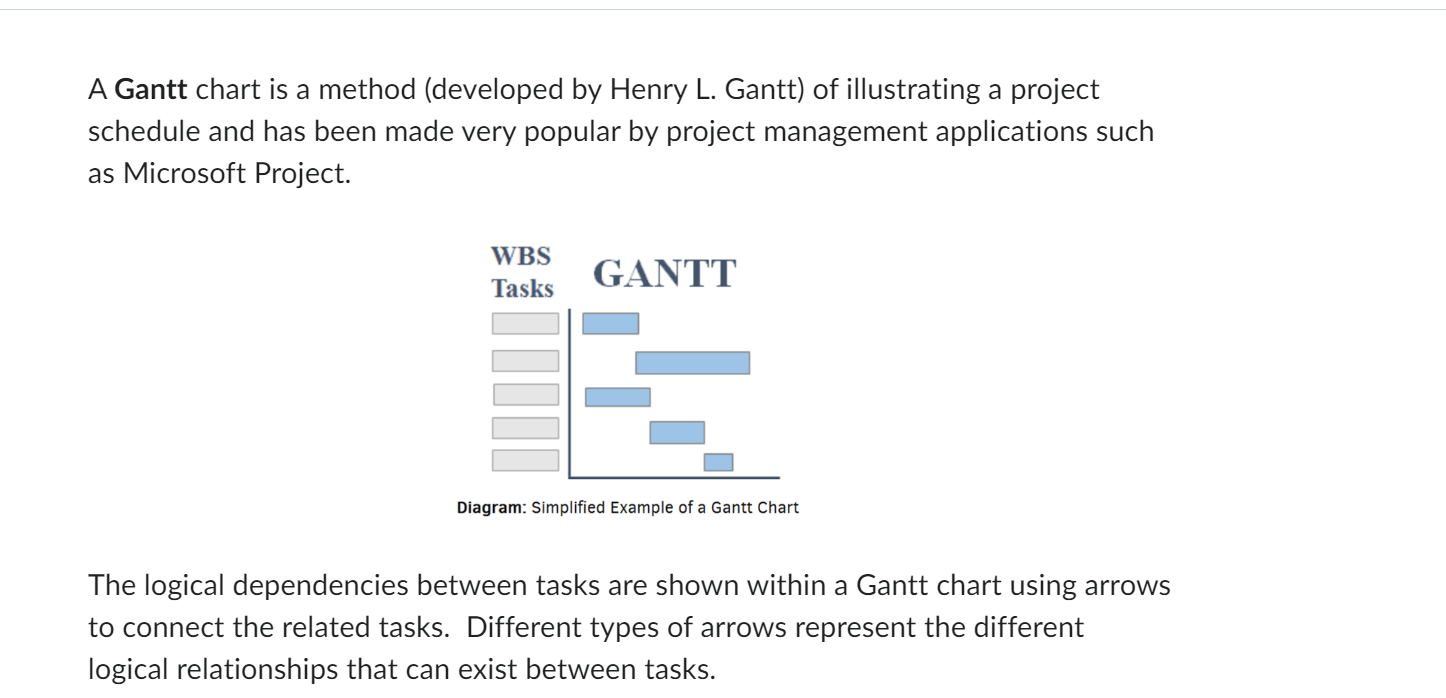
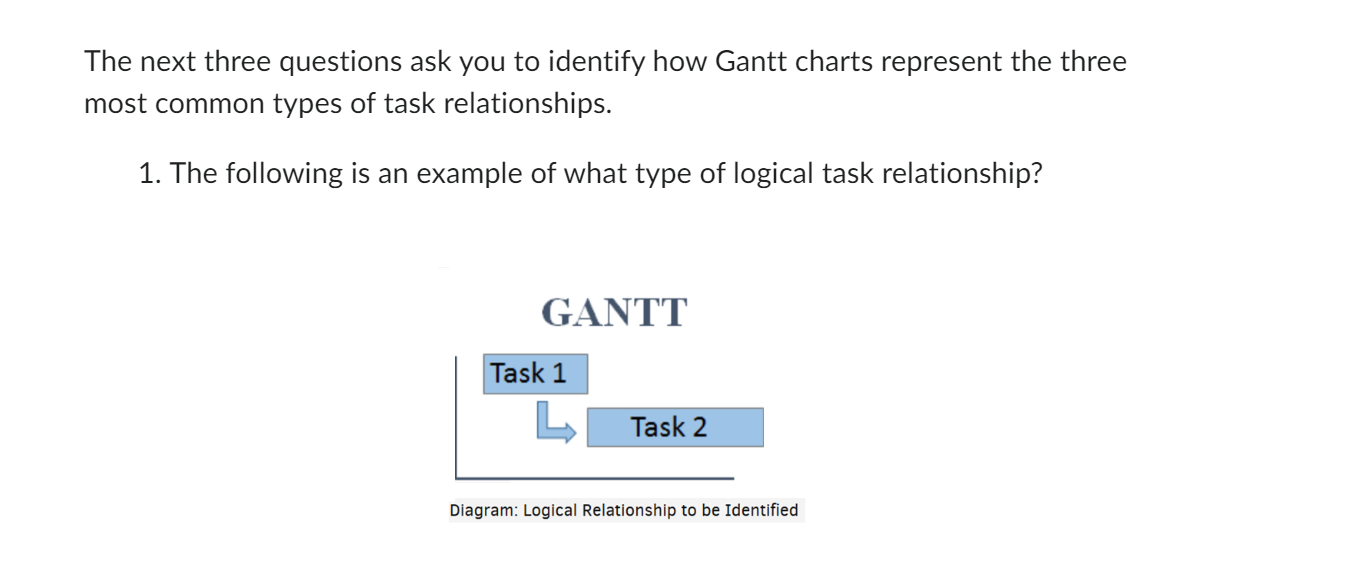
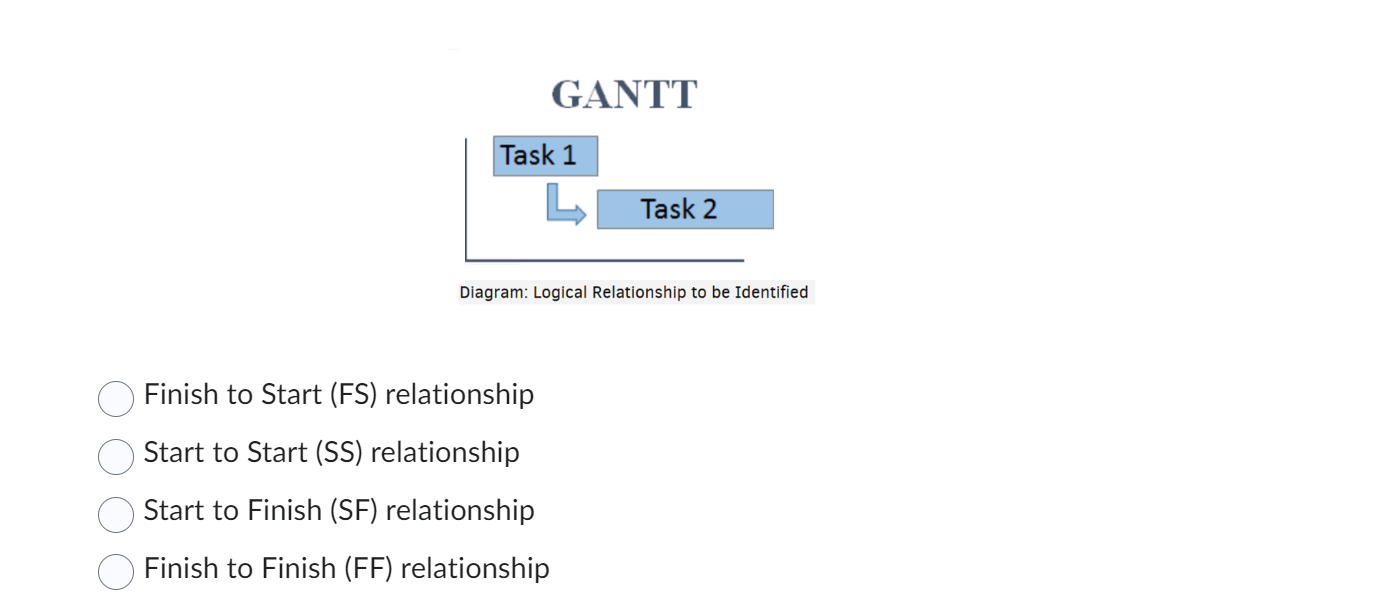
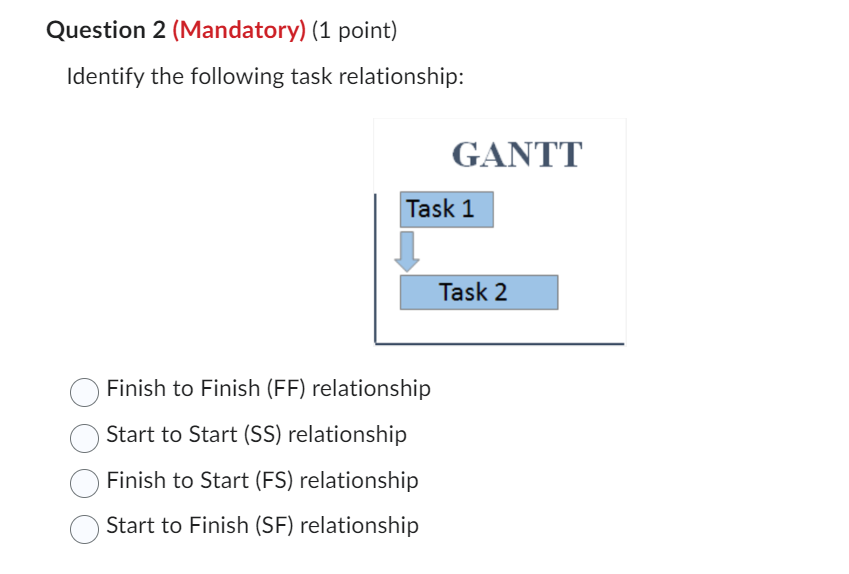
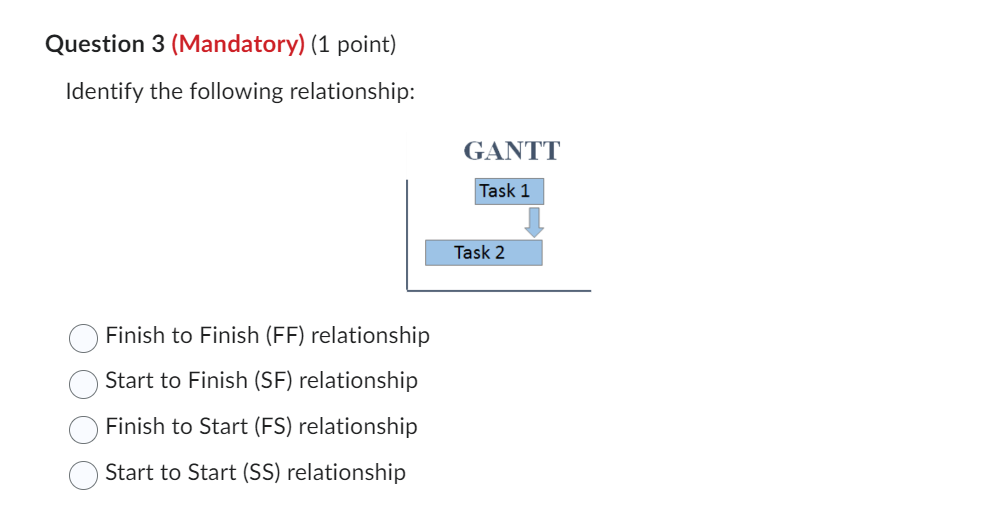
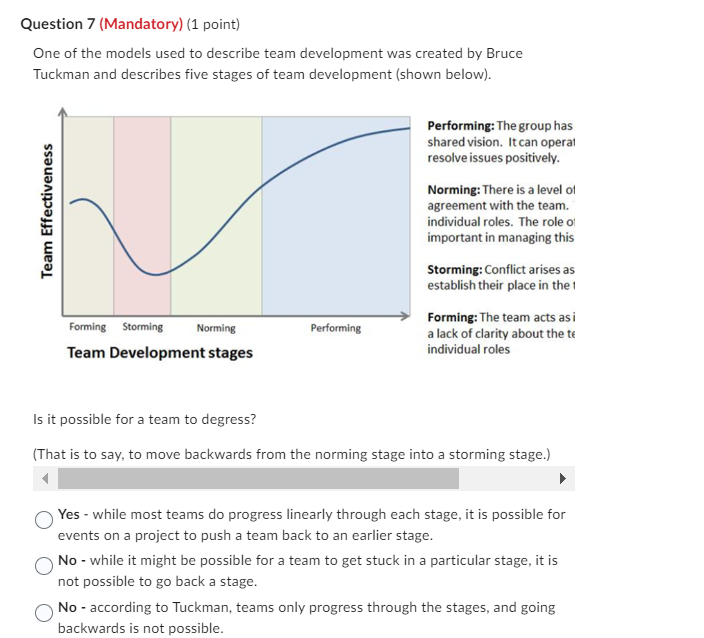
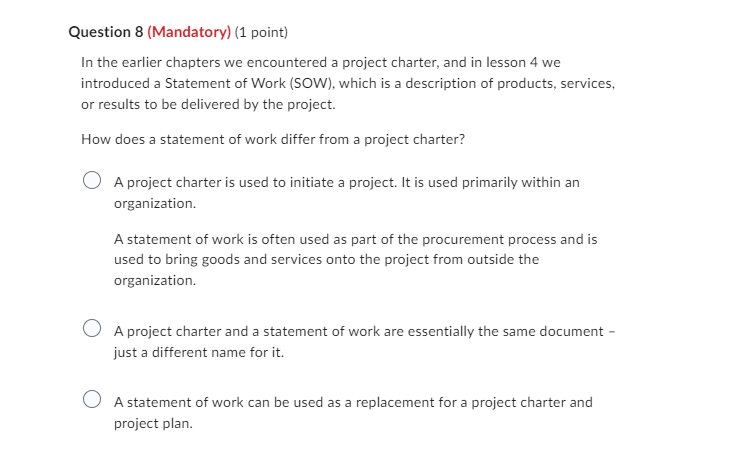
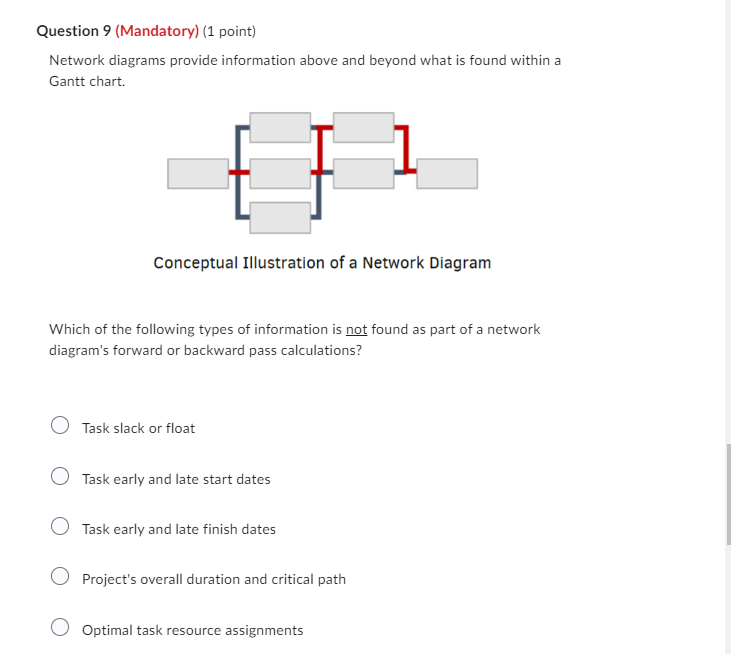
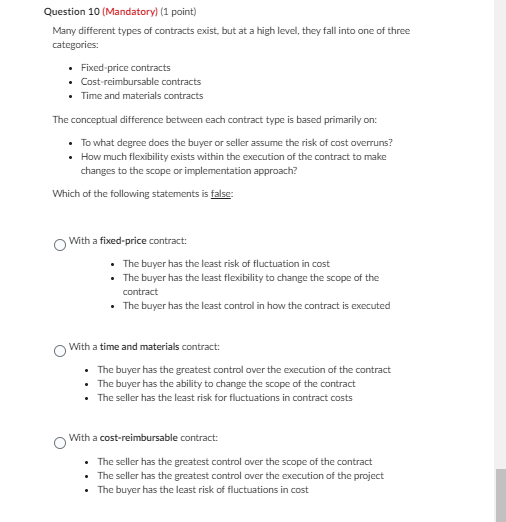
A Gantt chart is a method (developed by Henry L. Gantt) of illustrating a project schedule and has been made very popular by project management applications such as Microsoft Project. WBS Tasks GANTT Diagram: Simplified Example of a Gantt Chart The logical dependencies between tasks are shown within a Gantt chart using arrows to connect the related tasks. Different types of arrows represent the different logical relationships that can exist between tasks.The next three questions ask you to identify how Gantt charts represent the three most common types of task relationships. 1. The following is an example of what type of logical task relationship? GANTT Task 1 L Task 2 Diagram: Logical Relationship to be IdentifiedGANTT Task 1 L Task 2 Diagram: Logical Relationship to be Identified O Finish to Start (FS) relationship O Start to Start (SS) relationship O Start to Finish (SF) relationship O Finish to Finish (FF) relationshipQuestion 2 (Mandatory) (1 point) Identify the following task relationship: GANTT Task 1 Task 2 Finish to Finish (FF) relationship O Start to Start (SS) relationship Finish to Start (FS) relationship Start to Finish (SF) relationshipQuestion 3 (Mandatory) (1 point) Identify the following relationship: GANTT Task 1 Task 2 Finish to Finish (FF) relationship O Start to Finish (SF) relationship Finish to Start (FS) relationship Start to Start (SS) relationshipQuestion 4 (Mandatory) (1 point) Network diagrams are used to show a project's critical path. The critical path refers to the sequence of activities that represent the longest path through a project plan, and therefore determines the shortest possible project duration. Is it possible to have more than one critical path on a project? O Yes - more than one critical path through a project is possible, as long the project has multiple paths. No - a project cannot have more than one critical path. The critical path is defined as the shortest possible path through a project, and there can only be one shortest path.Question 5 (Mandatory) (1 point) Along with deliverables and tasks, project schedules also have milestones. Which of the following statements about project milestones is not true? O Within Gantt charts, milestones are represented by diamond symbols like this: OMilestones are moments in time, and as such, do not have durations like tasks do. O A milestone is a significant point or event in a project, program, or portfolio. For example, making a major decision might be considered a milestone. A milestone can be used to show work assignments to project team members.Question 6 (Mandatory) (1 point) Many different approaches to project management are now available to us. These include: . Traditional . Agile . Extreme But how do you know which one to use? Which one of the following statements is correct? O The selection of a project management approach is based on budget considerations. O The selection of a project management approach is based on how clear the project's objectives and solution are. O The selection of project management approaches should be based on the formal training and experience the project manager has received. If they are most skilled with one approach over another, then the approach that they are most comfortable with should be used. O Selection of a project management approach should be made by the customer and is based on how quickly they want the project completed.Question 7 (Mandatory) (1 point) One of the models used to describe team development was created by Bruce Tuckman and describes five stages of team development (shown below). Performing: The group has shared vision. It can operat resolve issues positively. Norming: There is a level of agreement with the team. Team Effectiveness individual roles. The role of important in managing this Storming: Conflict arises as establish their place in the 1 Forming: The team acts as i Forming Storming Norming Performing a lack of clarity about the te Team Development stages individual roles Is it possible for a team to degress? (That is to say, to move backwards from the norming stage into a storming stage.) O Yes - while most teams do progress linearly through each stage, it is possible for events on a project to push a team back to an earlier stage. No - while it might be possible for a team to get stuck in a particular stage, it is not possible to go back a stage. No - according to Tuckman, teams only progress through the stages, and going backwards is not possible.Question 8 (Mandatory) (1 point) In the earlier chapters we encountered a project charter, and in lesson 4 we introduced a Statement of Work (SOW), which is a description of products, services, or results to be delivered by the project. How does a statement of work differ from a project charter? A project charter is used to initiate a project. It is used primarily within an organization. A statement of work is often used as part of the procurement process and is used to bring goods and services onto the project from outside the organization. A project charter and a statement of work are essentially the same document - just a different name for it. O A statement of work can be used as a replacement for a project charter and project plan.Question 9 (Mandatory) (1 point) Network diagrams provide information above and beyond what is found within a Gantt chart. Conceptual Illustration of a Network Diagram Which of the following types of information is not found as part of a network diagram's forward or backward pass calculations? O Task slack or float O Task early and late start dates Task early and late finish dates Project's overall duration and critical path Optimal task resource assignmentsQuestion 10 (Mandatory) (1 point) Many different types of contracts exist, but at a high level, they fall into one of three categories: . Fixed-price contracts . Cost-reimbursable contracts Time and materials contracts The conceptual difference between each contract type is based primarily on: . To what degree does the buyer or seller assume the risk of cost overruns? How much flexibility exists within the execution of the contract to make changes to the scope or implementation approach? Which of the following statements is false: With a fixed-price contract: The buyer has the least risk of fluctuation in cost The buyer has the least flexibility to change the scope of the contract . The buyer has the least control in how the contract is executed With a time and materials contract: The buyer has the greatest control over the execution of the contract . The buyer has the ability to change the scope of the contract . The seller has the least risk for fluctuations in contract costs With a cost-reimbursable contract: . The seller has the greatest control over the scope of the contract . The seller has the greatest control over the execution of the project . The buyer has the least risk of fluctuations in cost
Step by Step Solution
There are 3 Steps involved in it
1 Expert Approved Answer
Step: 1 Unlock
Question Has Been Solved by an Expert!
Get step-by-step solutions from verified subject matter experts
Step: 2 Unlock
Step: 3 Unlock
Students Have Also Explored These Related General Management Questions!









 Study Help