







Question: (a) Give notation for the quantity we are estimating. eTextbook and Media Synchronized Dancins Anyone? This exercise uses data from a study designed to examine
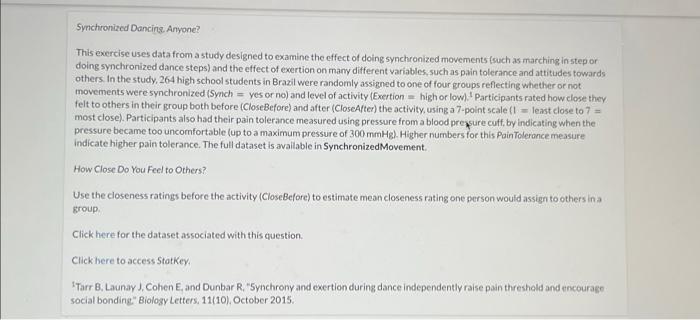
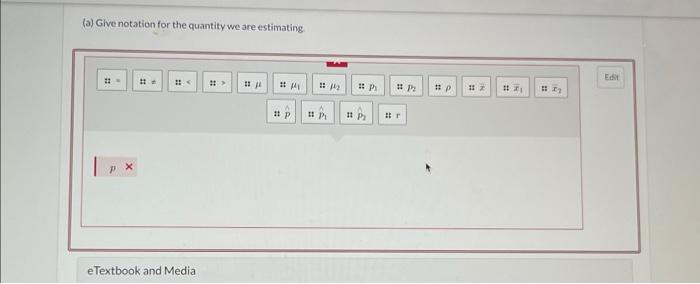
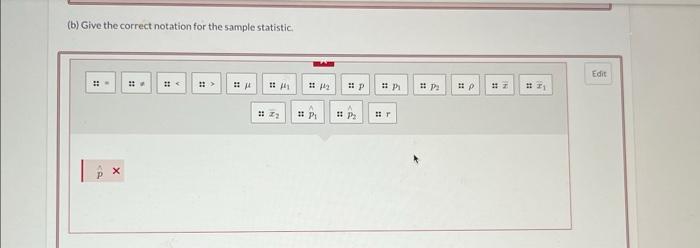
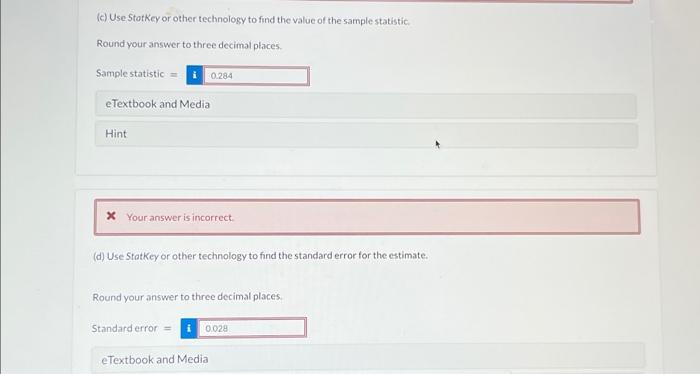
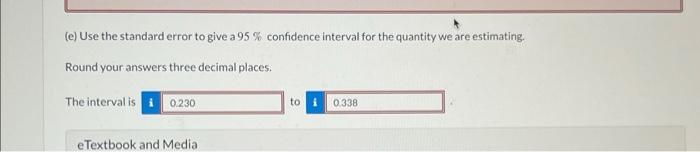
(a) Give notation for the quantity we are estimating. eTextbook and Media Synchronized Dancins Anyone? This exercise uses data from a study designed to examine the effect of doing synchronized movements (such as marching in step or doing synchronized dance steps) and the effect of exertion on many different variables, such as pain tolerance and attitudes towards others. In the study, 264 high school students in Brazil were randomly assigned to one of four groups reflecting whether or not movements were synchronized ( Synch = yes or no) and level of activity (Exertion = high or low). 1 Participants rated how close they felt to others in their group both before (CloseBefore) and after (CloseAfter) the activity, using a 7-point scale ( 1=1 least close to 7= most close). Participants also had their pain tolerance measured using pressure from a blood presure cuff, by indicating when the pressure became too uncomfortable (up to a maximum pressure of 300mmHg ). Higher numbers for this PainToleronce measure indicate higher pain tolerance. The full dataset is avaliable in SynchronizedMovement. How Close Do You Feel to Others? Use the closeness ratings before the activity (CloseBefore) to estimate mean closeness rating one person would assign to others in a sroup. Click here for the dataset associated with this question. Clickbere to access StotKey, 2 Tarr B. Launay J, Cohen E, and Dunbar R, "Synchrony and exertion during dance independently raise pain threshold and encourage social bonding" Biology Letters, 11(10), October 2015. (d) Use StatKey or other technology to find the standard error for the estimate. (b) Give the correct notation for the sample statistic (e) Use the standard error to give a 95% confidence interval for the quantity we are estimating. Round your answers three decimal places. The interval is to (a) Give notation for the quantity we are estimating. eTextbook and Media Synchronized Dancins Anyone? This exercise uses data from a study designed to examine the effect of doing synchronized movements (such as marching in step or doing synchronized dance steps) and the effect of exertion on many different variables, such as pain tolerance and attitudes towards others. In the study, 264 high school students in Brazil were randomly assigned to one of four groups reflecting whether or not movements were synchronized ( Synch = yes or no) and level of activity (Exertion = high or low). 1 Participants rated how close they felt to others in their group both before (CloseBefore) and after (CloseAfter) the activity, using a 7-point scale ( 1=1 least close to 7= most close). Participants also had their pain tolerance measured using pressure from a blood presure cuff, by indicating when the pressure became too uncomfortable (up to a maximum pressure of 300mmHg ). Higher numbers for this PainToleronce measure indicate higher pain tolerance. The full dataset is avaliable in SynchronizedMovement. How Close Do You Feel to Others? Use the closeness ratings before the activity (CloseBefore) to estimate mean closeness rating one person would assign to others in a sroup. Click here for the dataset associated with this question. Clickbere to access StotKey, 2 Tarr B. Launay J, Cohen E, and Dunbar R, "Synchrony and exertion during dance independently raise pain threshold and encourage social bonding" Biology Letters, 11(10), October 2015. (d) Use StatKey or other technology to find the standard error for the estimate. (b) Give the correct notation for the sample statistic (e) Use the standard error to give a 95% confidence interval for the quantity we are estimating. Round your answers three decimal places. The interval is to
Step by Step Solution
There are 3 Steps involved in it

Get step-by-step solutions from verified subject matter experts
 Study Help