Question: a graph represents a function and whether the graph is invertible? (F.BF.B.4) The vertical line test tells us if a graph is a function when
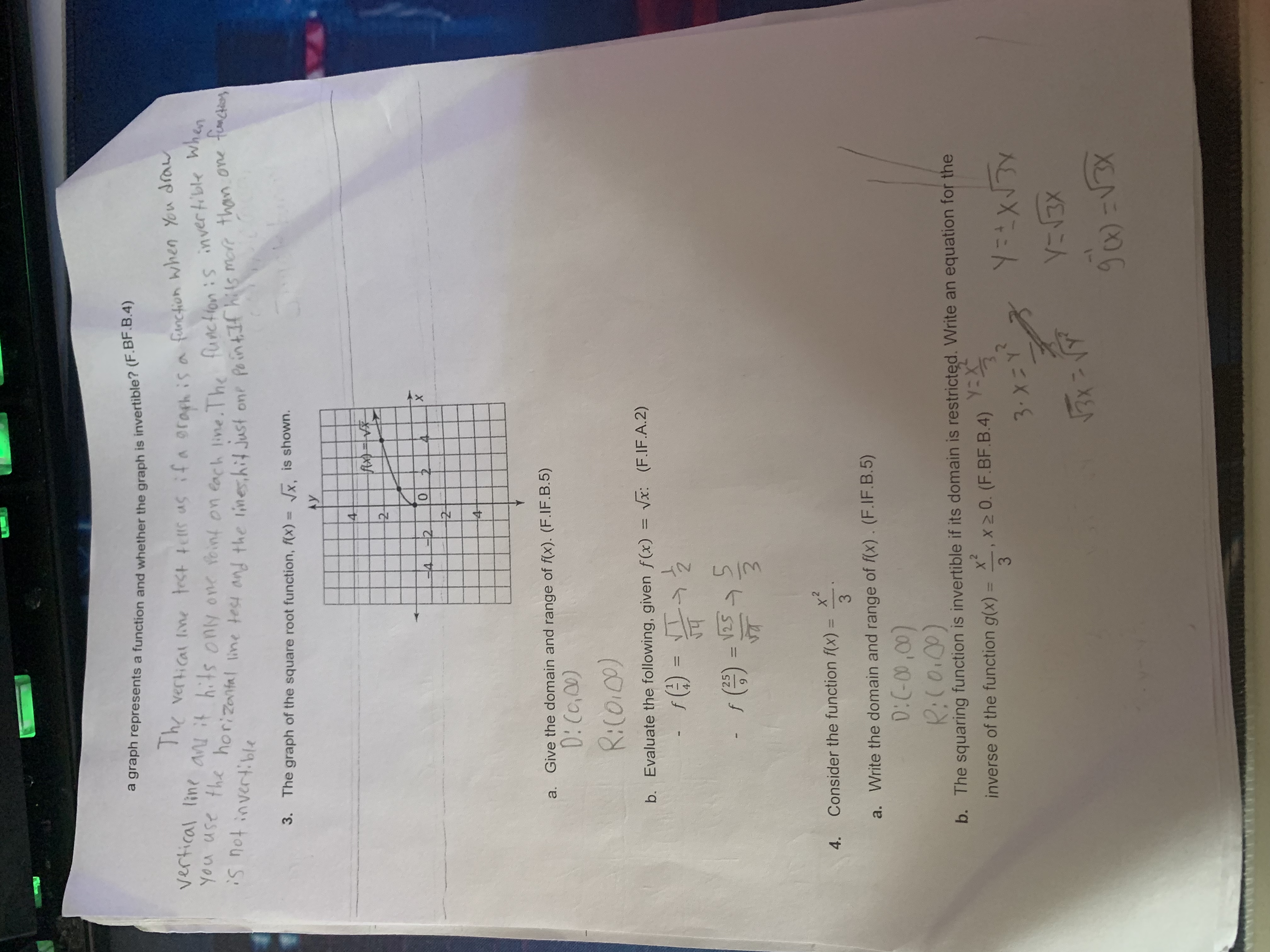
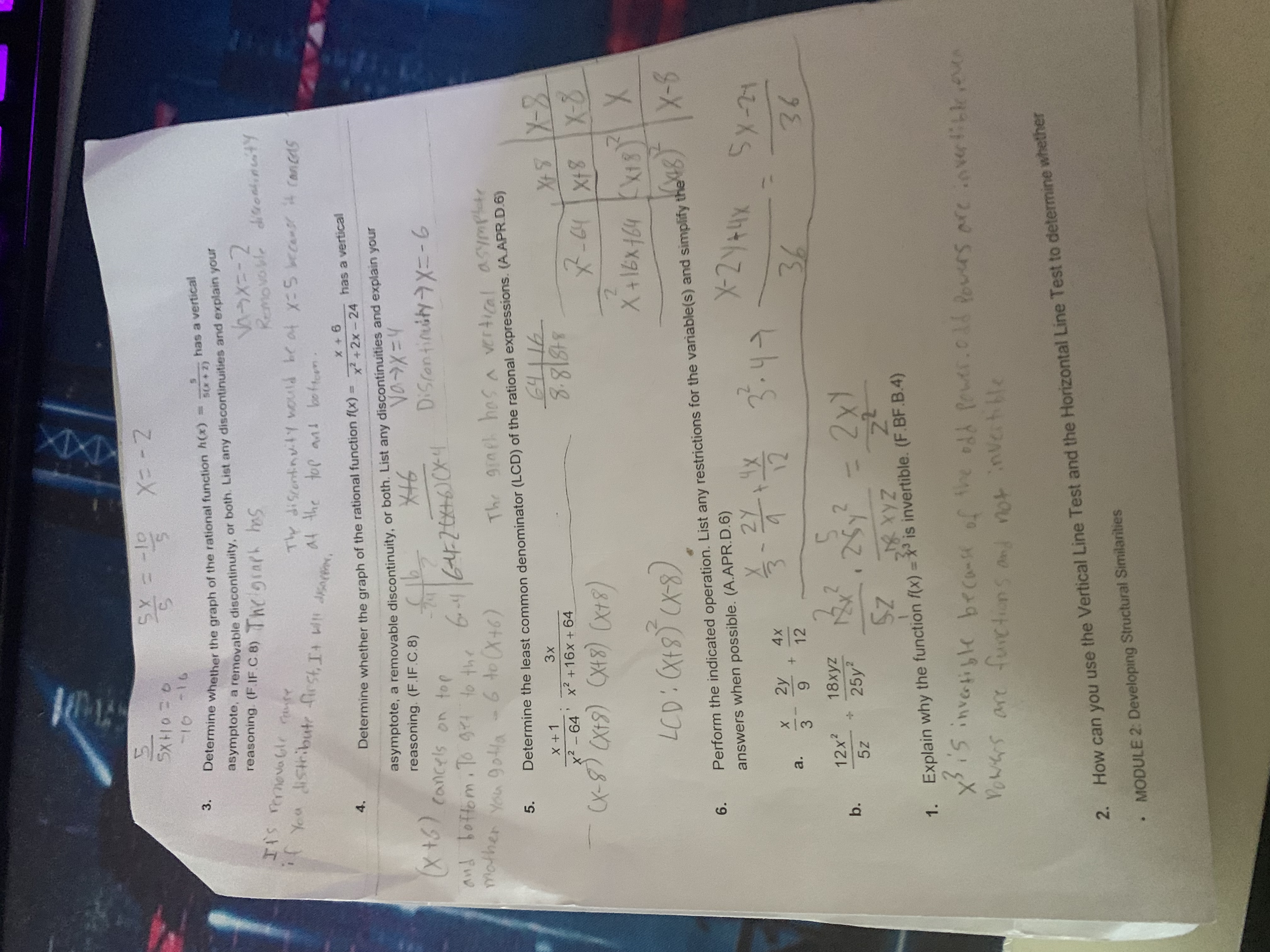
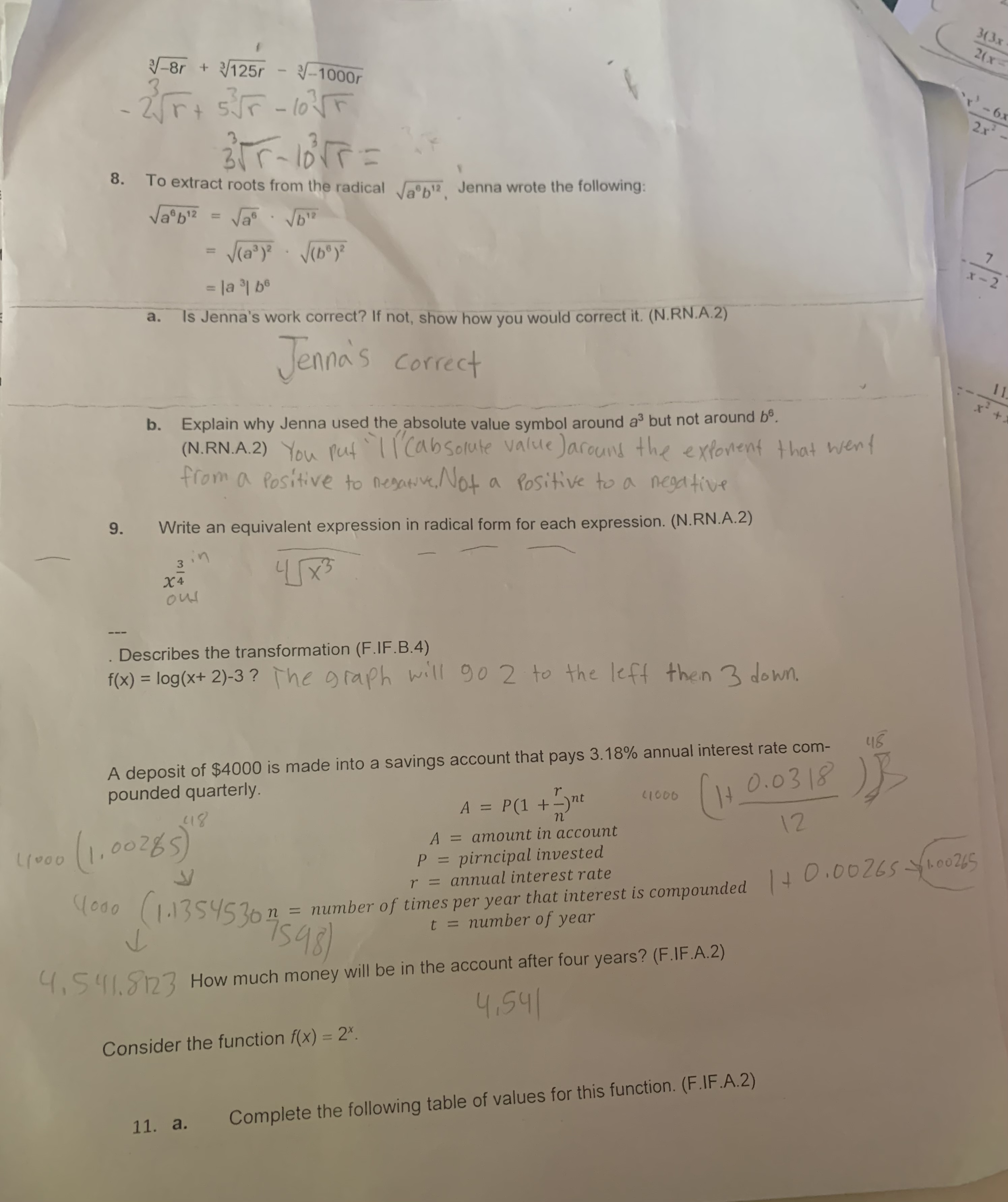
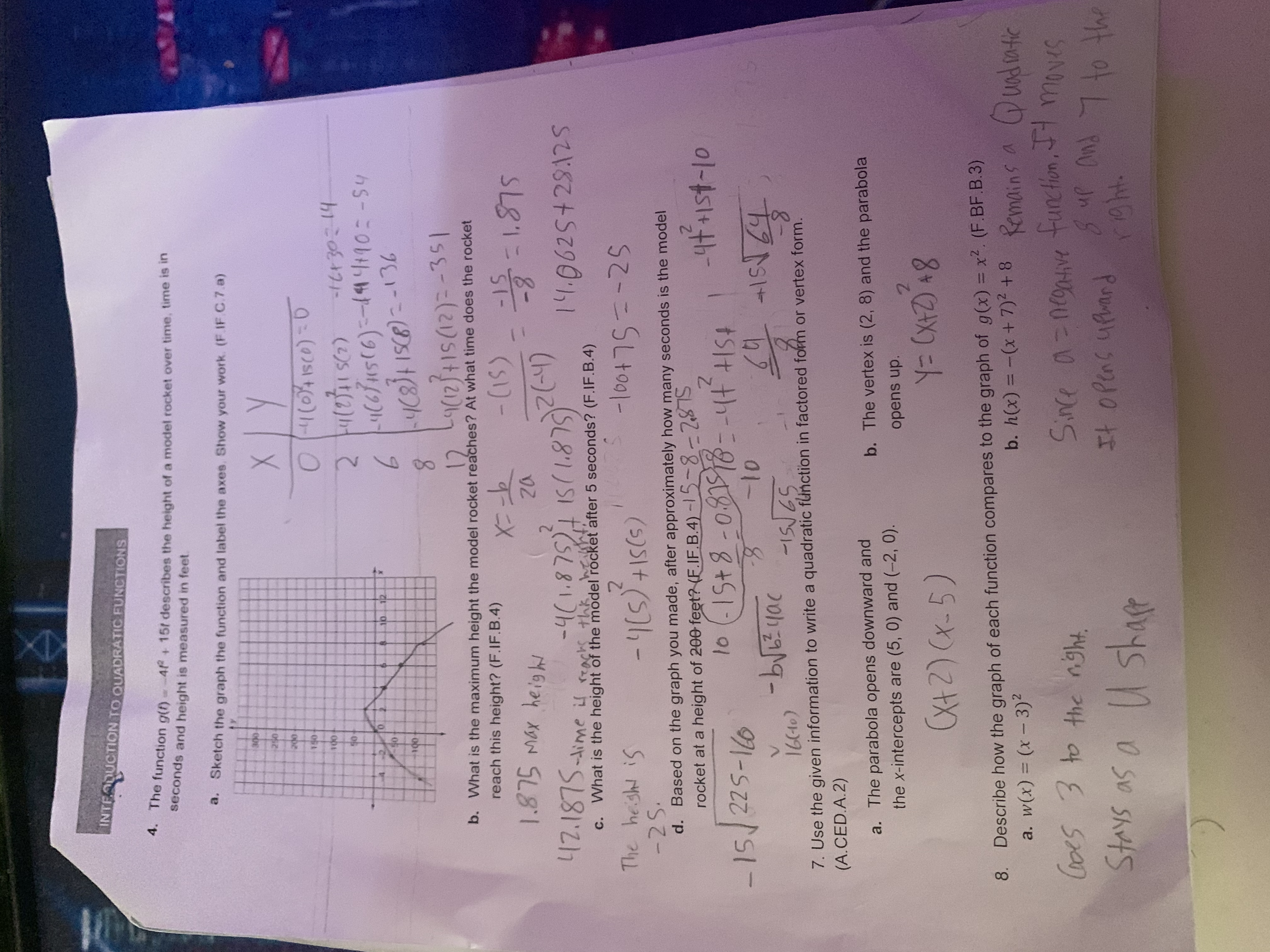
a graph represents a function and whether the graph is invertible? (F.BF.B.4) The vertical line test tells us if a graph is a function when you draw vertical line and it hits only one point on each line The functionis invertible when is not invertible you use the horizontal line test and the lines, hit just one point If hits more than one function 3. The graph of the square root function, f(x) = Vx, is shown. Ax) a. Give the domain and range of f(x). (F.IF.B.5) D: (0, 00 ) R: (0100) b. Evaluate the following, given f (x) = Vx: (F.IF.A.2) f ( # ) = VI f (25 ) = V25 15 2 4. Consider the function f(x) = x 3 a. Write the domain and range of f(x) . (F. IF.B.5) D: (-00, 00) R: (0,00 ) b. The squaring function is invertible if its domain is restricted. Write an equation for the inverse of the function g(x) = >, x 2 0. (F.BF.B.4) Y=X 3 . X = Y Y = + XJ 3 X 8 3 x = Vy ? Y= V3X 9 (X ) = V3X5 SX+10 70 5X = -10 X = - 2 -10 3. Determine whether the graph of the rational function h(x) = B(x 4 2) has a vertical asymptote, a removable discontinuity, or both. List any discontinuities and explain your reasoning. (F.IF.Ca) The graph ms Va-x= - 2 It's removable cause Removable discontinuity if you distribute first, It will disarent. The discontinuity would be at X= 5 because it cancels at the top and bottom . 4. * +6 Determine whether the graph of the rational function f(x) = x2 4 2x _ 24 has a vertical asymptote, a removable discontinuity, or both. List any discontinuities and explain your reasoning. (F. IF.C.8) Va-x = 4 ( x +6 ) cancels on top 6.-4 ( 6-42( * +6) (X- 4 Discontinuity -7 *=-6 and bottom , To get to the mother you gotta - 6 to (X + 6 ) The graph has a vertical asymptote 5 . Determine the least common denominator (LCD) of the rational expressions. (A.APR.D.6) x+ 1 64116 x2 - 64' x2 +16x +64 8.81878 *+ 8 X-8 (x-8) (X+8 ) ( X +8 ) (X +8 ) 2-64 x18 X - 8 LCD : ( X +8 ) ( X - 8 ) X + 16x 164 ( X18) X 6. Perform the indicated operation. List any restrictions for the variable(s) and simplify the +8) X - 8 answers when possible. (A.APR.D.6) 2Y X- 24+ 4x 12 3 . 4 7 5 X - 2+ X zy 4x a 3 9 12 36 36 12x2 18xyz 15 5z 25y 25y? = 2xY SZ 1 xyZ 172 1. Explain why the function f(x) = 3 is invertible. (F.BF.B.4) X5 is invertible because of the odd power. old powers are invertible seven Powers are functions and not invertible 2. How can you use the Vertical Line Test and the Horizontal Line Test to determine whether MODULE 2: Developing Structural SimilaritiesV-8r + 125r - -1000r 3(3. 2(x - 2Vr + SVT - 10 VT r - 6 3 15 - 10 VT = . To extract roots from the radical Vab12, Jenna wrote the following: = la 31 60 a. Is Jenna's work correct? If not, show how you would correct it. (N.RN.A.2) Jenna's correct b. Explain why Jenna used the absolute value symbol around a3 but not around be. ( N. RN. A. 2) You put "Il (absolute value )around the exponent that went from a positive to negative. Not a positive to a negative 9. Write an equivalent expression in radical form for each expression. (N.RN.A.2) x4 41 x 3 Ous Describes the transformation (F. IF.B.4) f ( x ) = log ( x+ 2)-3 ? The graph will go 2 to the left thein 3 down. A deposit of $4000 is made into a savings account that pays 3. 18% annual interest rate com- 48 pounded quarterly. A = P ( 1 + - ) nt 41000 ( 1+ 0. 0318 ) B 1 1000 (100285 ) A = amount in account 12 P = pirncipal invested r = annual interest rate yooo ( 1.135453on = number of times per year that interest is compounded 1+ 0.00 265 -$1:00265 15 98) t = number of year 4, 541.8123 How much money will be in the account after four years? (F. IF. A. 2) 4, 541 Consider the function f(x) = 2x. 11. a. Complete the following table of values for this function. (F.IF.A.2)INTERDUCTION TO QUADRATIC FUNCTIONS 4. The function g() - -48 + 15/ describes the height of a model rocket over time, time is in seconds and height is measured in feet a. Sketch the graph the function and label the axes. Show your work. (F IF C.7.a) X O ( -4 ( 0) + 15 (0 ) = 0 4(2) +15 ( 2 ) - 16+30=14 1- 4 ( 6 / 415 (6 ) = - $41 4 + 90 - - 54 6 8 - 4 ( 8 ) + 15 ( 8 ) = - 136 17 L9(12) + 15 ( 12 )= - 351 b. What is the maximum height the model rocket reaches? At what time does the rocket reach this height? (F. IF.B.4) X= = b - ( IS ) 1.875 max height za - 8 = 1.875 42.1875 -time if reachs - 4 ( 1 . 875 ) + 15 ( 1.875 ) 26-4 ) 14.0625+ 28:125 c. What is the height of the model rocket after 5 seconds? (F. IF.B.4) The height is -4 (5 ) +15 ( 5 ) - 100 + 75 = - 25 - 25. d. Based on the graph you made, after approximately how many seconds is the model rocket at a height of 200 feet? (F. IF.B.4) -15-8 - 2.8 75 - 4+ + 154 - 10 - 15/ 225- 160 10 (- 15+8- 087578 = - 4+ +15+ - 10 16 ( - 10 ) - bub zyac - 15J65 + 157 64, 7. Use the given information to write a quadratic function in factored form or vertex form. (A.CED.A.2) a. The parabola opens downward and b. The vertex is (2, 8) and the parabola the x-intercepts are (5, 0) and (-2, 0). opens up. ( X + 2 ) ( x - 5 ) Y = ( X + 2 ) + 8 8. Describe how the graph of each function compares to the graph of g(x) = x2. (F.BF.B.3) a. w ( x ) = (x - 3)2 b. h(x ) =-(x+7)2+8 Remains a Quadratic Codes 3 to the right. Since a = negative function. It moves Stays as a U shape It opens upward 8 up and 7 to the right
Step by Step Solution
There are 3 Steps involved in it
1 Expert Approved Answer
Step: 1 Unlock
Question Has Been Solved by an Expert!
Get step-by-step solutions from verified subject matter experts
Step: 2 Unlock
Step: 3 Unlock
Students Have Also Explored These Related Mathematics Questions!









 Study Help