



Question: A graphene based molecular wire is synthesised for molecular electronics and may be modelled quantum mechanically as a rectangular two-dimensional (2-D) surface with length L
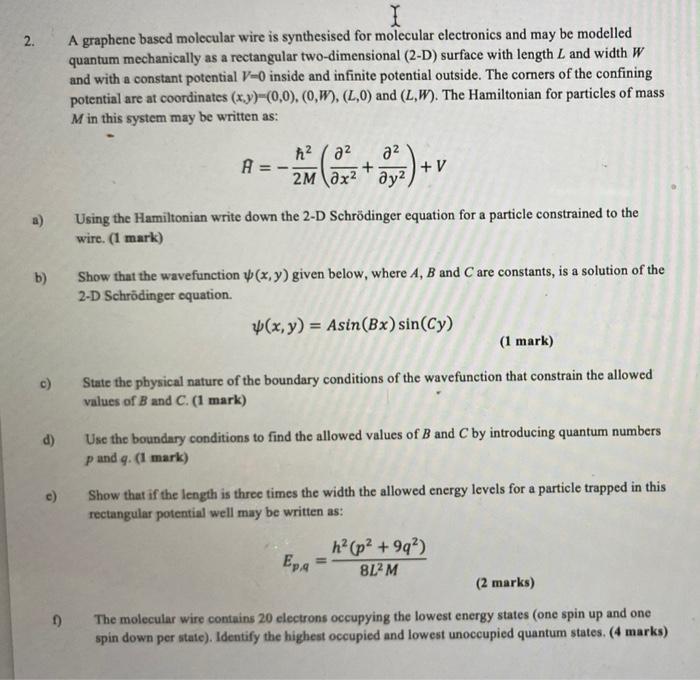
A graphene based molecular wire is synthesised for molecular electronics and may be modelled quantum mechanically as a rectangular two-dimensional (2-D) surface with length L and width W and with a constant potential V=0 inside and infinite potential outside. The corners of the confining potential are at coordinates (x,y)=(0,0),(0,W),(L,0) and (L,W). The Hamiltonian for particles of mass M in this system may be written as: A=2M2(x22+y22)+V Using the Hamiltonian write down the 2-D Schrdinger equation for a particle constrained to the wire. (1 mark) b) Show that the wavefunction (x,y) given below, where A,B and C are constants, is a solution of the 2-D Schrdinger equation. (x,y)=Asin(Bx)sin(Cy) (1 mark) c) State the physical nature of the boundary conditions of the wavefunction that constrain the allowed values of B and C. (1 mark) d) Use the boundary conditions to find the allowed values of B and C by introducing quantum numbers p and q.(1 mark) e) Show that if the length is three times the width the allowed energy levels for a particle trapped in this rectangular potential well may be written as: Ep,q=8L2Mh2(p2+9q2) (2 marks) f) The molecular wire contains 20 electrons occupying the lowest energy states (one spin up and one spin down per state). Identify the highest occupied and lowest unoccupied quantum states. (4 marks)
Step by Step Solution
There are 3 Steps involved in it

Get step-by-step solutions from verified subject matter experts