







Question: A gravity-driven hydroponic watering system is shown in the figure below. A large reservoir of water is connected to a dispenser via the pipes
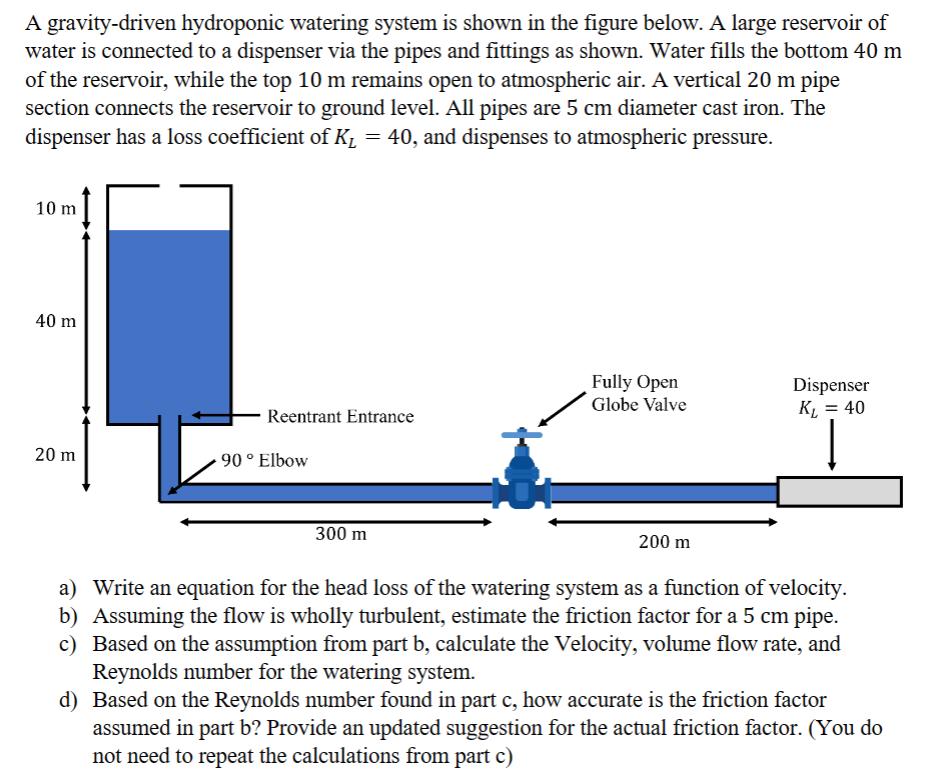
A gravity-driven hydroponic watering system is shown in the figure below. A large reservoir of water is connected to a dispenser via the pipes and fittings as shown. Water fills the bottom 40 m of the reservoir, while the top 10 m remains open to atmospheric air. A vertical 20 m pipe section connects the reservoir to ground level. All pipes are 5 cm diameter cast iron. The dispenser has a loss coefficient of K = 40, and dispenses to atmospheric pressure. 10 m 40 m 20 m Reentrant Entrance 90 Elbow 300 m Fully Open Globe Valve 200 m Dispenser K = 40 a) Write an equation for the head loss of the watering system as a function of velocity. b) Assuming the flow is wholly turbulent, estimate the friction factor for a 5 cm pipe. c) Based on the assumption from part b, calculate the Velocity, volume flow rate, and Reynolds number for the watering system. d) Based on the Reynolds number found in part c, how accurate is the friction factor assumed in part b? Provide an updated suggestion for the actual friction factor. (You do not need to repeat the calculations from part c) A gravity-driven hydroponic watering system is shown in the figure below. A large reservoir of water is connected to a dispenser via the pipes and fittings as shown. Water fills the bottom 40 m of the reservoir, while the top 10 m remains open to atmospheric air. A vertical 20 m pipe section connects the reservoir to ground level. All pipes are 5 cm diameter cast iron. The dispenser has a loss coefficient of K = 40, and dispenses to atmospheric pressure. 10 m 40 m 20 m Reentrant Entrance 90 Elbow 300 m Fully Open Globe Valve 200 m Dispenser K = 40 a) Write an equation for the head loss of the watering system as a function of velocity. b) Assuming the flow is wholly turbulent, estimate the friction factor for a 5 cm pipe. c) Based on the assumption from part b, calculate the Velocity, volume flow rate, and Reynolds number for the watering system. d) Based on the Reynolds number found in part c, how accurate is the friction factor assumed in part b? Provide an updated suggestion for the actual friction factor. (You do not need to repeat the calculations from part c)
Step by Step Solution
3.37 Rating (150 Votes )
There are 3 Steps involved in it
a Head loss equation as a function of velocity HL K1v22g SumfLDv22... View full answer

Get step-by-step solutions from verified subject matter experts
 Study Help