







Question: A) Griffiths works out (EX ).2) the general solution to motion of a particle in crossed E and B fields (E points in the z-direction,
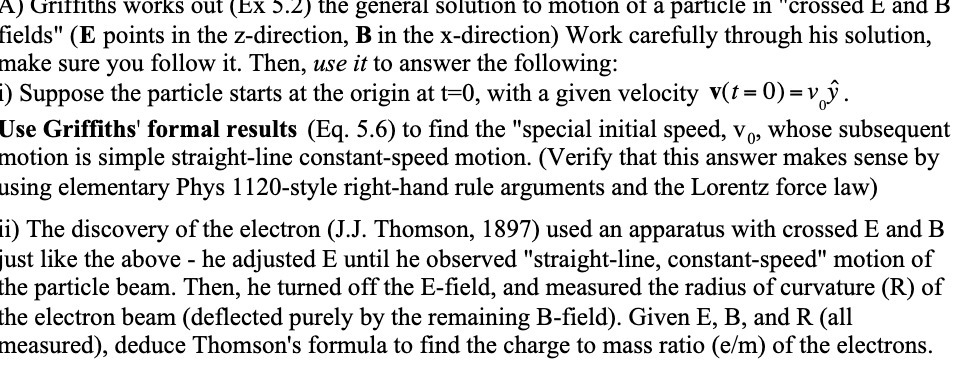
A) Griffiths works out (EX ).2) the general solution to motion of a particle in "crossed E and B fields" (E points in the z-direction, B in the x-direction) Work carefully through his solution, make sure you follow it. Then, use it to answer the following: ) Suppose the particle starts at the origin at t=0, with a given velocity v(t = 0) = vy. Use Griffiths' formal results (Eq. 5.6) to find the "special initial speed, Vo, whose subsequent motion is simple straight-line constant-speed motion. (Verify that this answer makes sense by using elementary Phys 1120-style right-hand rule arguments and the Lorentz force law) i) The discovery of the electron (J.J. Thomson, 1897) used an apparatus with crossed E and B ust like the above - he adjusted E until he observed "straight-line, constant-speed" motion of the particle beam. Then, he turned off the E-field, and measured the radius of curvature (R) of the electron beam (deflected purely by the remaining B-field). Given E, B, and R (all measured), deduce Thomson's formula to find the charge to mass ratio (e/m) of the electrons
Step by Step Solution
There are 3 Steps involved in it

Get step-by-step solutions from verified subject matter experts
 Study Help