







Question: A hash function is often the mathematical result of two functions. Which are they? (assume that the data is stored in an array) A hash
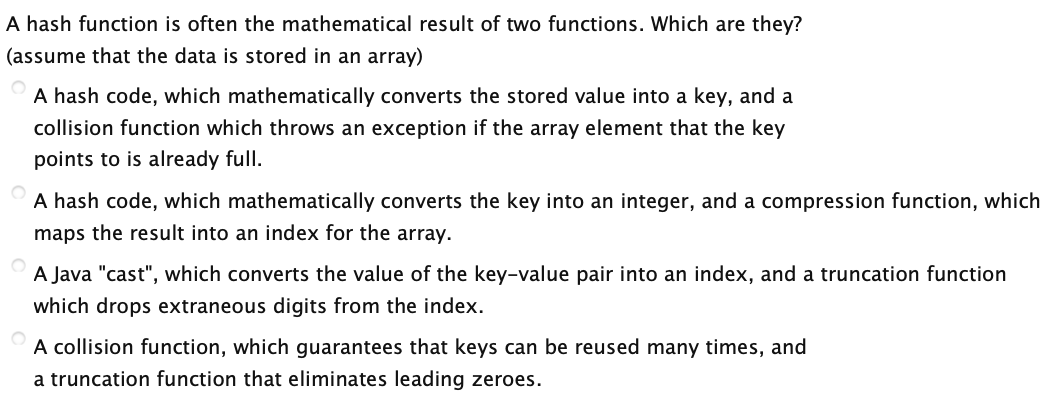
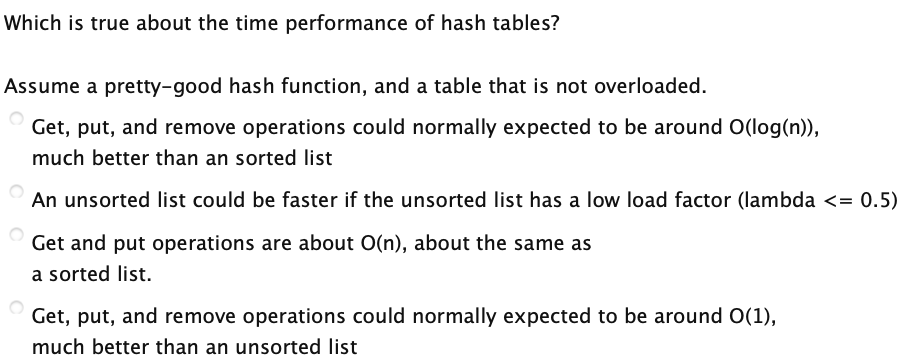
A hash function is often the mathematical result of two functions. Which are they? (assume that the data is stored in an array) A hash code, which mathematically converts the stored value into a key, and a collision function which throws an exception if the array element that the key points to is already full. A hash code, which mathematically converts the key into an integer, and a compression function, which maps the result into an index for the array. A Java "cast", which converts the value of the key-value pair into an index, and a truncation function which drops extraneous digits from the index. A collision function, which guarantees that keys can be reused many times, and a truncation function that eliminates leading zeroes. Which is true about the time performance of hash tables? Assume a pretty-good hash function, and a table that is not overloaded. Get, put, and remove operations could normally expected to be around O(log(n)), much better than an sorted list An unsorted list could be faster if the unsorted list has a low load factor (lambda
Step by Step Solution
There are 3 Steps involved in it

Get step-by-step solutions from verified subject matter experts
 Study Help