







Question: A horizontal force F is applied to a small block of mass m_(1) to make It slide along the top of a larger block of
A horizontal force
Fis applied to a small block of mass
m_(1)to make It slide along the top of a larger block of mass
m_(2)and length 1 . The coefficient of friction between the blocks is
\\\\mu . The larger block slides without friction along a horizontal surface. The blocks start from rest with the small block at one end of the larger block, as shown.\ a) On the diagrams below draw all of the forces acting on each block. Identify each force.\ b) Find the acceleration of each block.
a_(1)and
a_(2), relative to the horizontal surface.\ c) In terms of
I,a_(1), and
a_(2), find the time
tneeded for the small block to slide off the end of the larger block.\ d) Find an expression for the energy dissipated as heat because of the friction between the two blocks.
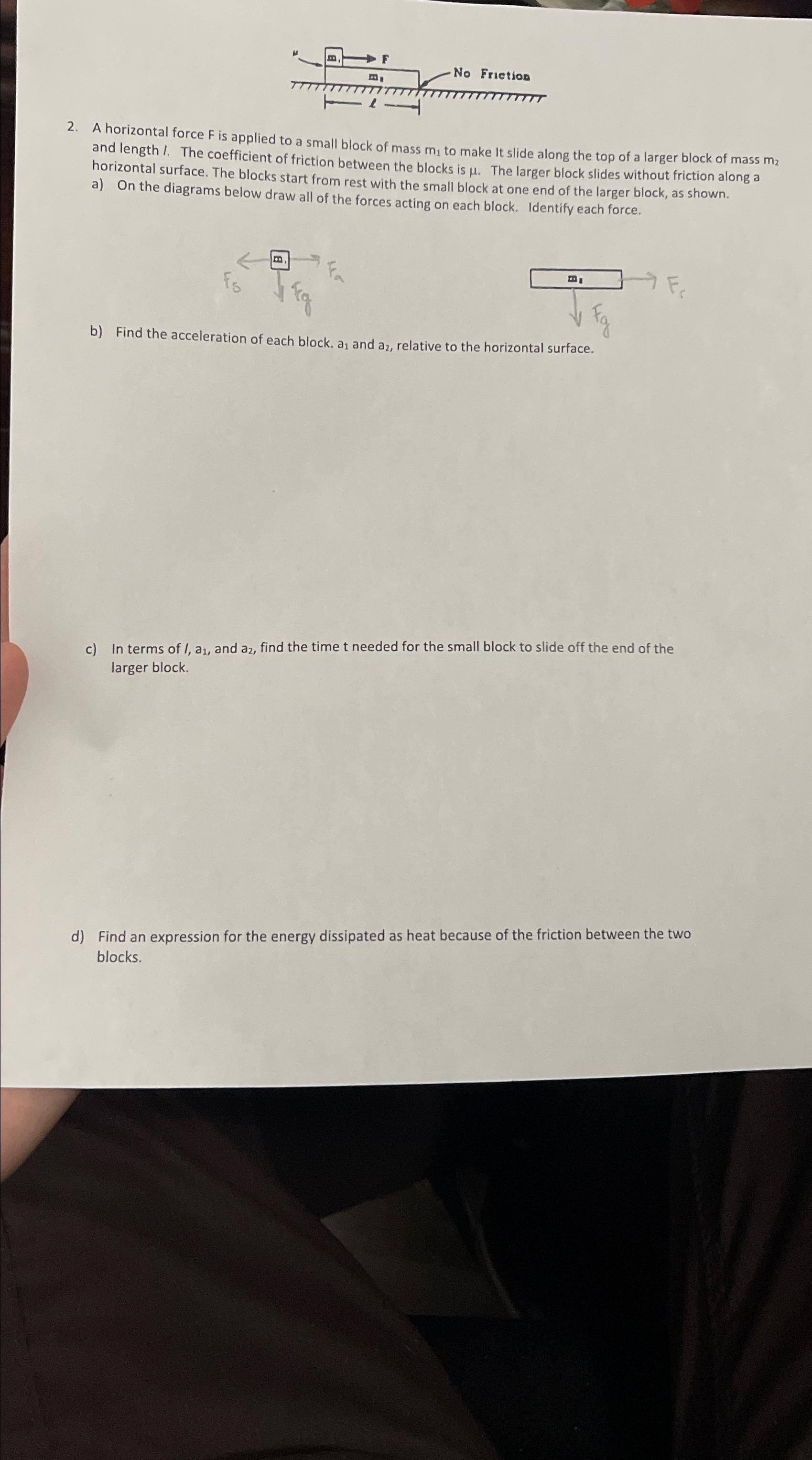
2. A horizontal force F is applied to a small block of mass m1 to make It slide along the top of a larger block of mass m2 and length 1 . The coefficient of friction between the blocks is . The larger block slides without friction along a horizontal surface. The blocks start from rest with the small block at one end of the larger block, as shown. a) On the diagrams below draw all of the forces acting on each block. Identify each force. b) Find the acceleration of each block. a1 and a2, relative to the horizontal surface. c) In terms of I,a1, and a2, find the time t needed for the small block to slide off the end of the larger block. d) Find an expression for the energy dissipated as heat because of the friction between the two blocks
Step by Step Solution
There are 3 Steps involved in it

Get step-by-step solutions from verified subject matter experts
 Study Help