







Question: A hotel manager is negotiating with a client (assembly organizer) the rate for a room that will be charged to those attending an assembly to
A hotel manager is negotiating with a client (assembly organizer) the rate for a room that will be charged to those attending an assembly to be held at the hotel. The organizer of the Assembly estimates an attendance of 200 people and that at least 10% of these will stay at the hotel because they come from abroad. The activity will take place during the hotel's low season, so that the hotel manager understands that he will have enough rooms available to meet the agreement. If the assembly is not held at the hotel, most of the rooms will remain empty.
In this activity, the assembly organizer is responsible for obtaining a rate for the rooms that are competitive for attendees and ensuring that a minimum number of people stay during the event activity. The cost of the rooms is the responsibility of the attendees and is NOT included in the cost of registration that pays to attend the assembly. The organizer is responsible for paying for food during the activities (breakfast, lunch, and snack, which includes service and other activities to support the assembly), in exchange for this they can use the free conference rooms. The assembly registration fee does not include dinner.
The cost of the room does NOT include breakfast, lunch, or dinner, this is paid separately. Neither includes the cost of washing or ironing clothes, also paid separately. The hotel provides free internet but does not include long-distance calls as part of the room rate.
Questions (use a table similar to the one below to answer questions 1 and 2):
1. What costs should hotel management take into account when establishing the total price per room per night that you charge to customers during the regular season (assume that all rooms are the same)? DO NOT use monetary amounts, neither real nor hypothetical (see example in the board).
Provide a list of at least 10 costs that include costs directly associated with the room and other general hotel costs. Avoid repeating costs that essentially represent the same thing (for example: depreciation of furniture and depreciation of tables is the same: depreciation of furniture).
2. Which costs identified in question 1 should the hotel manager take into account when determining the special price per room per night that you will grant to those attending the assembly during the off-season?
3. Assembly attendees always have the option of staying at the convention hotel or another nearby hotel. In addition to a low or competitive price, what other considerations or variables can the hotel manager use when promoting his rooms and the hotel to the assembly's enrollment to make the hotel stay more attractive than that of any competing hotel? Provide a list.
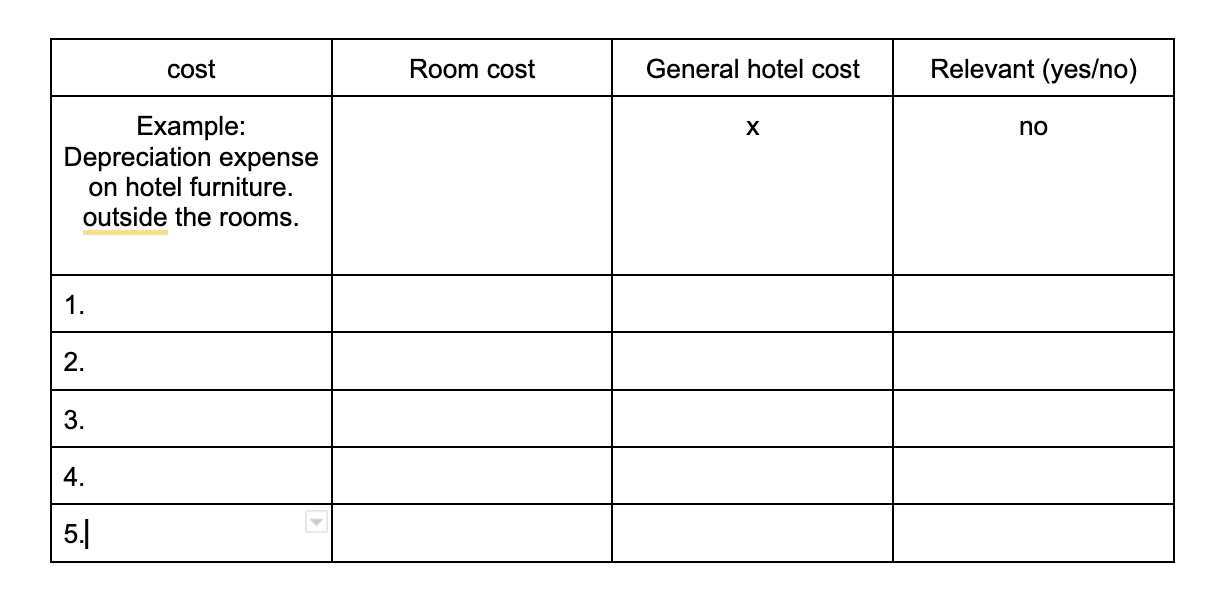
\begin{tabular}{|l|l|l|c|} \hline \multicolumn{1}{|c|}{ cost } & Room cost & General hotel cost & Relevant (yeso) \\ \hline Example:Depreciationexpenseonhotelfurniture.outsidetherooms. & & x & no \\ \hline 1. & & & \\ \hline 2. & & & \\ \hline 3. & & & \\ \hline 4. & & & \\ \hline 5.1 & & & \\ \hline \end{tabular}
Step by Step Solution
There are 3 Steps involved in it

Get step-by-step solutions from verified subject matter experts
 Study Help