







Question: A hot-wire anemometer is essentially a fine wire, often made of platinum (Pt), which is heated electrically while exposed to a flowing fluid. The wire
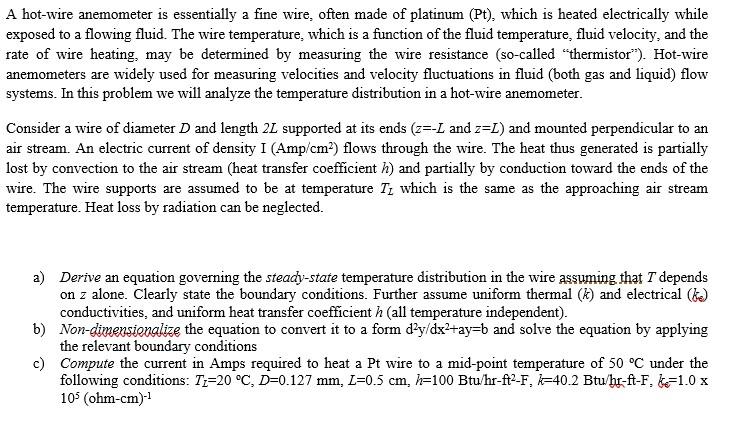
A hot-wire anemometer is essentially a fine wire, often made of platinum (Pt), which is heated electrically while exposed to a flowing fluid. The wire temperature, which is a function of the fluid temperature, fluid velocity, and the rate of wire heating, may be determined by measuring the wire resistance (so-called "thermistor). Hot-wire anemometers are widely used for measuring velocities and velocity fluctuations in fluid (both gas and liquid) flow systems. In this problem we will analyze the temperature distribution in a hot-wire anemometer. Consider a wire of diameter D and length 2L supported at its ends (z=-L and z=L) and mounted perpendicular to an air stream. An electric current of density I (Amp/cm2) flows through the wire. The heat thus generated is partially lost by convection to the air stream (heat transfer coefficient h) and partially by conduction toward the ends of the wire. The wire supports are assumed to be at temperature T which is the same as the approaching air stream temperature. Heat loss by radiation can be neglected. a) Derive an equation governing the steady-state temperature distribution in the wire assuming that I depends on z alone. Clearly state the boundary conditions. Further assume uniform thermal (k) and electrical (fe) conductivities, and uniform heat transfer coefficient h (all temperature independent). b) Non-dimensionalize the equation to convert it to a form dy/dx2+ay=b and solve the equation by applying the relevant boundary conditions c) Compute the current in Amps required to heat a Pt wire to a mid-point temperature of 50 C under the following conditions: Ti=20 C, D=0.127 mm, L=0.5 cm, h=100 Btu/hr-ft--F, k=40.2 Btu/hr-ft-F. k=1.0 x 10³ (ohm-cm)-1 A hot-wire anemometer is essentially a fine wire, often made of platinum (Pt), which is heated electrically while exposed to a flowing fluid. The wire temperature, which is a function of the fluid temperature, fluid velocity, and the rate of wire heating, may be determined by measuring the wire resistance (so-called "thermistor). Hot-wire anemometers are widely used for measuring velocities and velocity fluctuations in fluid (both gas and liquid) flow systems. In this problem we will analyze the temperature distribution in a hot-wire anemometer. Consider a wire of diameter D and length 2L supported at its ends (z=-L and z=L) and mounted perpendicular to an air stream. An electric current of density I (Amp/cm2) flows through the wire. The heat thus generated is partially lost by convection to the air stream (heat transfer coefficient h) and partially by conduction toward the ends of the wire. The wire supports are assumed to be at temperature T which is the same as the approaching air stream temperature. Heat loss by radiation can be neglected. a) Derive an equation governing the steady-state temperature distribution in the wire assuming that I depends on z alone. Clearly state the boundary conditions. Further assume uniform thermal (k) and electrical (fe) conductivities, and uniform heat transfer coefficient h (all temperature independent). b) Non-dimensionalize the equation to convert it to a form dy/dx2+ay=b and solve the equation by applying the relevant boundary conditions c) Compute the current in Amps required to heat a Pt wire to a mid-point temperature of 50 C under the following conditions: Ti=20 C, D=0.127 mm, L=0.5 cm, h=100 Btu/hr-ft--F, k=40.2 Btu/hr-ft-F. k=1.0 x 10³ (ohm-cm)-1
Step by Step Solution
There are 3 Steps involved in it

Get step-by-step solutions from verified subject matter experts
 Study Help