





Question: (a) (i) For the finite arithmetic sequence 3, 8, 13, ..., 58 write down the first term a, the difference d, and the last term
(a) (i) For the finite arithmetic sequence 3, 8,
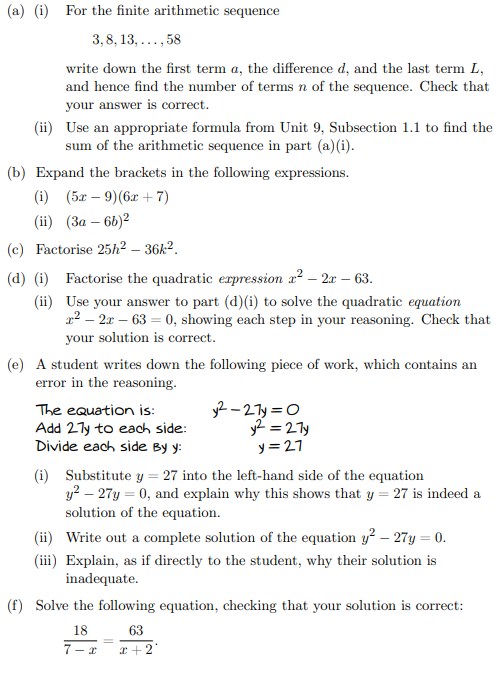
(a) (i) For the finite arithmetic sequence 3, 8, 13, ..., 58 write down the first term a, the difference d, and the last term L, and hence find the number of terms n of the sequence. Check that your answer is correct. (ii) Use an appropriate formula from Unit 9, Subsection 1.1 to find the sum of the arithmetic sequence in part (a) (i). (b) Expand the brackets in the following expressions. (i) (5x -9) (6x + 7) (ii) (3a - 6b)2 (c) Factorise 25h2 - 3612. (d) (i) Factorise the quadratic expression a- - 2x - 63. (ii) Use your answer to part (d) (i) to solve the quadratic equation x2 - 2x -63 =0, showing each step in your reasoning. Check that your solution is correct. (e) A student writes down the following piece of work, which contains an error in the reasoning. The equation is: 42 - 27y = 0 Add 27y to each side: yz = 27y Divide each side By y: y = 27 (i) Substitute y = 27 into the left-hand side of the equation y- - 27y =0, and explain why this shows that y = 27 is indeed a solution of the equation. (ii) Write out a complete solution of the equation y' - 27y = 0. (iii) Explain, as if directly to the student, why their solution is inadequate. (f) Solve the following equation, checking that your solution is correct: 18 63 r +2

Step by Step Solution

There are 3 Steps involved in it

1 Expert Approved Answer
Step: 1 Unlock blur-text-image

Question Has Been Solved by an Expert!

Get step-by-step solutions from verified subject matter experts

Step: 2 Unlock
Step: 3 Unlock

Students Have Also Explored These Related Mathematics Questions!