







Question: (a) (i) Write an example of a process that could be approximated as being (1 mark) a constant-pressure process but NOT a constant-volume process. (ii)
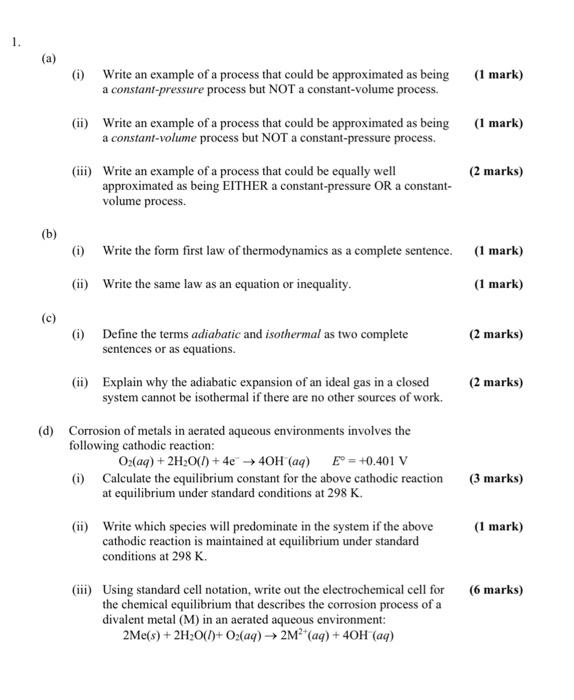
(a) (i) Write an example of a process that could be approximated as being (1 mark) a constant-pressure process but NOT a constant-volume process. (ii) Write an example of a process that could be approximated as being (1 mark) a constant-volume process but NOT a constant-pressure process. (iii) Write an example of a process that could be equally well (2 marks) approximated as being EITHER a constant-pressure OR a constantvolume process. (b) (i) Write the form first law of thermodynamics as a complete sentence. (1 mark) (ii) Write the same law as an equation or inequality. (1 mark) (c) (i) Define the terms adiabatic and isothermal as two complete (2 marks) sentences or as equations. (ii) Explain why the adiabatic expansion of an ideal gas in a closed (2 marks) system cannot be isothermal if there are no other sources of work. (d) Corrosion of metals in aerated aqueous environments involves the following cathodic reaction: O2(aq)+2H2O(l)+4e4OH(aq)E=+0.401V (i) Calculate the equilibrium constant for the above cathodic reaction (3 marks) at equilibrium under standard conditions at 298K. (ii) Write which species will predominate in the system if the above (1 mark) cathodic reaction is maintained at equilibrium under standard conditions at 298K. (iii) Using standard cell notation, write out the electrochemical cell for (6 marks) the chemical equilibrium that describes the corrosion process of a divalent metal (M) in an aerated aqueous environment: 2Me(s)+2H2O(l)+O2(aq)2M2+(aq)+4OH(aq)
Step by Step Solution
There are 3 Steps involved in it

Get step-by-step solutions from verified subject matter experts
 Study Help