





Question: (a) ( ) IAlla = p(A) for all square matrices A. (b) ( ) Suppose A is a symmetric, positive definite matrix, then Gaussian elimination
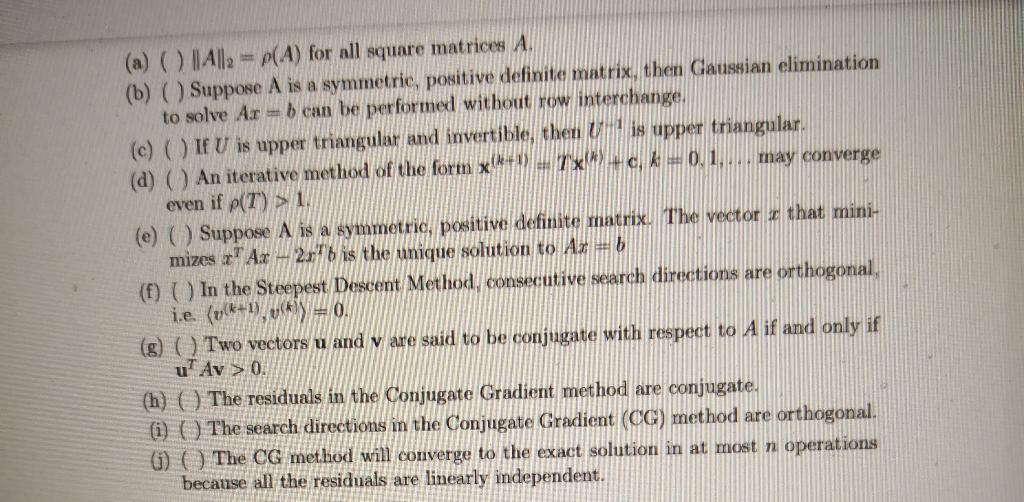
(a) ( ) IAlla = p(A) for all square matrices A.
(a) ( ) IAlla = p(A) for all square matrices A. (b) ( ) Suppose A is a symmetric, positive definite matrix, then Gaussian elimination to solve Ar - b can be performed without row interchange. (c) ( ) If U is upper triangular and invertible, then U I is upper triangular. (d) ( ) An iterative method of the form x - I x 4 c. = 0. 1. . . may converge even if p(T) (e) ( ) Suppose A is a symmetric, positive definite matrix. The vector is that mini- mizes r Ax -25 6 is the unique solution to Ar - b (f) ( ) In the Steepest Descent Method, consecutive search directions are orthogonal g) ( ) Two vectors u and v are said to be conjugate with respect to A if and only if u Av > 0 (h) ( ) The residuals in the Conjugate Gradient method are conjugate. (i) ( ) The search directions in the Conjugate Gradient (CG) method are orthogonal. () ( ) The CG method will converge to the exact solution in at most n operations because all the residuals are linearly independent

Step by Step Solution

There are 3 Steps involved in it

1 Expert Approved Answer
Step: 1 Unlock blur-text-image
Question Has Been Solved by an Expert!

Get step-by-step solutions from verified subject matter experts

Step: 2 Unlock
Step: 3 Unlock

Students Have Also Explored These Related Mathematics Questions!