







Question: A) If language L1 is regular and language L2 is non-regular, then language L1 + L2 is non-regular. b) If language L1 is non-regular and
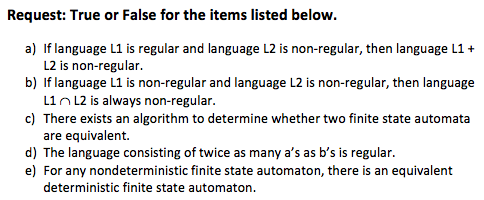
A) If language L1 is regular and language L2 is non-regular, then language L1 + L2 is non-regular. b) If language L1 is non-regular and language L2 is non-regular, then language L1 Intersection L2 is always non-regular. c) There exists an algorithm to determine whether two finite state automata are equivalent. d) The language consisting of twice as many a's as b's is regular. e) For any nondeterministic finite state automaton, there is an equivalent deterministic finite state automaton
Step by Step Solution
There are 3 Steps involved in it
1 Expert Approved Answer
Step: 1 Unlock

Question Has Been Solved by an Expert!
Get step-by-step solutions from verified subject matter experts
Step: 2 Unlock
Step: 3 Unlock
 Study Help