



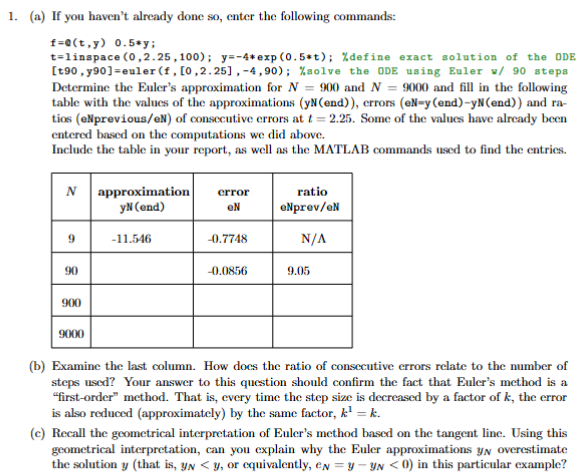
Question: ( a ) If you haven't already done so , enter the following commands: f = 0 ( t , y ) , 0 .
a If you haven't already done so enter the following commands:
ftyy;
t inspace ;yexpt; define exact solution of the ODE
tyeulerf; solve the ODE uaing Euler w atepa
Determine the Euler's approximation for N and NeNy endyN endt Some of the values have already been
entered based on the computations we did above.
Include the table in your report, as well as the MATLAB commands used to find the entries.
b Examine the last column. How does the ratio of consecutive errors relate to the number of
steps used? Your answer to this question should confirm the fact that Euler's method is a
"firstorder" method. That is every time the step size is decreased by a factor of k the error
is also reduced approximately by the same factor, kk
c Recall the geometrical interpretation of Euler's method based on the tangent line. Using this
geometrical interpretation, can you explain why the Euler approximations yN overestimate
the solution yeNyyNyN or equivalently, eNyyN
Step by Step Solution
There are 3 Steps involved in it
1 Expert Approved Answer
Step: 1 Unlock

Question Has Been Solved by an Expert!
Get step-by-step solutions from verified subject matter experts
Step: 2 Unlock
Step: 3 Unlock