







Question: (a) int 50 Which return type cannot return any value to the calling function? (b) float (c) void (d) double 51 Initializing a string can
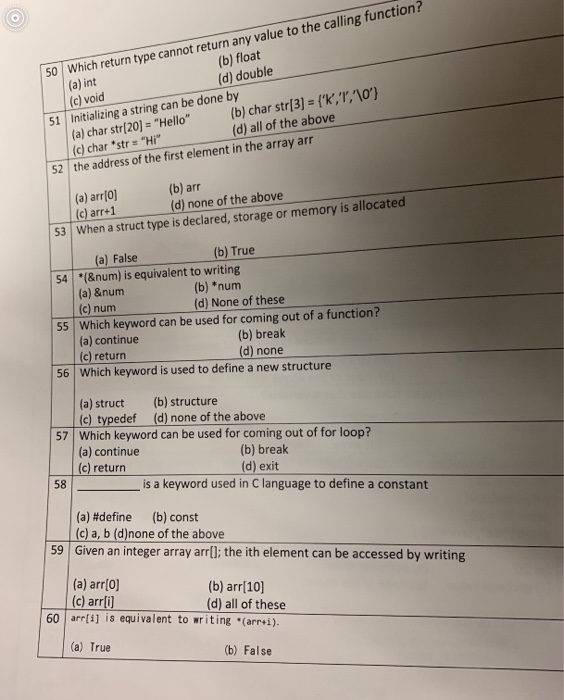
(a) int 50 Which return type cannot return any value to the calling function? (b) float (c) void (d) double 51 Initializing a string can be done by (a) char str(20) = "Hello" (b) char str[3] = {'K',T,'\0'} (c) char *str = "Hi" (d) all of the above 52 the address of the first element in the array arr (a) arr[0] (b) arr (d) none of the above 53 When a struct type is declared, storage or memory is allocated (a) False (b) True 54 *(&num) is equivalent to writing (a) &num (b) *num (c) num (d) None of these 55 Which keyword can be used for coming out of a function? (a) continue (b) break (c) return (d) none 56 Which keyword is used to define a new structure (a) struct (b) structure (c) typedef (d) none of the above 57 Which keyword can be used for coming out of for loop? (a) continue (b) break (c) return (d) exit is a keyword used in Clanguage to define a constant (a) #define (b) const (c) a, b (d) none of the above 59 Given an integer array arr(); the ith element can be accessed by writing (a) arr[0] (b) arr(10) (c) arr[i (d) all of these 60 arr[:] is equivalent to writing (arr+i). (a) True (b) False
Step by Step Solution
There are 3 Steps involved in it

Get step-by-step solutions from verified subject matter experts
 Study Help