





Question: A journalist has received a message from a source stating an astonishing claim about the mayor. Currently, the journalist believes that the claim is true
A journalist has received a message from a source

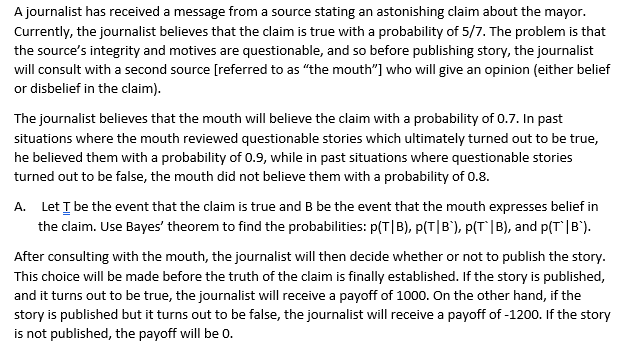
A journalist has received a message from a source stating an astonishing claim about the mayor. Currently, the journalist believes that the claim is true with a probability of 5/7. The problem is that the source's integrity and motives are questionable, and so before publishing story, the journalist will consult with a second source [referred to as the mouth"] who will give an opinion (either belief or disbelief in the claim). The journalist believes that the mouth will believe the claim with a probability of 0.7. In past situations where the mouth reviewed questionable stories which ultimately turned out to be true, he believed them with a probability of 0.9, while in past situations where questionable stories turned out to be false, the mouth did not believe them with a probability of 0.8. A. Let I be the event that the claim is true and B be the event that the mouth expresses belief in the claim. Use Bayes' theorem to find the probabilities: p(T|B), P(T|B"), P(T|B), and p(T|B). After consulting with the mouth, the journalist will then decide whether or not to publish the story. This choice will be made before the truth of the claim is finally established. If the story is published, and it turns out to be true, the journalist will receive a payoff of 1000. On the other hand, if the story is published but it turns out to be false, the journalist will receive a payoff of -1200. If the story is not published, the payoff will be 0

Step by Step Solution

There are 3 Steps involved in it

1 Expert Approved Answer
Step: 1 Unlock blur-text-image

Question Has Been Solved by an Expert!

Get step-by-step solutions from verified subject matter experts

Step: 2 Unlock
Step: 3 Unlock

Students Have Also Explored These Related General Management Questions!