







Question: A. K = 17: B. K = 7: C. K = 60: D. K = 112: Follow above rules. Assumptions Integers are represented in twos-complement

A. K = 17:
B. K = 7:
C. K = 60:
D. K = 112:
Follow above rules.
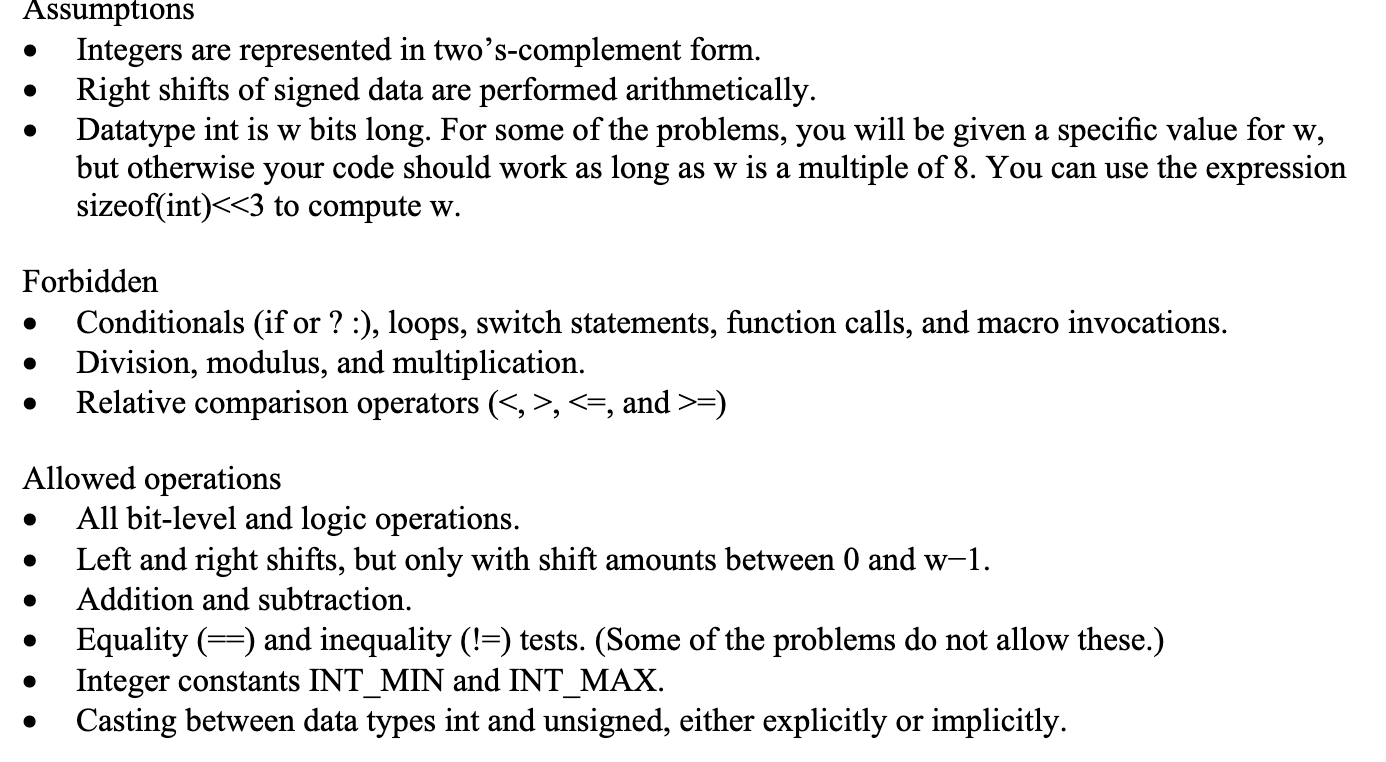
Assumptions Integers are represented in twos-complement form. Right shifts of signed data are performed arithmetically. Datatype int is w bits long. For some of the problems, you will be given a specific value for w, but otherwise your code should work as long as w is a multiple of 8. You can use the expression sizeof(int),=) . . Allowed operations All bit-level and logic operations. Left and right shifts, but only with shift amounts between 0 and w-1. Addition and subtraction. Equality (==) and inequality (!=) tests. (Some of the problems do not allow these.) Integer constants INT_MIN and INT MAX. Casting between data types int and unsigned, either explicitly or implicitly. . . 8. Suppose we are given the task of generating code to multiply integer variable x by various different constant factors K. To be efficient, we want to use only the operations +, -, and
Step by Step Solution
There are 3 Steps involved in it

Get step-by-step solutions from verified subject matter experts
 Study Help