







Question: (a) Let F:D + RN for some open subset D CRM and let the standard assumptions hold, then there exists some 8 > 0 such
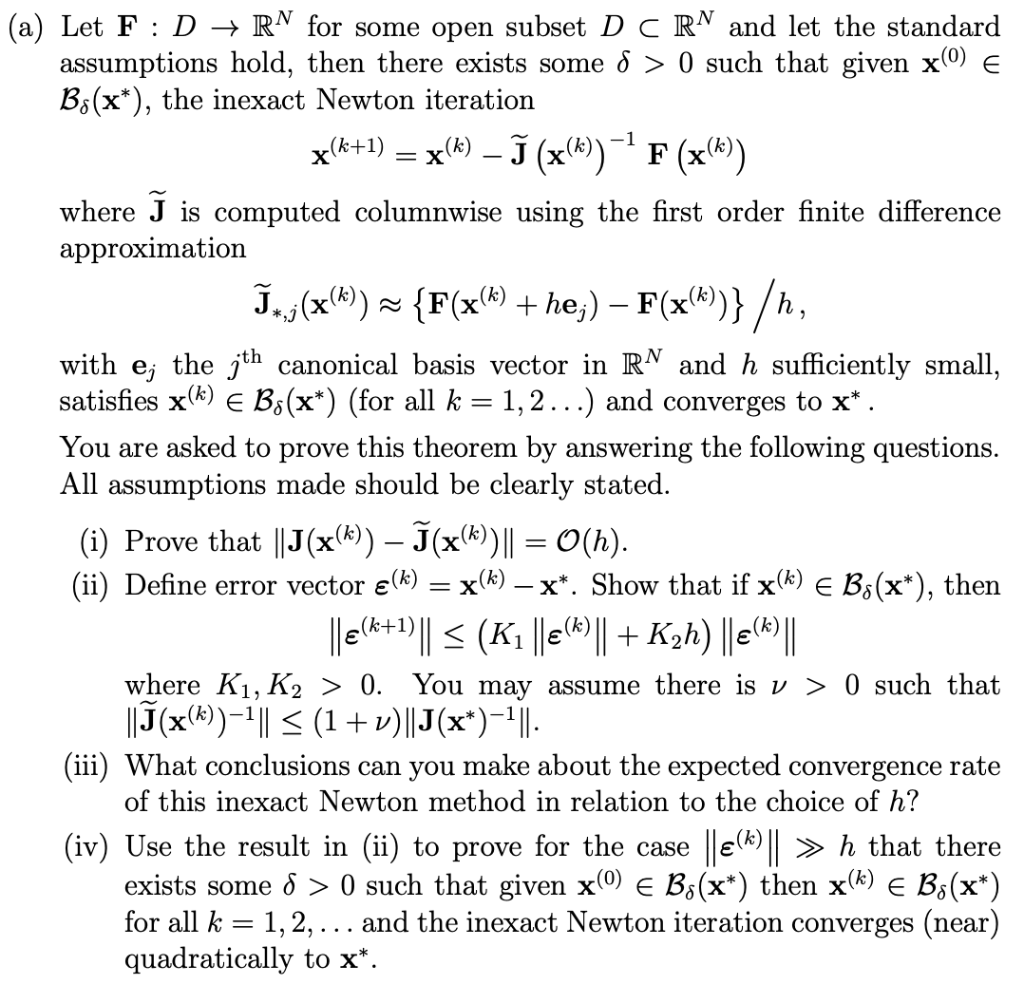
(a) Let F:D + RN for some open subset D CRM and let the standard assumptions hold, then there exists some 8 > 0 such that given x(0) E Bs(x*), the inexact Newton iteration x(x+1) = x(K) ] (x(x)) - F(x)) where J is computed columnwise using the first order finite difference approximation J.;(x)) ~ {F(x(X) + he;) F(x("}}}, with e; the jth canonical basis vector in RN and h sufficiently small, satisfies x(k) E B7(x*) (for all k = 1, 2...) and converges to x*. You are asked to prove this theorem by answering the following questions. All assumptions made should be clearly stated. (i) Prove that ||J(x(K)) J(x(K)) || = O(h). (ii) Define error vector (k) = x(k) x*. Show that if x(k) E B7(**), then ||$(k+1)|| 0. You may assume there is v > such that ||)(x(k))-1|| = (1+v)||J(**) 1 ||. (iii) What conclusions can you make about the expected convergence rate of this inexact Newton method in relation to the choice of h? (iv) Use the result in (ii) to prove for the case ||(k) || h that there exists some 8 >0 such that given x(0) e B3(x*) then x(k) e B3(x*) for all k = 1, 2, ... and the inexact Newton iteration converges (near) quadratically to x*. (a) Let F:D + RN for some open subset D CRM and let the standard assumptions hold, then there exists some 8 > 0 such that given x(0) E Bs(x*), the inexact Newton iteration x(x+1) = x(K) ] (x(x)) - F(x)) where J is computed columnwise using the first order finite difference approximation J.;(x)) ~ {F(x(X) + he;) F(x("}}}, with e; the jth canonical basis vector in RN and h sufficiently small, satisfies x(k) E B7(x*) (for all k = 1, 2...) and converges to x*. You are asked to prove this theorem by answering the following questions. All assumptions made should be clearly stated. (i) Prove that ||J(x(K)) J(x(K)) || = O(h). (ii) Define error vector (k) = x(k) x*. Show that if x(k) E B7(**), then ||$(k+1)|| 0. You may assume there is v > such that ||)(x(k))-1|| = (1+v)||J(**) 1 ||. (iii) What conclusions can you make about the expected convergence rate of this inexact Newton method in relation to the choice of h? (iv) Use the result in (ii) to prove for the case ||(k) || h that there exists some 8 >0 such that given x(0) e B3(x*) then x(k) e B3(x*) for all k = 1, 2, ... and the inexact Newton iteration converges (near) quadratically to x*
Step by Step Solution
There are 3 Steps involved in it

Get step-by-step solutions from verified subject matter experts
 Study Help