







Question: a) Let f(x) = x cos(x), g(x) = x + cos(x). Find f(x) lim I-00 g(x) without using l'Hopital's rule. What happens if you
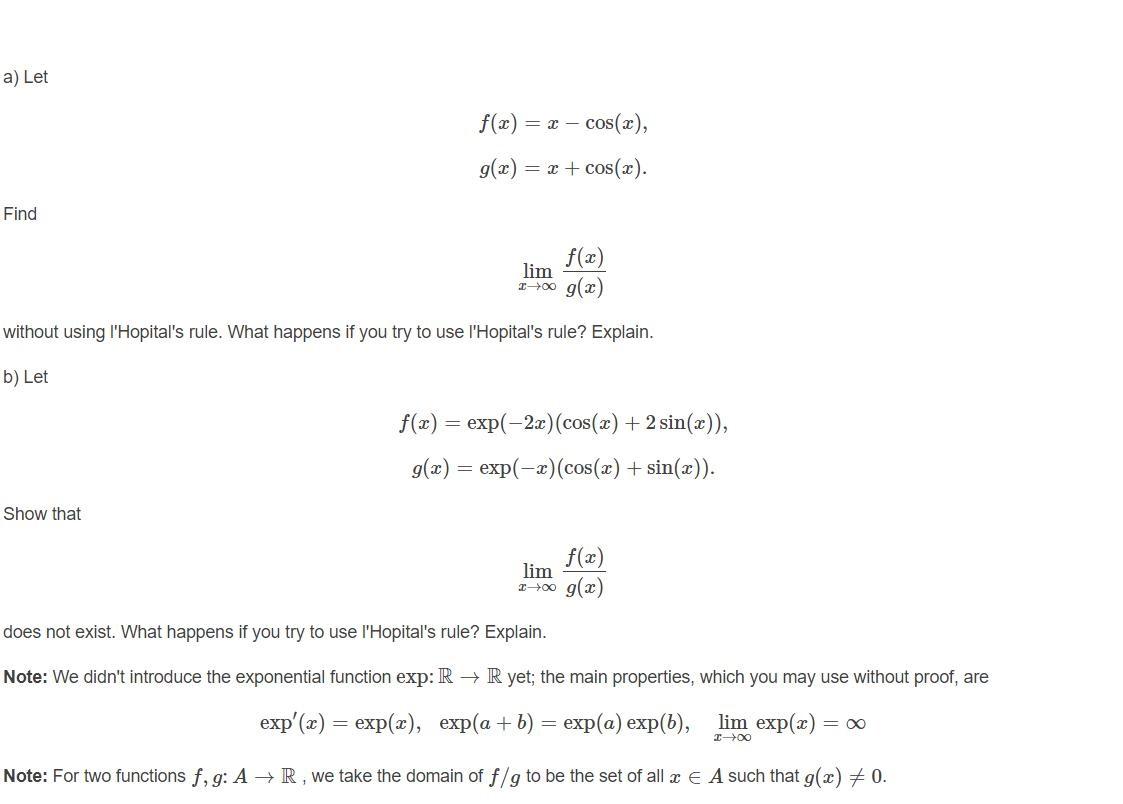
a) Let f(x) = x cos(x), g(x) = x + cos(x). Find f(x) lim I-00 g(x) without using l'Hopital's rule. What happens if you try to use l'Hopital's rule? Explain. b) Let f(x) = exp(-22)(cos(x) + 2 sin(x)), g(2) = exp(-2)(cos(x) + sin(x)). Show that f(x) lim 2-00 g(x) does not exist. What happens if you try to use l'Hopital's rule? Explain. Note: We didn't introduce the exponential function exp: R R yet; the main properties, which you may use without proof, are exp () xp(2), xp( + b) xp() p(b), lim exp(x) = Note: For two functions f, g: A R, we take the domain of f/g to be the set of all x A such that g(x) 0.
Step by Step Solution
3.40 Rating (169 Votes )
There are 3 Steps involved in it

Get step-by-step solutions from verified subject matter experts
 Study Help