







Question: (a) Let the twice continuously differentiable function u ( x ) be a solution of the initial value problem y + py + qy
(a) Let the twice continuously differentiable function u(x) be a solution of the initial value problem
y′′ + py′ + qy = 0, y(0) = 0, y′(0) = 1,
where p and q are constants. Show that the function
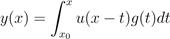
is a solution of the nonhomogeneous differential equation
y′′+ py′+ qy = g(x),
satisfying the initial conditions y(x0) = 0 = y′(x0).
Hint: Use the Leibniz’s formula.
(b) The existence and uniqueness theorem states that if p(x),q(x) and g(x) are continuous on an open interval I containing x0, then there exists a unique solution of the initial value problem 
throughout the interval I. Explain in the context of the existence and uniqueness theorem whether the function y = sin(x2) can be a solution of the initial value problem
y′′ + p(x)y′ + q(x)y = g(x), y(0) = 1, y′(0) = −1.
(x) 3D u(x- t)g(t)dt
Step by Step Solution
3.49 Rating (159 Votes )
There are 3 Steps involved in it

Get step-by-step solutions from verified subject matter experts
 Study Help