







Question: a) Let Y be a second order tensor, and a first-order tensor; and let A be some coordinate system. Let [2]^ be an eigen-vector of
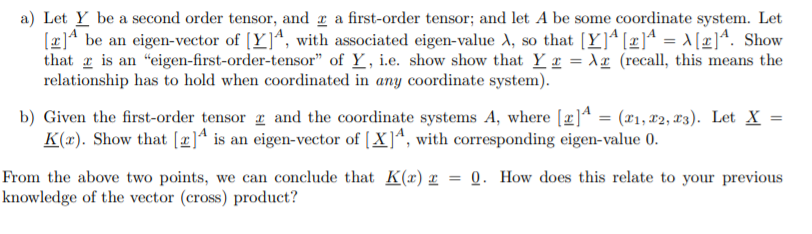
a) Let Y be a second order tensor, and a first-order tensor; and let A be some coordinate system. Let [2]^ be an eigen-vector of [Y]4, with associated eigen-value 1, so that [Y]*[2]4 = 1 [2]4. Show that r is an "eigen-first-order-tensor of Y , i.e. show show that Y r = 12 (recall, this means the relationship has to hold when coordinated in any coordinate system). b) Given the first-order tensor r and the coordinate systems A, where [2]^ = (x1, x2, 13). Let X = K(x). Show that [2]^ is an eigen-vector of ( X]^, with corresponding eigen-value 0. From the above two points, we can conclude that K(x) 2 0. How does this relate to your previous knowledge of the vector (cross) product? a) Let Y be a second order tensor, and a first-order tensor; and let A be some coordinate system. Let [2]^ be an eigen-vector of [Y]4, with associated eigen-value 1, so that [Y]*[2]4 = 1 [2]4. Show that r is an "eigen-first-order-tensor of Y , i.e. show show that Y r = 12 (recall, this means the relationship has to hold when coordinated in any coordinate system). b) Given the first-order tensor r and the coordinate systems A, where [2]^ = (x1, x2, 13). Let X = K(x). Show that [2]^ is an eigen-vector of ( X]^, with corresponding eigen-value 0. From the above two points, we can conclude that K(x) 2 0. How does this relate to your previous knowledge of the vector (cross) product
Step by Step Solution
There are 3 Steps involved in it

Get step-by-step solutions from verified subject matter experts
 Study Help