







Question: A line passes through the points M (4, 5) and N (9,5). a. Sketch this line. b. Determine vector and parametric equations for this

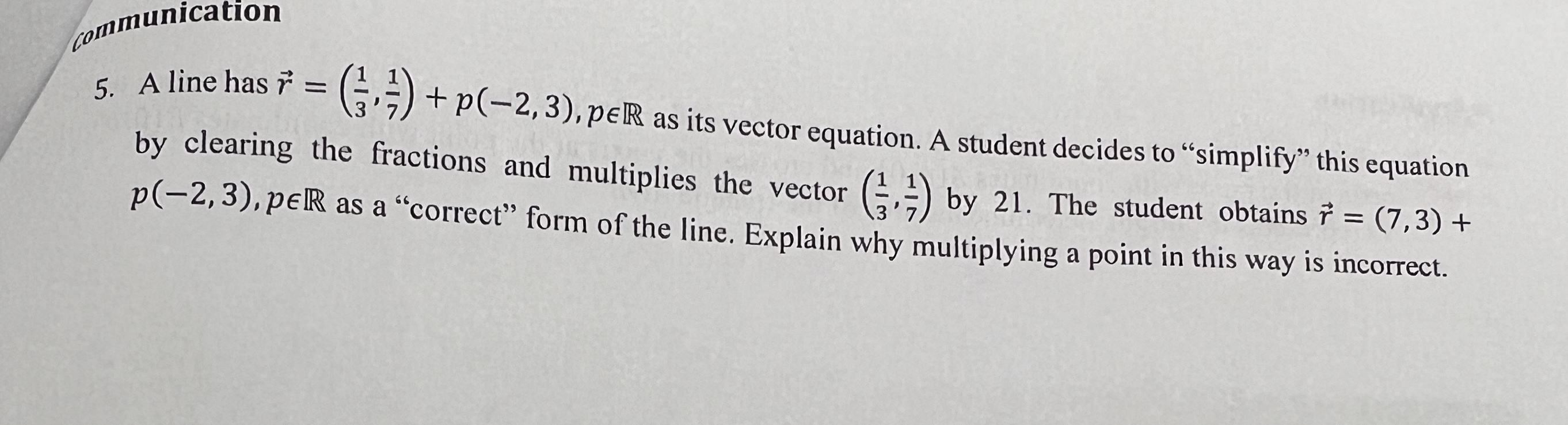
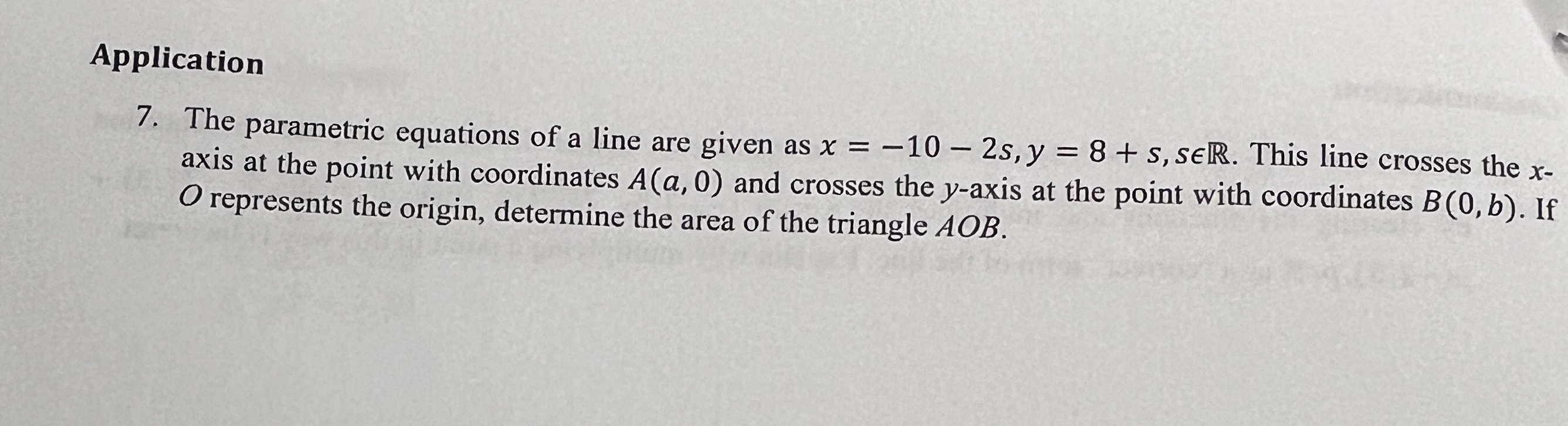
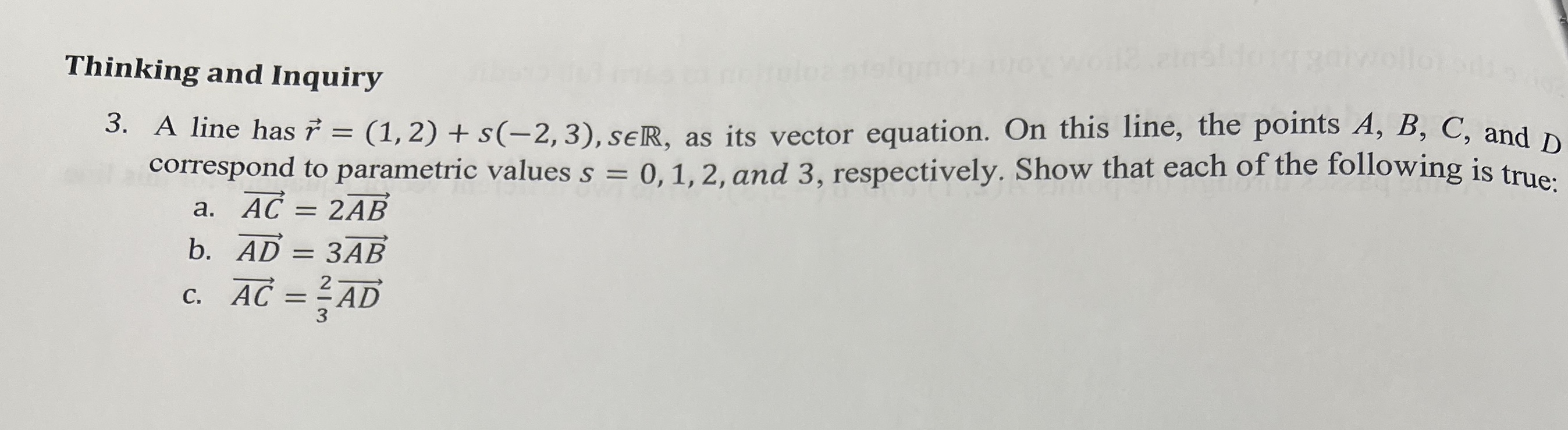

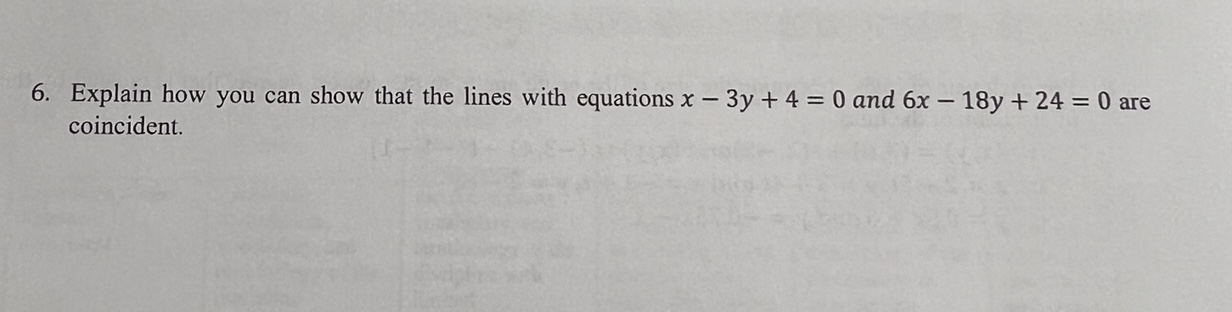
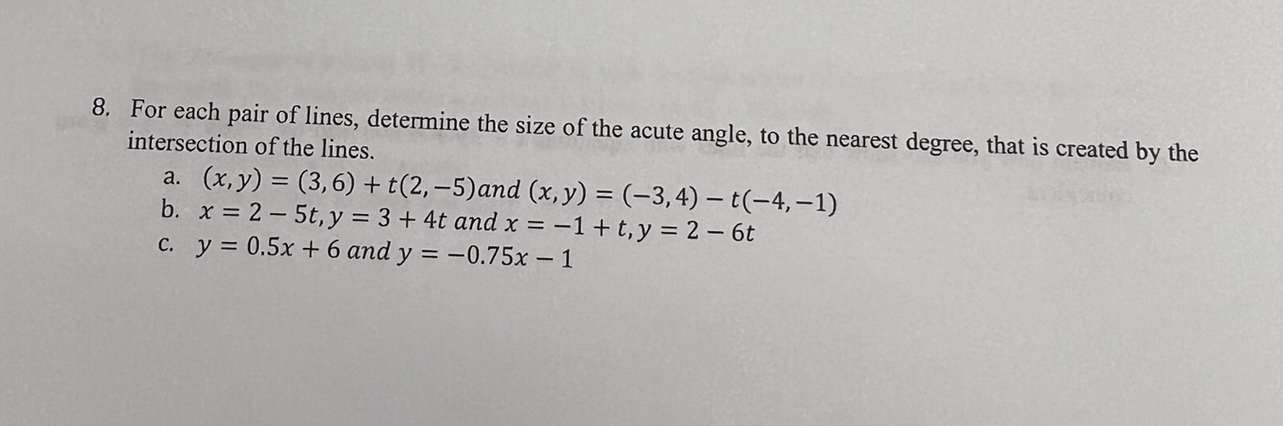
A line passes through the points M (4, 5) and N (9,5). a. Sketch this line. b. Determine vector and parametric equations for this line. 24 communication 5. A line has 7 = () + p(-2,3), peR as its vector equation. A student decides to "simplify this equation (1, ) by clearing the fractions and multiplies the vector p(-2,3), peR as a "correct" form of the line. Explain why multiplying a point in this way is incorrect. () by 21. The student obtains = (7,3)+ Application 7. The parametric equations of a line are given as x = -10- 2s, y= 8 + s, seR. This line crosses the x- axis at the point with coordinates A (a,0) and crosses the y-axis at the point with coordinates B(0, b). If O represents the origin, determine the area of the triangle AOB. dong garwollor od 9.0 Thinking and Inquiry 3. A line has r = (1, 2) + s(2, 3), seR, as its vector equation. On this line, the points A, B, C, and D correspond to parametric values s = 0, 1, 2, and 3, respectively. Show that each of the following is true: a. AC = 2AB b. AD = 3AB 2 c. AC = AD 3 Solve the following problems. Show your complete solution to earn full credit. Knowledge and Understanding 1. A line passes through the points A(2, 1) and B(-3,5). Write two different vector equations for this line. volupad bos geldaidr 6. Explain how you can show that the lines with equations x - 3y + 4 = 0 and 6x - 18y + 24 = 0 are coincident. 8. For each pair of lines, determine the size of the acute angle, to the nearest degree, that is created by the intersection of the lines. a. (x, y) = (3,6) + t(2,-5) and (x, y) = (-3,4) -t(-4,-1) b. x = 2-5t, y = 3+ 4t and x = 1+t, y = 2 - 6t c. y = 0.5x + 6 and y = -0.75x - 1
Step by Step Solution
There are 3 Steps involved in it

Get step-by-step solutions from verified subject matter experts
 Study Help