Question: A linear programming computer package is needed. work 8 hours per day. The rest of the employees are part-time employees who are scheduled for 4-hour
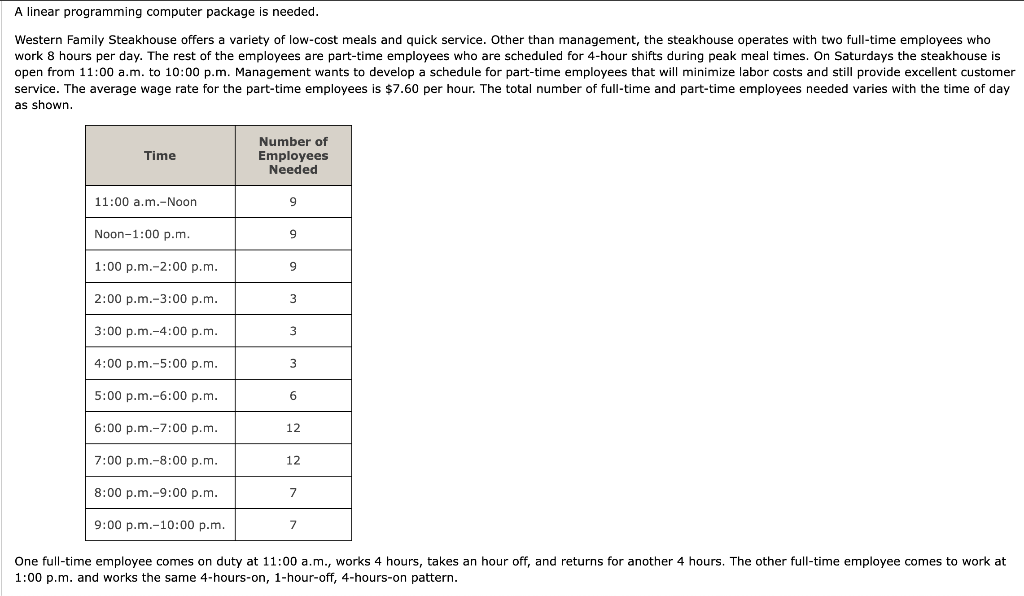
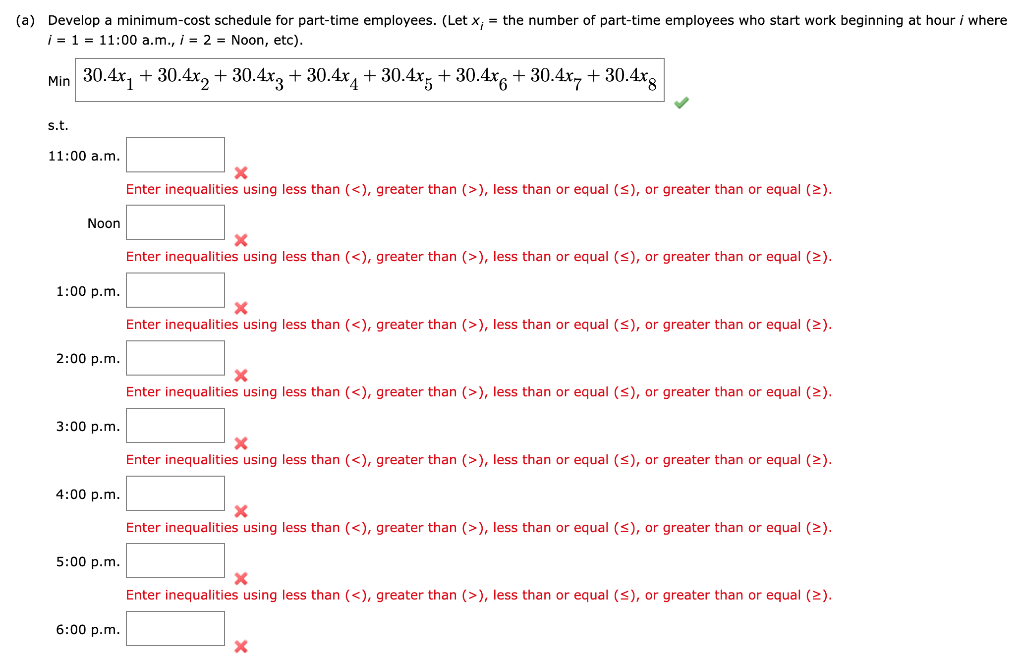
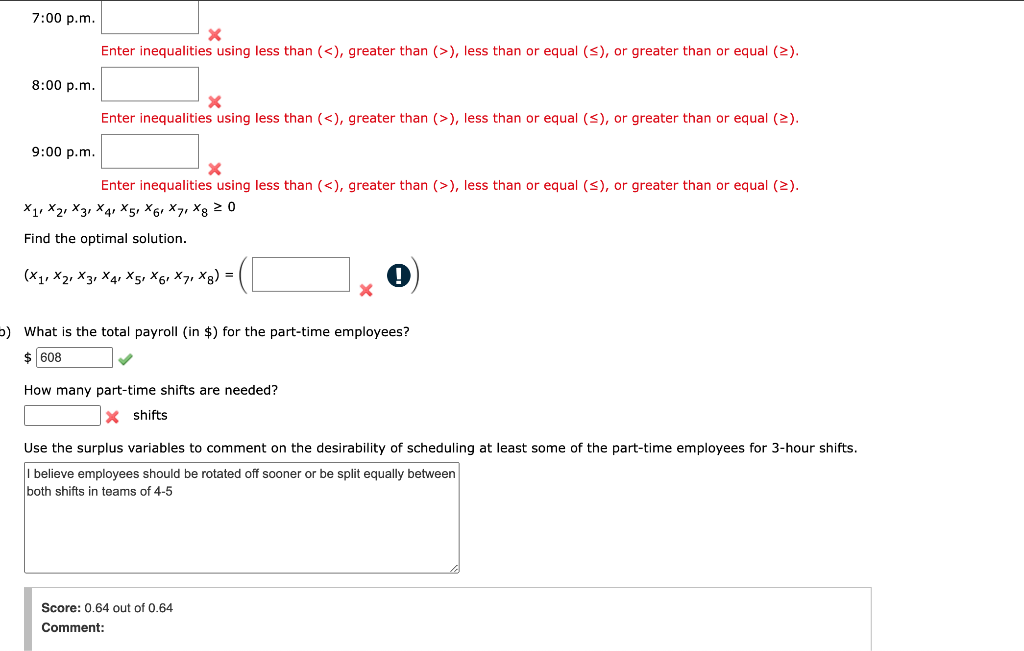
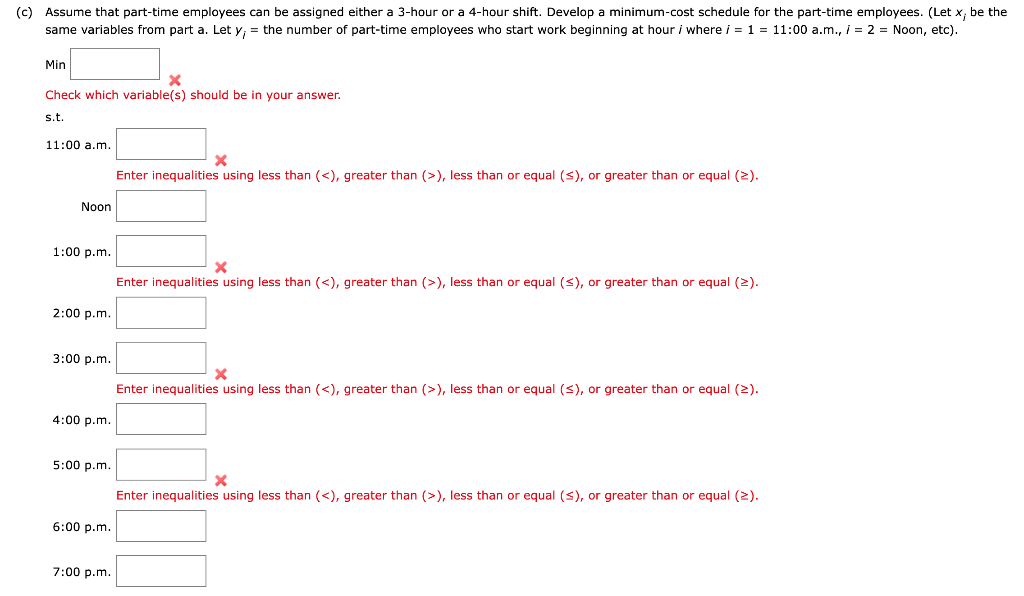
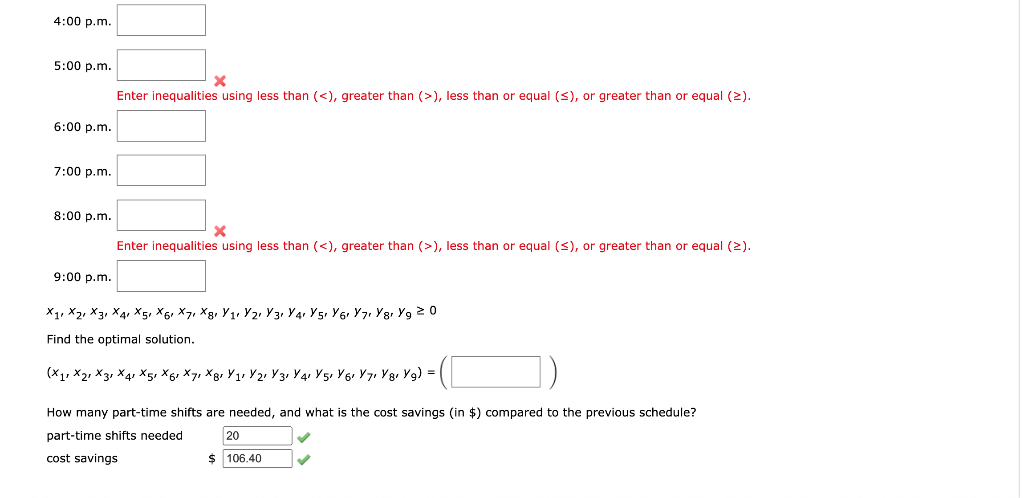
A linear programming computer package is needed. work 8 hours per day. The rest of the employees are part-time employees who are scheduled for 4-hour shifts during peak meal times. On Saturdays the steakhouse is open from 11:00 a.m. to 10:00 p.m. Management wants to develop a schedule for part-time employees that will minimize labor costs and still provide excellent customer service. The average wage rate for the part-time employees is $7.60 per hour. The total number of full-time and part-time employees needed varies with the time of day as shown. One full-time employee comes on duty at 11:00 a.m., works 4 hours, takes an hour off, and returns for another 4 hours. The other full-time employee comes to work at 1:00 p.m. and works the same 4-hours-on, 1-hour-off, 4-hours-on pattern. (a) Develop a minimum-cost schedule for part-time employees. (Let xi= the number of part-time employees who start work beginning at hour i whe i=1=11:00 a.m., i=2= Noon, etc . Min30.4x1+30.4x2+30.4x3+30.4x4+30.4x5+30.4x6+30.4x7+30.4x8 s.t. 11:00a.m. Enter inequalities using less than (), less than or equal (), or greater than or equal (). Noon Enter inequalities using less than (), less than or equal (), or greater than or equal (). 1:00p.m. Enter inequalities using less than (), less than or equal (), or greater than or equal (). 2:00p.m. Enter inequalities using less than (), less than or equal (), or greater than or equal (). 3:00p.m. Enter inequalities using less than (), less than or equal (), or greater than or equal (). 4:00p.m. Enter inequalities using less than (), less than or equal (), or greater than or equal (). 5:00p.m. Enter inequalities using less than (), less than or equal (), or greater than or equal (). 6:00p.m. 7:00p.m. Enter inequalities using less than (), less than or equal (), or greater than or equal (). 8:00p.m. Enter inequalities using less than (), less than or equal (), or greater than or equal (). 9:00p.m. Enter inequalities using less than (), less than or equal (), or greater than or equal ( ). x1,x2,x3,x4,x5,x6,x7,x80 Find the optimal solution. (x1,x2,x3,x4,x5,x6,x7,x8)=( What is the total payroll (in \$) for the part-time employees? $ How many part-time shifts are needed? 23 shifts Use the surplus variables to comment on the desirability of scheduling at least some of the part-time employees for 3 -hour shifts. Score: 0.64 out of 0.64 Comment: (c) Assume that part-time employees can be assigned either a 3-hour or a 4-hour shift. Develop a minimum-cost schedule for the part-time employees. (Let xi be the same variables from part a. Let yi= the number of part-time employees who start work beginning at hour i where i=1=11:00 a.m., i=2= Noon, etc). Min Check which variable(s) should be in your answer. s.t. 11:00 a.m. Enter inequalities using less than (), less than or equal (), or greater than or equal (). Noon 1:00 p.m. Enter inequalities using less than (), less than or equal (), or greater than or equal (). 2:00 p.m. 3:00 p.m. Enter inequalities using less than (), less than or equal (), or greater than or equal (). 4:00 p.m. 5:00 p.m. Enter inequalities using less than (), less than or equal (), or greater than or equal (). 6:00 p.m. 7:00 p.m. 4:00p.m. 5:00p.m. Enter inequalities using less than (), less than or equal (), or greater than or equal (). 6:00p.m. 7:00p.m. 8:00p.m. Enter inequalities using less than (), less than or equal (), or greater than or equal (). 9:00p.m.x1,x2,x3,x4,x5,x6,x7,x8,y1,y2,y3,y4,y5,y6,y7,y8,y90 Find the optimal solution. (x1,x2,x3,x4,x5rx6,x7,x8y1,y2,y3,y4,y5,y6,y7,y8,y9)=( How many part-time shifts are needed, and what is the cost savings (in \$) compared to the previous schedule? part-time shifts needed cost savings A linear programming computer package is needed. work 8 hours per day. The rest of the employees are part-time employees who are scheduled for 4-hour shifts during peak meal times. On Saturdays the steakhouse is open from 11:00 a.m. to 10:00 p.m. Management wants to develop a schedule for part-time employees that will minimize labor costs and still provide excellent customer service. The average wage rate for the part-time employees is $7.60 per hour. The total number of full-time and part-time employees needed varies with the time of day as shown. One full-time employee comes on duty at 11:00 a.m., works 4 hours, takes an hour off, and returns for another 4 hours. The other full-time employee comes to work at 1:00 p.m. and works the same 4-hours-on, 1-hour-off, 4-hours-on pattern. (a) Develop a minimum-cost schedule for part-time employees. (Let xi= the number of part-time employees who start work beginning at hour i whe i=1=11:00 a.m., i=2= Noon, etc . Min30.4x1+30.4x2+30.4x3+30.4x4+30.4x5+30.4x6+30.4x7+30.4x8 s.t. 11:00a.m. Enter inequalities using less than (), less than or equal (), or greater than or equal (). Noon Enter inequalities using less than (), less than or equal (), or greater than or equal (). 1:00p.m. Enter inequalities using less than (), less than or equal (), or greater than or equal (). 2:00p.m. Enter inequalities using less than (), less than or equal (), or greater than or equal (). 3:00p.m. Enter inequalities using less than (), less than or equal (), or greater than or equal (). 4:00p.m. Enter inequalities using less than (), less than or equal (), or greater than or equal (). 5:00p.m. Enter inequalities using less than (), less than or equal (), or greater than or equal (). 6:00p.m. 7:00p.m. Enter inequalities using less than (), less than or equal (), or greater than or equal (). 8:00p.m. Enter inequalities using less than (), less than or equal (), or greater than or equal (). 9:00p.m. Enter inequalities using less than (), less than or equal (), or greater than or equal ( ). x1,x2,x3,x4,x5,x6,x7,x80 Find the optimal solution. (x1,x2,x3,x4,x5,x6,x7,x8)=( What is the total payroll (in \$) for the part-time employees? $ How many part-time shifts are needed? 23 shifts Use the surplus variables to comment on the desirability of scheduling at least some of the part-time employees for 3 -hour shifts. Score: 0.64 out of 0.64 Comment: (c) Assume that part-time employees can be assigned either a 3-hour or a 4-hour shift. Develop a minimum-cost schedule for the part-time employees. (Let xi be the same variables from part a. Let yi= the number of part-time employees who start work beginning at hour i where i=1=11:00 a.m., i=2= Noon, etc). Min Check which variable(s) should be in your answer. s.t. 11:00 a.m. Enter inequalities using less than (), less than or equal (), or greater than or equal (). Noon 1:00 p.m. Enter inequalities using less than (), less than or equal (), or greater than or equal (). 2:00 p.m. 3:00 p.m. Enter inequalities using less than (), less than or equal (), or greater than or equal (). 4:00 p.m. 5:00 p.m. Enter inequalities using less than (), less than or equal (), or greater than or equal (). 6:00 p.m. 7:00 p.m. 4:00p.m. 5:00p.m. Enter inequalities using less than (), less than or equal (), or greater than or equal (). 6:00p.m. 7:00p.m. 8:00p.m. Enter inequalities using less than (), less than or equal (), or greater than or equal (). 9:00p.m.x1,x2,x3,x4,x5,x6,x7,x8,y1,y2,y3,y4,y5,y6,y7,y8,y90 Find the optimal solution. (x1,x2,x3,x4,x5rx6,x7,x8y1,y2,y3,y4,y5,y6,y7,y8,y9)=( How many part-time shifts are needed, and what is the cost savings (in \$) compared to the previous schedule? part-time shifts needed cost savings









 Study Help