







Question: A liquid flows over a flat, rectangular plate and thus a boundary layer is formed. At 0.5 [m] from the leading edge, the thickness of
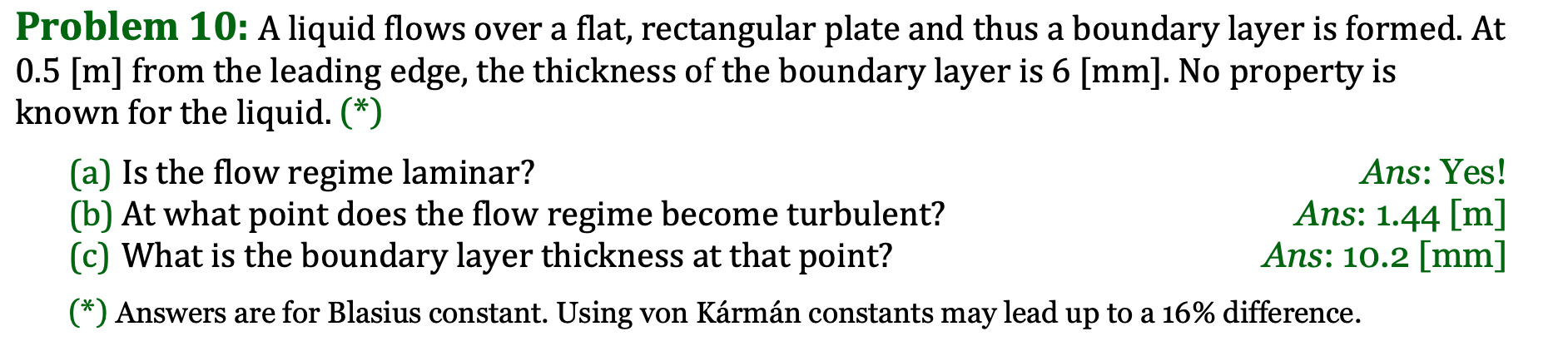 A liquid flows over a flat, rectangular plate and thus a boundary layer is formed. At 0.5 [m] from the leading edge, the thickness of the boundary layer is 6 [mm]. No property is known for the liquid. (*) (a) Is the flow regime laminar? (b) At what point does the flow regime become turbulent? (c) What is the boundary layer thickness at that point? Ans: Yes! Ans: 1.44 [m] Ans: 10.2 [mm] (*) Answers are for Blasius constant. Using von Krmn constants may lead up to a 16% difference.
Problem 10: A liquid flows over a flat, rectangular plate and thus a boundary layer is formed. At 0.5 [m] from the leading edge, the thickness of the boundary layer is 6 [mm]. No property is known for the liquid. (*) (a) Is the flow regime laminar? Ans: Yes! (b) At what point does the flow regime become turbulent? Ans: 1.44 [m] (c) What is the boundary layer thickness at that point? Ans: 10.2 [mm] (*) Answers are for Blasius constant. Using von Krmn constants may lead up to a 16% difference
Step by Step Solution
There are 3 Steps involved in it

Get step-by-step solutions from verified subject matter experts
 Study Help