







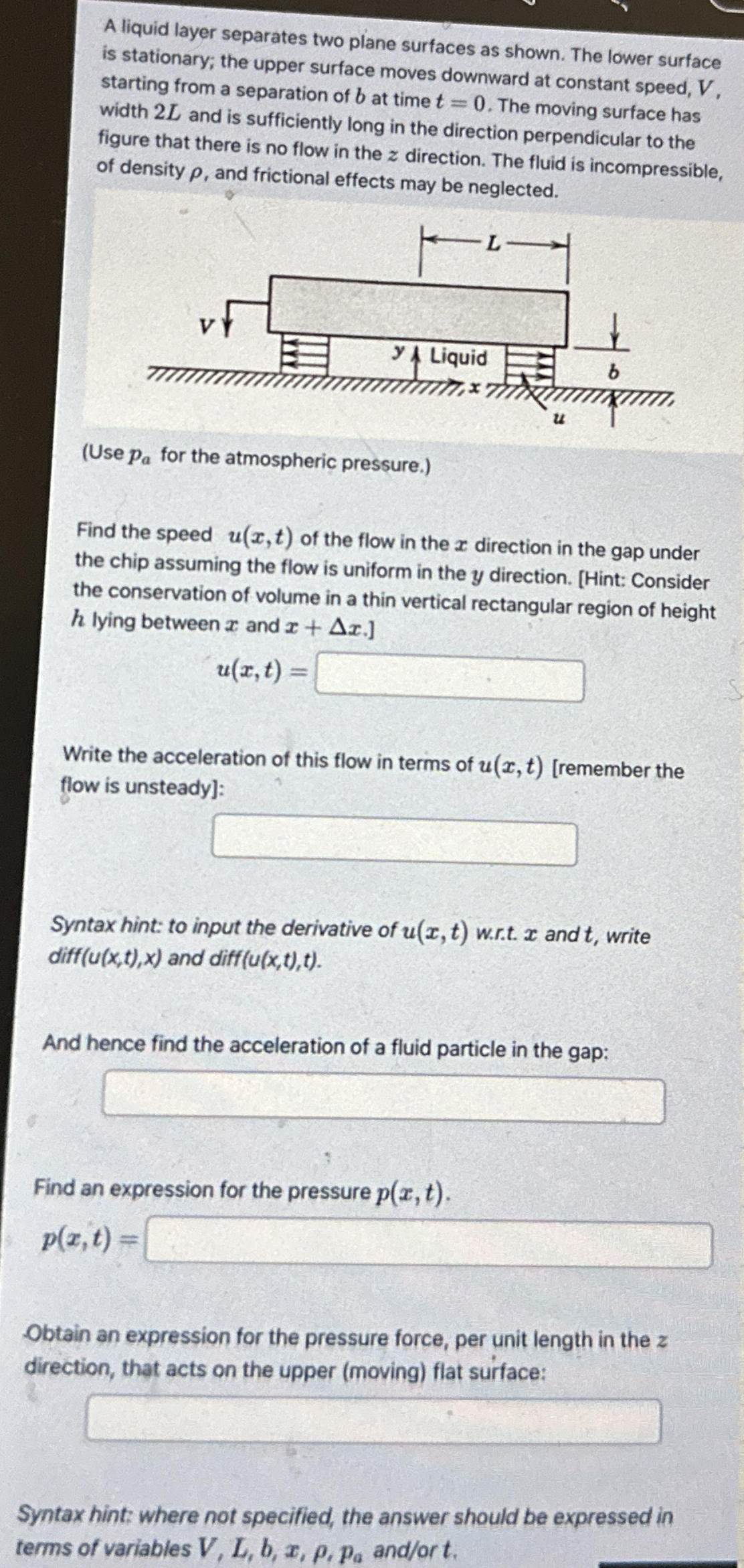
Question: A liquid layer separates two plane surfaces as shown. The lower surface is stationary; the upper surface moves downward at constant speed, V , starting
A liquid layer separates two plane surfaces as shown. The lower surface is stationary; the upper surface moves downward at constant speed, starting from a separation of at time The moving surface has width and is sufficiently long in the direction perpendicular to the figure that there is no flow in the direction. The fluid is incompressible, of density and frictional effects may be neglected.
Use for the atmospheric pressure.
Find the speed of the flow in the direction in the gap under the chip assuming the flow is uniform in the direction. Hint: Consider the conservation of volume in a thin vertical rectangular region of height lying between and
Write the acceleration of this flow in terms of remember the flow is unsteady:
Syntax hint: to input the derivative of wrt and write diff and diff
And hence find the acceleration of a fluid particle in the gap:
Find an expression for the pressure
Obtain an expression for the pressure force, per unit length in the direction, that acts on the upper moving flat surface:
Syntax hint: where not specified, the answer should be expressed in terms of variables andor
Step by Step Solution
There are 3 Steps involved in it
1 Expert Approved Answer
Step: 1 Unlock

Question Has Been Solved by an Expert!
Get step-by-step solutions from verified subject matter experts
Step: 2 Unlock
Step: 3 Unlock
 Study Help