







Question: A. Marketing for Dunkin' Donuts (five points--one point each for A1, A2, A3, A4, A5) You are Marketing Manager for Dunkin' Donuts, the largest doughnut
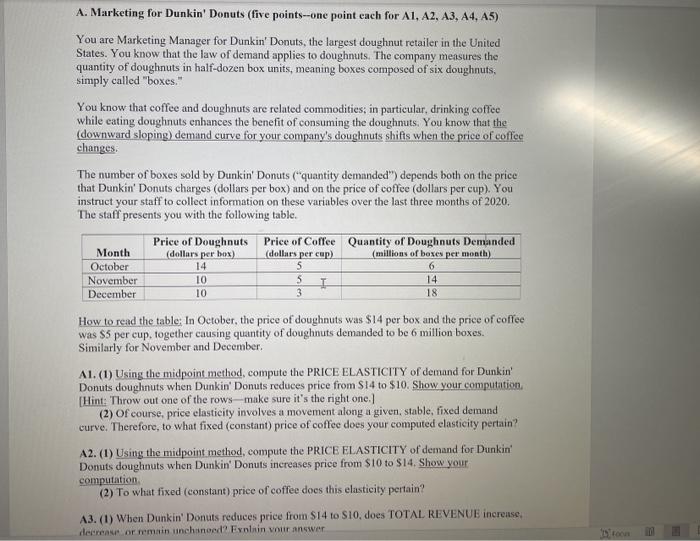
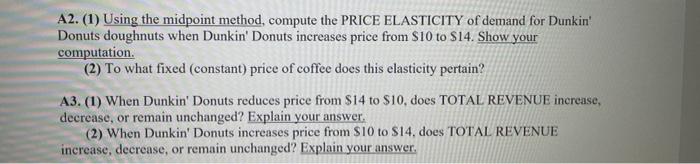
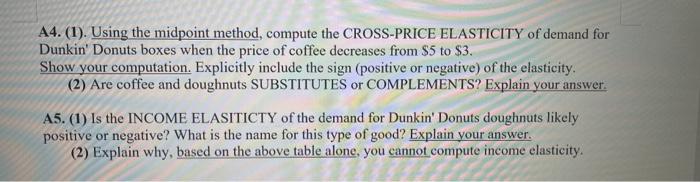
A. Marketing for Dunkin' Donuts (five points--one point each for A1, A2, A3, A4, A5) You are Marketing Manager for Dunkin' Donuts, the largest doughnut retailer in the United States. You know that the law of demand applies to doughnuts. The company measures the quantity of doughnuts in half-dozen box units, meaning boxes composed of six doughnuts, simply called "boxes." You know that coffee and doughnuts are related commodities, in particular, drinking coffee while eating doughnuts enhances the benefit of consuming the doughnuts. You know that the (downward sloping) demand curve for your company's doughnuts shifts when the price of coffee changes The number of boxes sold by Dunkin' Donuts ("quantity demanded") depends both on the price that Dunkin' Donuts charges (collars per box) and on the price of coffee (dollars per cup). You instruct your staff to collect information on these variables over the last three months of 2020. The staff presents you with the following table. Price of Doughnuts Price of Coffee Quantity of Doughnuts Demanded Month (dollars per box) (dollars per cup) (millions of boxes per month) October 14 5 6 November 10 I December 10 3 18 How to read the table: In October, the price of doughnuts was $14 per box and the price of coffee was $5 per cup, together causing quantity of doughnuts demanded to be 6 million boxes. Similarly for November and December A1. (1) Using the midpoint method, compute the PRICE ELASTICITY of demand for Dunkin' Donuts doughnuts when Dunkin' Donuts reduces price from $14 to $10. Show your computation [Hint: Throw out one of the rows-make sure it's the right one.) (2) Of course, price elasticity involves a movement along a given, stable, fixed demand curve. Therefore, to what fixed (constant) price of coffee does your computed elasticity pertain? A2. (1) Using the midpoint method, compute the PRICE ELASTICITY of demand for Dunkin' Donuts doughnuts when Dunkin' Donuts increases price from $10 to $14. Show your computation (2) To what fixed (constant) price of coffee does this elasticity pertain? A3. (1) When Dunkin' Donuts reduces price from $14 to $10, does TOTAL REVENUE increase decrease or remain unchanged? Fynlain your answer 5 14 A2. (1) Using the midpoint method, compute the PRICE ELASTICITY of demand for Dunkin' Donuts doughnuts when Dunkin' Donuts increases price from $10 to $14. Show your computation. (2) To what fixed (constant) price of coffee does this elasticity pertain? A3. (1) When Dunkin' Donuts reduces price from $14 to $10, does TOTAL REVENUE increase, decrease, or remain unchanged? Explain your answer. (2) When Dunkin' Donuts increases price from $10 to $14. does TOTAL REVENUE increase, decrease, or remain unchanged? Explain your answer. A4. (1). Using the midpoint method, compute the CROSS-PRICE ELASTICITY of demand for Dunkin' Donuts boxes when the price of coffee decreases from $5 to $3. Show your computation. Explicitly include the sign (positive or negative) of the elasticity. (2) Are coffee and doughnuts SUBSTITUTES or COMPLEMENTS? Explain your answer. A5. (1) Is the INCOME ELASITICTY of the demand for Dunkin' Donuts doughnuts likely positive or negative? What is the name for this type of good? Explain your answer. (2) Explain why, based on the above table alone, you cannot compute income elasticity
Step by Step Solution
There are 3 Steps involved in it

Get step-by-step solutions from verified subject matter experts
 Study Help