







Question: A mining operation wants to use a large rectangular settling tank (see accompanying figure) to remove a very dilute amount of suspended lead oxide
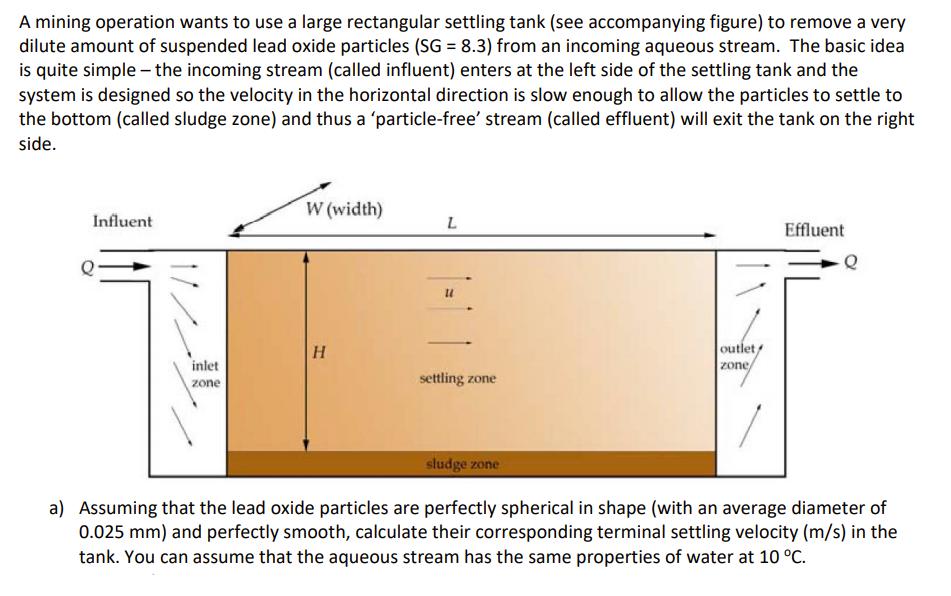
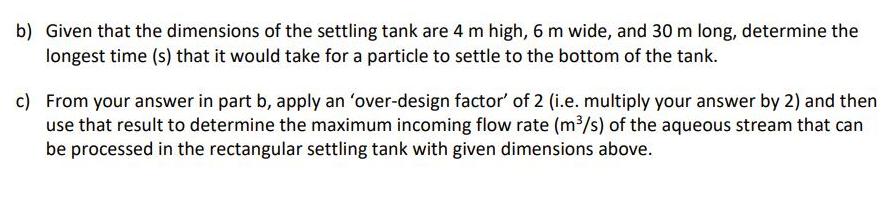
A mining operation wants to use a large rectangular settling tank (see accompanying figure) to remove a very dilute amount of suspended lead oxide particles (SG = 8.3) from an incoming aqueous stream. The basic idea is quite simple the incoming stream (called influent) enters at the left side of the settling tank and the system is designed so the velocity in the horizontal direction is slow enough to allow the particles to settle to the bottom (called sludge zone) and thus a 'particle-free' stream (called effluent) will exit the tank on the right side. W (width) Influent L Effluent Q outlet/ inlet zone zone settling zone sludge zone a) Assuming that the lead oxide particles are perfectly spherical in shape (with an average diameter of 0.025 mm) and perfectly smooth, calculate their corresponding terminal settling velocity (m/s) in the tank. You can assume that the aqueous stream has the same properties of water at 10 C. b) Given that the dimensions of the settling tank are 4 m high, 6 m wide, and 30 m long, determine the longest time (s) that it would take for a particle to settle to the bottom of the tank. c) From your answer in part b, apply an 'over-design factor' of 2 (i.e. multiply your answer by 2) and then use that result to determine the maximum incoming flow rate (m/s) of the aqueous stream that can be processed in the rectangular settling tank with given dimensions above.
Step by Step Solution
3.37 Rating (169 Votes )
There are 3 Steps involved in it

Get step-by-step solutions from verified subject matter experts
 Study Help