



Question: A monopoly's inverse demand function is p = 200 - 2G. and it has no fixed cost. Initially. its marginal cost is 16. Now. the
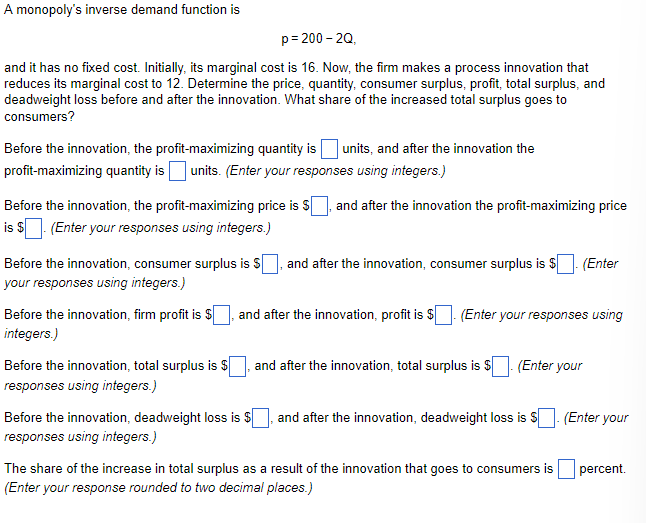
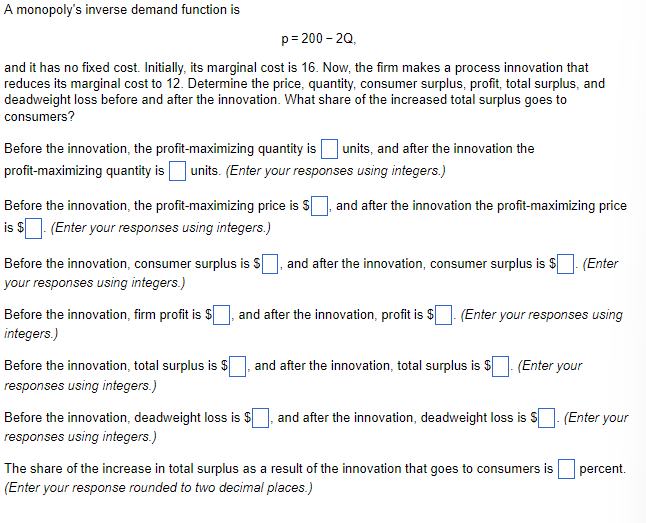
A monopoly's inverse demand function is p = 200 - 2G. and it has no fixed cost. Initially. its marginal cost is 16. Now. the rm makes a process innovation that reduces its marginal cost to 12. Determine the price. quantity. consumer surplus. prot. total surplus. and deadweight loss before and after the innovation. What share ofthe increased total surplus goes to consumers? Before the innovation. the profitmaximizing quantityr is units. and after the innovation the pro it-maximizing quantity is :l units. {Enteryour responses using integers.) Before the innovation. the profitmaximizing price is $ . and alter the innovation the protmaximizing price is $:|. f'Enteryour responses using integers.) Before the innovation. consumer surplus is S . and aer the innovation. consumer surplus is $|:. {Enter your responses using integers.)I Before the innovation. firm prot is $ . and after the innovation. prot is $ . {Enter your responses using integers.) Before the innovation. total surplus is $:|. and afterthe innovation. total surp us is $ . (Enteryour responses using integers.) Before the innovation. deadweight loss is $ . and after the innovation. deadweight loss is S . {Enter your responses using integers.) The share of the increase in total surplus as a result of the innovation that goes to consumers is percent. (Enter your response rounded to two deoimai places.)
Step by Step Solution
There are 3 Steps involved in it

Get step-by-step solutions from verified subject matter experts