







Question: A Moving to another question will save this response. > Question 17 4.5 points Save Answer From a sample of size 30, Jane calculates a
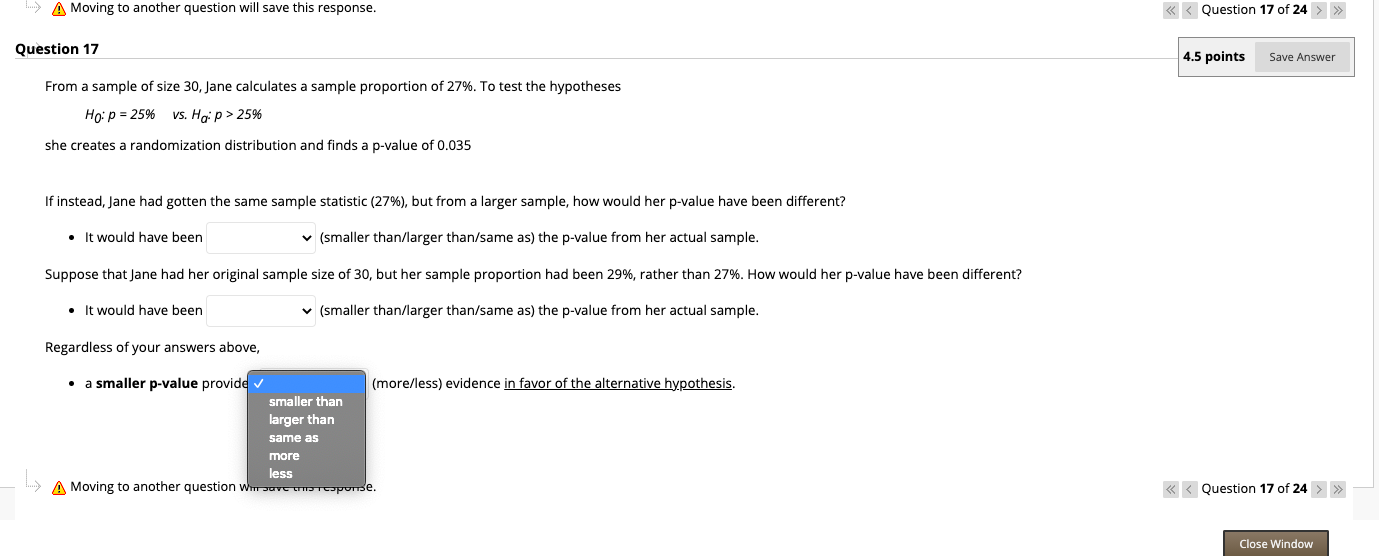
A Moving to another question will save this response. > Question 17 4.5 points Save Answer From a sample of size 30, Jane calculates a sample proportion of 27%. To test the hypotheses Ho: p = 25% vs. Hgip > 25% she creates a randomization distribution and finds a p-value of 0.035 If instead, Jane had gotten the same sample statistic (27%), but from a larger sample, how would her p-value have been different? . It would have been (smaller than/larger than/same as) the p-value from her actual sample. Suppose that Jane had her original sample size of 30, but her sample proportion had been 29%, rather than 27%. How would her p-value have been different? . It would have been (smaller than/larger than/same as) the p-value from her actual sample. Regardless of your answers above, . a smaller p-value provide v (more/less) evidence in favor of the alternative hypothesis. smaller than larger than same as more less A Moving to another question Will Save the Tapume. > Close Window
Step by Step Solution
There are 3 Steps involved in it

Get step-by-step solutions from verified subject matter experts
 Study Help