







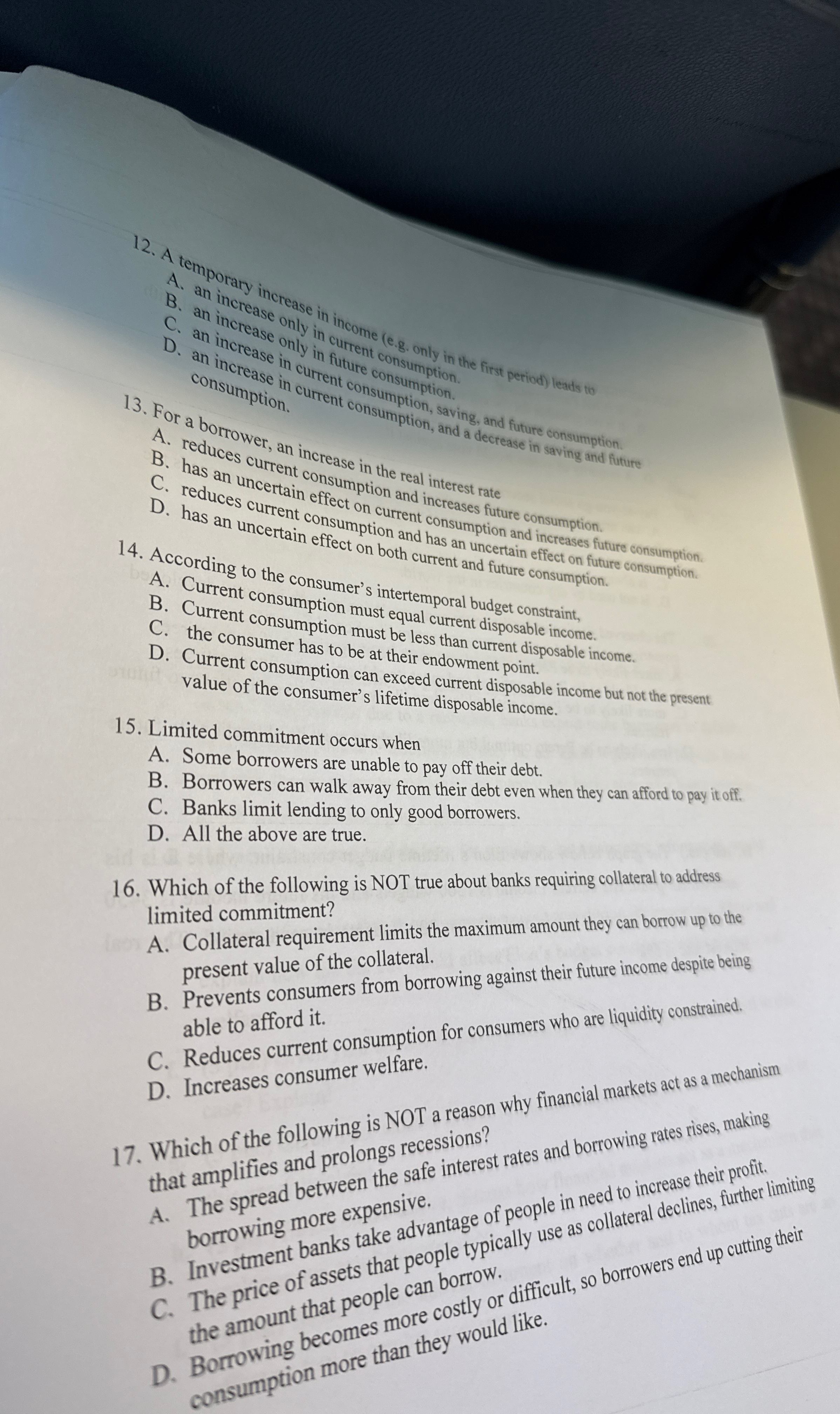
Question: A . mporary increase in income ( e . g . only in the first period ) leads to B . an increase only in
A "mporary increase in income eg only in the first period leads to
B an increase only in current consumption.
C an increase only in future consumption.
D an increase in current consumption, saving, and future consumption. consumption.
For a borrower, an increase in the real interest rate
A reduces current consumption and increases future consumption.
B has an uncertain effect on current consumption and increases future consumption.
C reduces current consumption and has an uncertain effect on future consumption.
D has an uncertain effect on both current and future consumption.
According to the consumer's intertemporal budget constraint,
A Current consumption must equal current disposable income.
B Current consumption must be less than current disposable income.
C the consumer has to be at their endowment point.
D Current consumption can exceed current disposable income but not the present value of the consumer's lifetime disposable income.
Limited commitment occurs when
A Some borrowers are unable to pay off their debt.
B Borrowers can walk away from their debt even when they can afford to pay it off.
C Banks limit lending to only good borrowers.
D All the above are true.
Which of the following is NOT true about banks requiring collateral to address limited commitment?
A Collateral requirement limits the maximum amount they can borrow up to the present value of the collateral.
B Prevents consumers from borrowing against their future income despite being able to afford it
C Reduces current consumption for consumers who are liquidity constrained.
D Increases consumer welfare.
Which of the following is NOT a reason why financial markets act as a mechanism that amplifies and prolongs recessions?
A The spread between the safe interest rates and borrowing rates rises, making borrowing more expensive.
B Investment banks take advantage of people in need to increase their profit. the amount that people can borrow.
D Borrowing becomes more costly or difficult, so borrowers end up cuting their
Step by Step Solution
There are 3 Steps involved in it
1 Expert Approved Answer
Step: 1 Unlock

Question Has Been Solved by an Expert!
Get step-by-step solutions from verified subject matter experts
Step: 2 Unlock
Step: 3 Unlock
 Study Help