







Question: A neuron is a body cell that functions to create and transmit electrical signals. To do this, it uses chemical processes to maintain an electrical
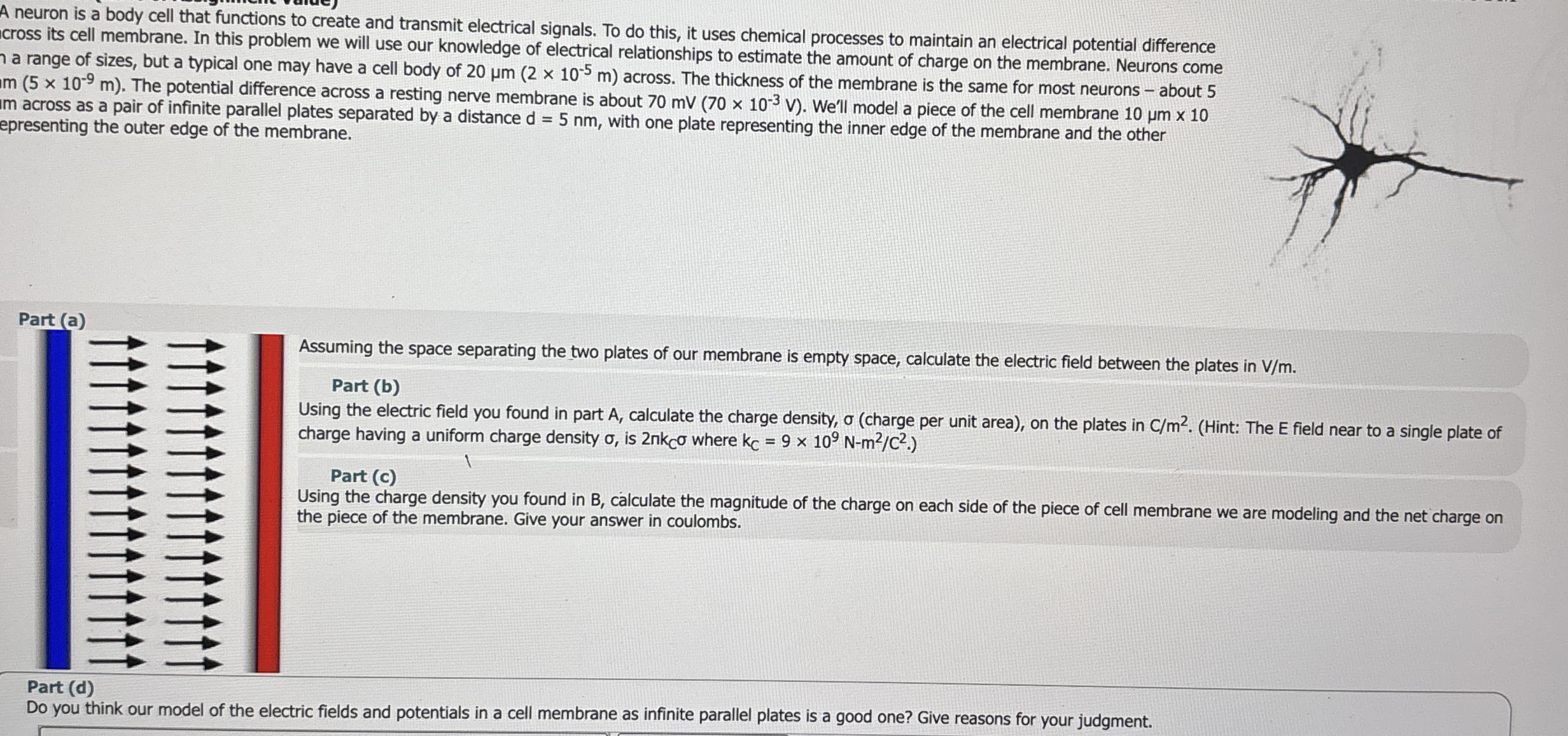
A neuron is a body cell that functions to create and transmit electrical signals. To do this, it uses chemical processes to maintain an electrical potential difference cross its cell membrane. In this problem we will use our knowledge of electrical relationships to estimate the amount of charge on the membrane. Neurons come a range of sizes, but a typical one may have a cell body of across. The thickness of the membrane is the same for most neurons about The potential difference across a resting nerve membrane is about We'll model a piece of the cell membrane im across as a pair of infinite parallel plates separated by a distance with one plate representing the inner edge of the membrane and the other epresenting the outer edge of the membrane.
Assuming the space separating the two plates of our membrane is empty space, calculate the electric field between the plates in
Part b
Using the electric field you found in part A calculate the charge density, charge per unit area on the plates in Hint: The E field near to a single plate of charge having a uniform charge density is where
Part c
Using the charge density you found in B calculate the magnitude of the charge on each side of the piece of cell membrane we are modeling and the net charge on the piece of the membrane. Give your answer in coulombs.
Part d
Do you think our model of the electric fields and potentials in a cell membrane as infinite parallel plates is a good one? Give reasons for your judgment.A neuron is a body cell that functions to create and transmit electrical signals. To do this, it uses chemical processes to maintain an electrical potential difference cross its cell membrane. In this problem we will use our knowledge of electrical relationships to estimate the amount of charge on the membrane. Neurons come a range of sizes, but a typical one may have a cell body of across. The thickness of the membrane is the same for most neurons about The potential difference across a resting nerve membrane is about We'll model a piece of the cell membrane im across as a pair of infinite parallel plates separated by a distance with one plate representing the inner edge of the membrane and the other epresenting the outer edge of the membrane.
Assuming the space separating the two plates of our membrane is empty space, calculate the electric field between the plates in
Part b
Using the electric field you found in part A calculate the charge density, charge per unit area on the plates in Hint: The E field near to a single plate of charge having a uniform charge density is where
Part c
Using the charge density you found in B calculate the magnitude of the charge on each side of the piece of cell membrane we are modeling and the net charge on the piece of the membrane. Give your answer in coulombs.
Part d
Do you think our model of the electric fields and potentials in a cell membrane as infinite parallel plates is a good one? Give reasons for your judgment.
Step by Step Solution
There are 3 Steps involved in it
1 Expert Approved Answer
Step: 1 Unlock

Question Has Been Solved by an Expert!
Get step-by-step solutions from verified subject matter experts
Step: 2 Unlock
Step: 3 Unlock
 Study Help