







Question: A node v in a directed rooted tree T = (V, E) is an ancestor of node u if the path from the root to
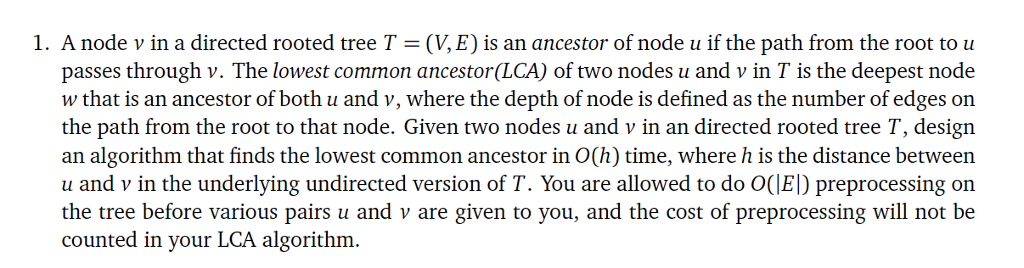
A node v in a directed rooted tree T = (V, E) is an ancestor of node u if the path from the root to u
passes through v. The lowest common ancestor(LCA) of two nodes u and v in T is the deepest node
w that is an ancestor of both u and v, where the depth of node is defined as the number of edges on
the path from the root to that node. Given two nodes u and v in an directed rooted tree T, design
an algorithm that finds the lowest common ancestor in O(h) time, where h is the distance between
u and v in the underlying undirected version of T. You are allowed to do O(jEj) preprocessing on
the tree before various pairs u and v are given to you, and the cost of preprocessing will not be
counted in your LCA algorithm.
1. A node v in a directed rooted tree T = (V, E) is an ancestor of node if the path from the root to u passes through v. The lowest common ancestor(LCA) of two nodes u and v in T is the deepest node w that is an ancestor of both u and v, where the depth of node is defined as the number of edges on the path from the root to that node. Given two nodes u and v in an directed rooted tree T, design an algorithm that finds the lowest common ancestor in O(h) time, where h is the distance between u and v in the underlying undirected version of T. You are allowed to do O(IEl) preprocessing on the tree before various pairs u and v are given to you, and the cost of preprocessing will not be counted in your LCA algorithm
Step by Step Solution
There are 3 Steps involved in it

Get step-by-step solutions from verified subject matter experts
 Study Help