







Question: A node weighted graph is a graph where every node x has a weight w(x). A k-node independent set of a graph G is a
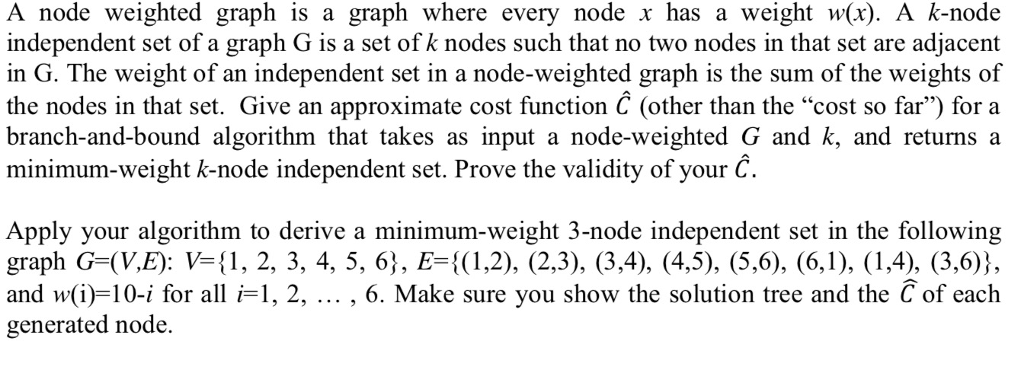
A node weighted graph is a graph where every node x has a weight w(x). A k-node independent set of a graph G is a set of k nodes such that no two nodes in that set are adjacent in G. The weight of an independent set in a node-weighted graph is the sum of the weights of the nodes in that set. Give an approximate cost function C (other than the "cost so far") for a branch-and-bound algorithm that takes as input a node-weighted G and k, and returns a minimum-weight k-node independent set. Prove the validity of your C Apply your algorithm to derive a minimum-weight 3-node independent set in the following graph G-(V.E): V-, 2, 3, 4, 5, 6;, E-((1,2), (2,3), (3,4), (4,5), (5,6), (6,1), (1,4), (3,6 and w(i)-10-i for all i-1, 2, , 6. Make sure you show the solution tree and the C of each generated node. A node weighted graph is a graph where every node x has a weight w(x). A k-node independent set of a graph G is a set of k nodes such that no two nodes in that set are adjacent in G. The weight of an independent set in a node-weighted graph is the sum of the weights of the nodes in that set. Give an approximate cost function C (other than the "cost so far") for a branch-and-bound algorithm that takes as input a node-weighted G and k, and returns a minimum-weight k-node independent set. Prove the validity of your C Apply your algorithm to derive a minimum-weight 3-node independent set in the following graph G-(V.E): V-, 2, 3, 4, 5, 6;, E-((1,2), (2,3), (3,4), (4,5), (5,6), (6,1), (1,4), (3,6 and w(i)-10-i for all i-1, 2, , 6. Make sure you show the solution tree and the C of each generated node
Step by Step Solution
There are 3 Steps involved in it

Get step-by-step solutions from verified subject matter experts
 Study Help