







Question: a. one b. two c. four d. six 37. Essentially, a(n) is a named constant for an address. . pointer b. reference c. class d.
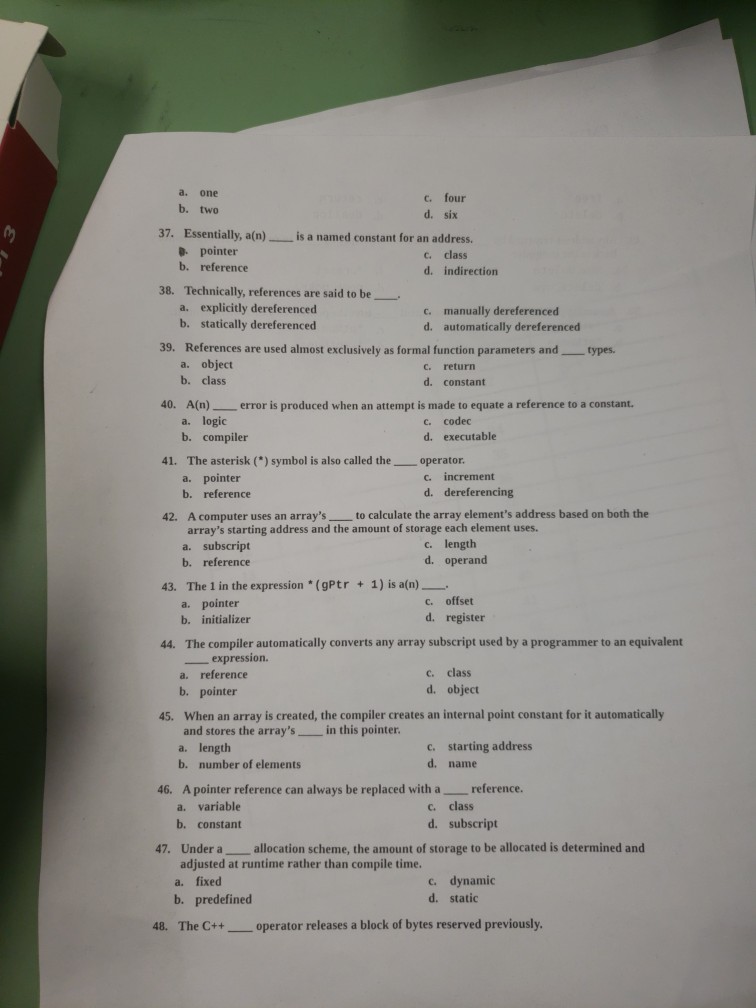
a. one b. two c. four d. six 37. Essentially, a(n) is a named constant for an address. . pointer b. reference c. class d. indirection 38. Technically, references are said to be a. explicitly dereferenced b. statically dereferenced c. manually dereferenced d. automatically dereferenced 39. References are used almost exclusively as formal function parameters and types. a. object b. class c. return d. constant 40. A(n)error is produced when an attempt is made to equate a reference to a constant. a. logic b. compiler c. codec d. executable 41. The asterisk (*) symbol is also called the operator a. pointer b. reference c. increment d. dereferencing 42. A computer uses an array's to calculate the array element's address based on both the array's starting address and the amount of storage each element uses. a. subscript b. reference c. length d. operand 43. The 1 in the expression *(gPtr 1) is a(n) a. pointer b. initializer c. offset d. register 44. The compiler automatically converts any array subscript used by a programmer to an equivalent a. reference b. pointer c. class d. object When an array is created, the compiler creates an internal point constant for it automatically and stores the array's a. length b. number of elements 45. in this pointer c. starting address d. name reference. A pointer reference can always be replaced with a a. variable b. constant 46. c. class d. subscript 47. Under aallocation scheme, the amount of storage to be allocated is determined and adjusted at runtime rather than compile time a. fixed b. predefined c. dynamic d. static 48. The C++ operator releases a block of bytes reserved previously
Step by Step Solution
There are 3 Steps involved in it

Get step-by-step solutions from verified subject matter experts
 Study Help