







Question: A particle moves from point ( A ) to ( B ) under the action of a force ( F
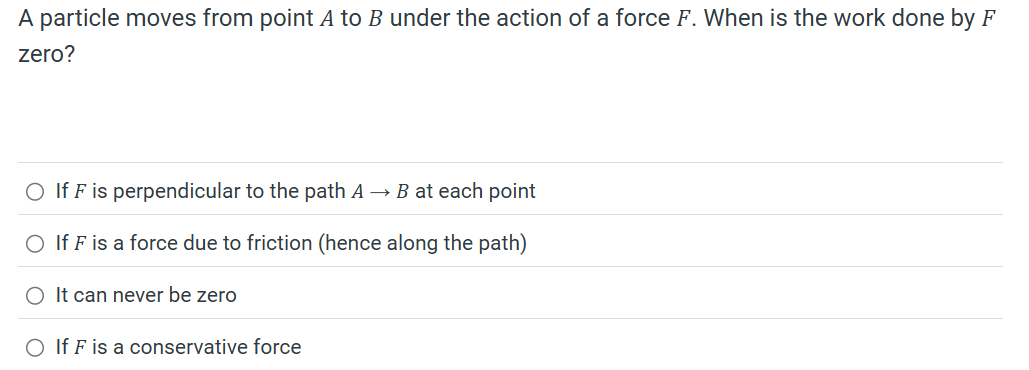
A particle moves from point A to B under the action of a force F When is the work done by F zero?
If F is perpendicular to the path A rightarrow B at each point
If F is a force due to friction hence along the path
It can never be zero
If F is a conservative force
Step by Step Solution
There are 3 Steps involved in it
1 Expert Approved Answer
Step: 1 Unlock

Question Has Been Solved by an Expert!
Get step-by-step solutions from verified subject matter experts
Step: 2 Unlock
Step: 3 Unlock
 Study Help