







Question: A particle moving along the x axis in simple harmonic motion starts from its equilibrium position, the origin, at t = 0 and moves
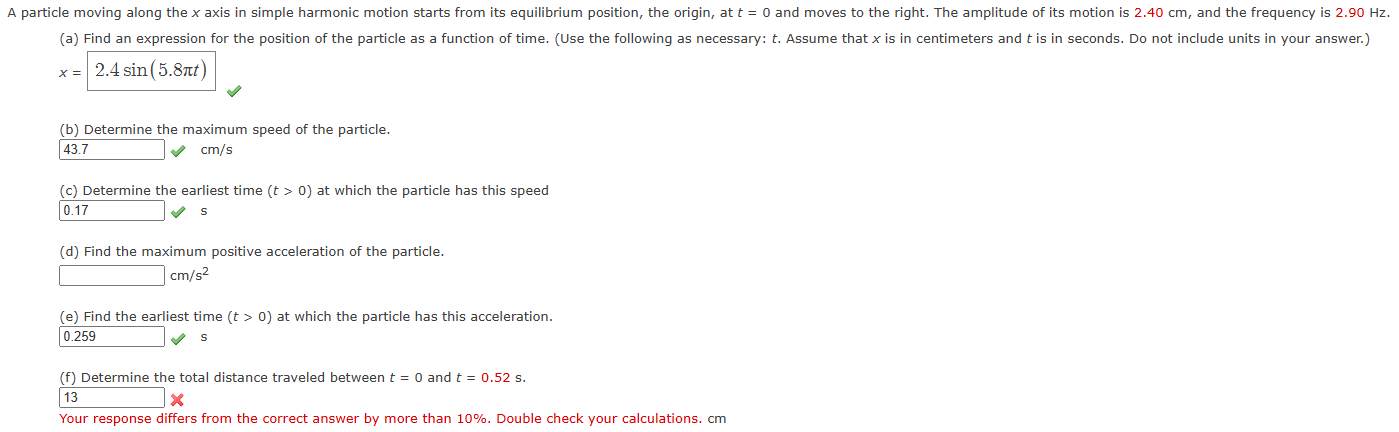
A particle moving along the x axis in simple harmonic motion starts from its equilibrium position, the origin, at t = 0 and moves to the right. The amplitude of its motion is 2.40 cm, and the frequency is 2.90 Hz. (a) Find an expression for the position of the particle as a function of time. (Use the following as necessary: t. Assume that x is in centimeters and t is in seconds. Do not include units in your answer.) x = 2.4 sin (5.8nt) (b) Determine the maximum speed of the particle. 43.7 cm/s (c) Determine the earliest time (t > 0) at which the particle has this speed 0.17 S (d) Find the maximum positive acceleration of the particle. cm/s (e) Find the earliest time (t > 0) at which the particle has this acceleration. 0.259 S (f) Determine the total distance traveled between t = 0 and t = 0.52 s. 13 Your response differs from the correct answer by more than 10%. Double check your calculations. cm
Step by Step Solution
There are 3 Steps involved in it
a The position of the particle as a function of time can be expressed as xt A sin2ft where xt is the position of the particle at time t A is the amplitude of the motion f is the frequency of the motio... View full answer

Get step-by-step solutions from verified subject matter experts
 Study Help