



Question: A piezoelectric bimorph operating as a bender actuator has the cross-sectional geometry shown in Figure 4.42. (a) Compute the nondimensional curvature as shown in
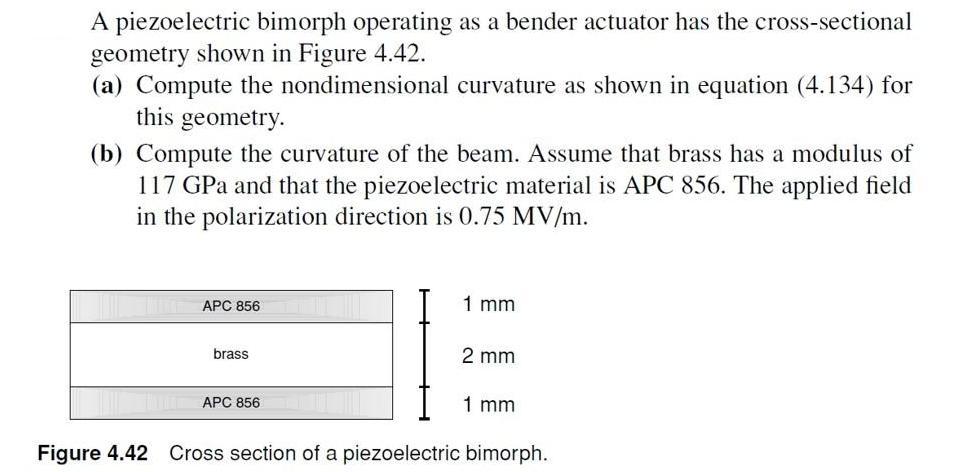
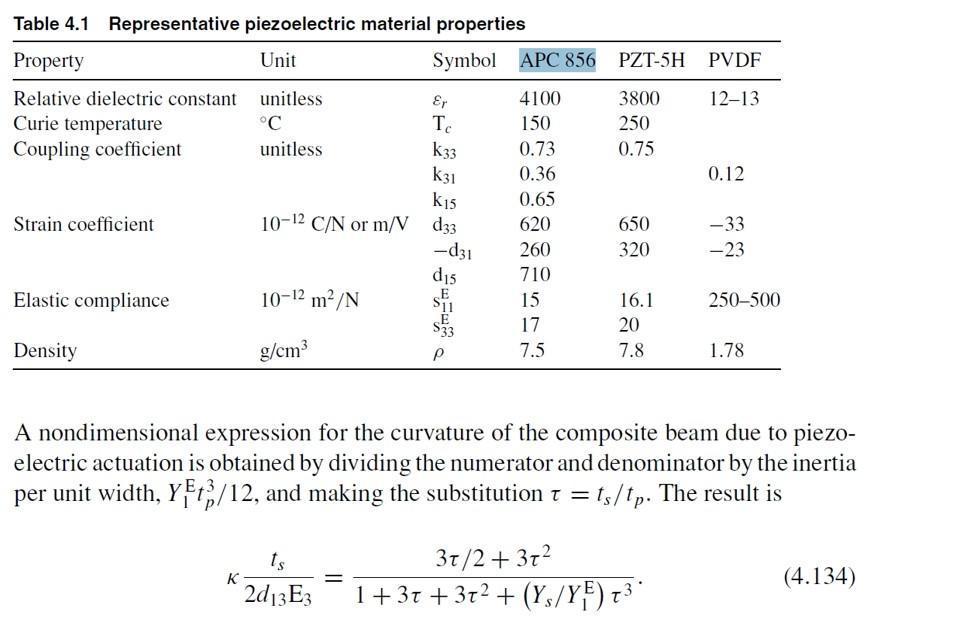
A piezoelectric bimorph operating as a bender actuator has the cross-sectional geometry shown in Figure 4.42. (a) Compute the nondimensional curvature as shown in equation (4.134) for this geometry. (b) Compute the curvature of the beam. Assume that brass has a modulus of 117 GPa and that the piezoelectric material is APC 856. The applied field in the polarization direction is 0.75 MV/m. APC 856 1 mm brass 2 mm 1 mm APC 856 Figure 4.42 Cross section of a piezoelectric bimorph. Property Unit Table 4.1 Representative piezoelectric material properties Symbol APC 856 PZT-5H PVDF Relative dielectric constant unitless Er 4100 3800 12-13 Curie temperature C Te 150 250 Coupling coefficient unitless K33 0.73 0.75 K31 0.36 0.12 K15 0.65 Strain coefficient 10-12 C/N or m/V d33 620 650 -33 -d31 260 320 -23 d15 710 Elastic compliance 10-12 m/N E $11 15 16.1 250-500 E 17 20 $33 Density g/cm 7.5 7.8 1.78 P A nondimensional expression for the curvature of the composite beam due to piezo- electric actuation is obtained by dividing the numerator and denominator by the inertia per unit width, YE+/12, and making the substitution = ts/tp. The result is ts 31/2+372 K 2d13E3 1+3t+3t + (Ys/YE) t (4.134)
Step by Step Solution
There are 3 Steps involved in it

Get step-by-step solutions from verified subject matter experts