







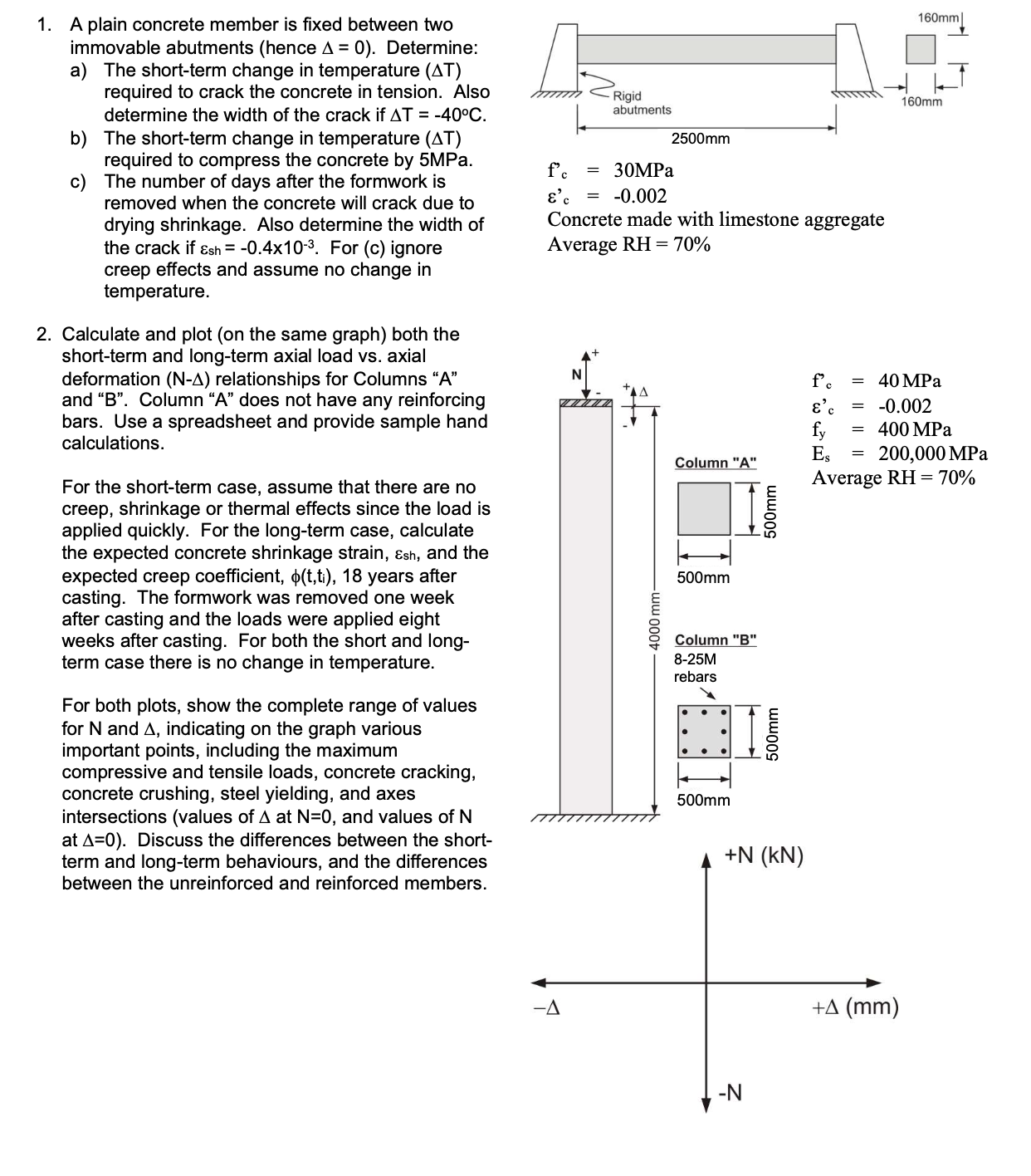
Question: A plain concrete member is fixed between two immovable abutments ( hence = 0 ) . Determine: a ) The short - term change in
A plain concrete member is fixed between two
immovable abutments hence Determine:
a The shortterm change in temperature
required to crack the concrete in tension. Also
determine the width of the crack if
b The shortterm change in temperature
required to compress the concrete by MPa.
c The number of days after the formwork is
removed when the concrete will crack due to
drying shrinkage. Also determine the width of
the crack if For c ignore
creep effects and assume no change in
temperature.
Calculate and plot on the same graph both the
shortterm and longterm axial load vs axial
deformation relationships for Columns
and B Column A does not have any reinforcing
bars. Use a spreadsheet and provide sample hand
calculations.
For the shortterm case, assume that there are no
creep, shrinkage or thermal effects since the load is
applied quickly. For the longterm case, calculate
the expected concrete shrinkage strain, and the
expected creep coefficient, years after
casting. The formwork was removed one week
after casting and the loads were applied eight
weeks after casting. For both the short and long
term case there is no change in temperature.
For both plots, show the complete range of values
for and indicating on the graph various
important points, including the maximum
compressive and tensile loads, concrete cracking,
concrete crushing, steel yielding, and axes
intersections values of at and values of
at Discuss the differences between the short
term and longterm behaviours, and the differences
between the unreinforced and reinforced members.
MPa
Concrete made with limestone aggregate
Average
Step by Step Solution
There are 3 Steps involved in it
1 Expert Approved Answer
Step: 1 Unlock

Question Has Been Solved by an Expert!
Get step-by-step solutions from verified subject matter experts
Step: 2 Unlock
Step: 3 Unlock
 Study Help