







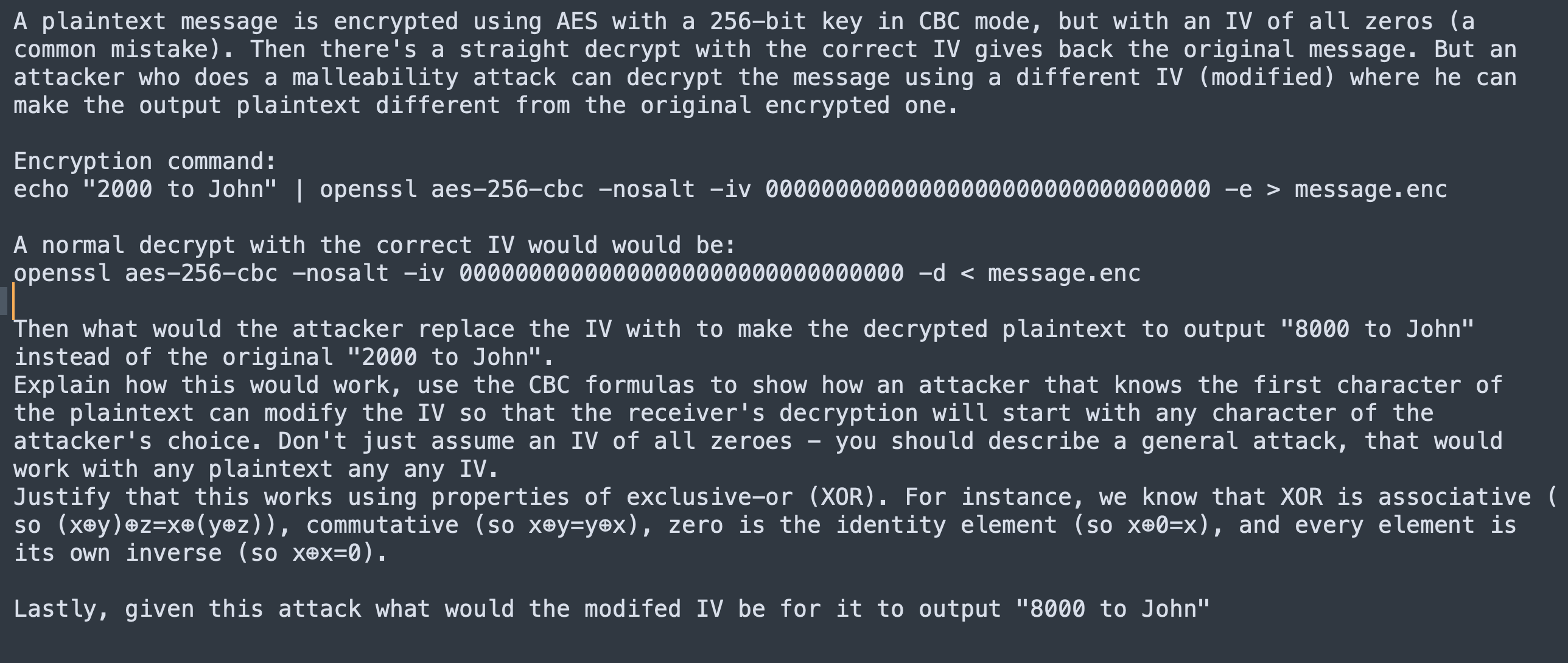
Question: A plaintext message is encrypted using AES with a 2 5 6 - bit key in CBC mode, but with an IV of all zeros
A plaintext message is encrypted using AES with a bit key in CBC mode, but with an IV of all zeros a
common mistake Then there's a straight decrypt with the correct IV gives back the original message. But an
attacker who does a malleability attack can decrypt the message using a different IV modified where he can
make the output plaintext different from the original encrypted one.
Encryption command:
echo to John" openssl aescbc nosalt iv e message.enc
A normal decrypt with the correct IV would would be:
openssl aescbc nosalt iv message.enc
Then what would the attacker replace the IV with to make the decrypted plaintext to output to John"
instead of the original to John".
Explain how this would work, use the CBC formulas to show how an attacker that knows the first character of
the plaintext can modify the IV so that the receiver's decryption will start with any character of the
attacker's choice. Don't just assume an IV of all zeroes you should describe a general attack, that would
work with any plaintext any any IV
Justify that this works using properties of exclusiveor XOR For instance, we know that XOR is associative
so commutative soxo zero is the identity element soxo and every element is
its own inverse so
Lastly, given this attack what would the modifed IV be for it to output to John"
Step by Step Solution
There are 3 Steps involved in it
1 Expert Approved Answer
Step: 1 Unlock

Question Has Been Solved by an Expert!
Get step-by-step solutions from verified subject matter experts
Step: 2 Unlock
Step: 3 Unlock
 Study Help