







Question: a ) Plot the Wagner function. ( boldsymbol { phi } mathbf { ( S ) } ) as a
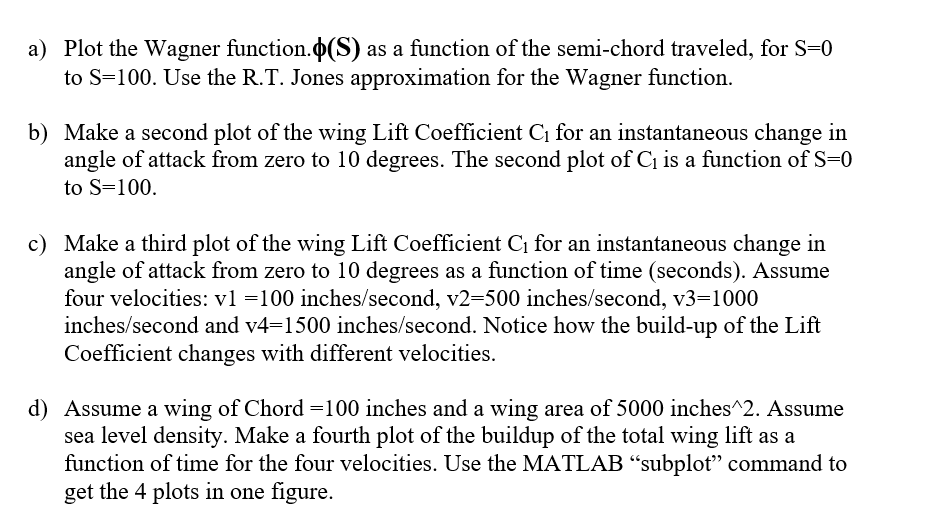
a Plot the Wagner function. boldsymbolphimathbf S as a function of the semichord traveled, for mathrmS to S Use the RT Jones approximation for the Wagner function.
b Make a second plot of the wing Lift Coefficient mathrmC for an instantaneous change in angle of attack from zero to degrees. The second plot of C is a function of S to S
c Make a third plot of the wing Lift Coefficient mathrmC for an instantaneous change in angle of attack from zero to degrees as a function of time seconds Assume four velocities: mathrmv inchessecondmathrmv inchessecondmathrmv inchessecond and v inchessecond Notice how the buildup of the Lift Coefficient changes with different velocities.
d Assume a wing of Chord inches and a wing area of inches Assume sea level density. Make a fourth plot of the buildup of the total wing lift as a function of time for the four velocities. Use the MATLAB "subplot" command to get the plots in one figure.
Step by Step Solution
There are 3 Steps involved in it
1 Expert Approved Answer
Step: 1 Unlock

Question Has Been Solved by an Expert!
Get step-by-step solutions from verified subject matter experts
Step: 2 Unlock
Step: 3 Unlock
 Study Help