







Question: A portfolio manager summarizes the input from the macro and micro forecasters in the following table: Micro Forecasts Residual Expected Standard Asset Return (%) Beta
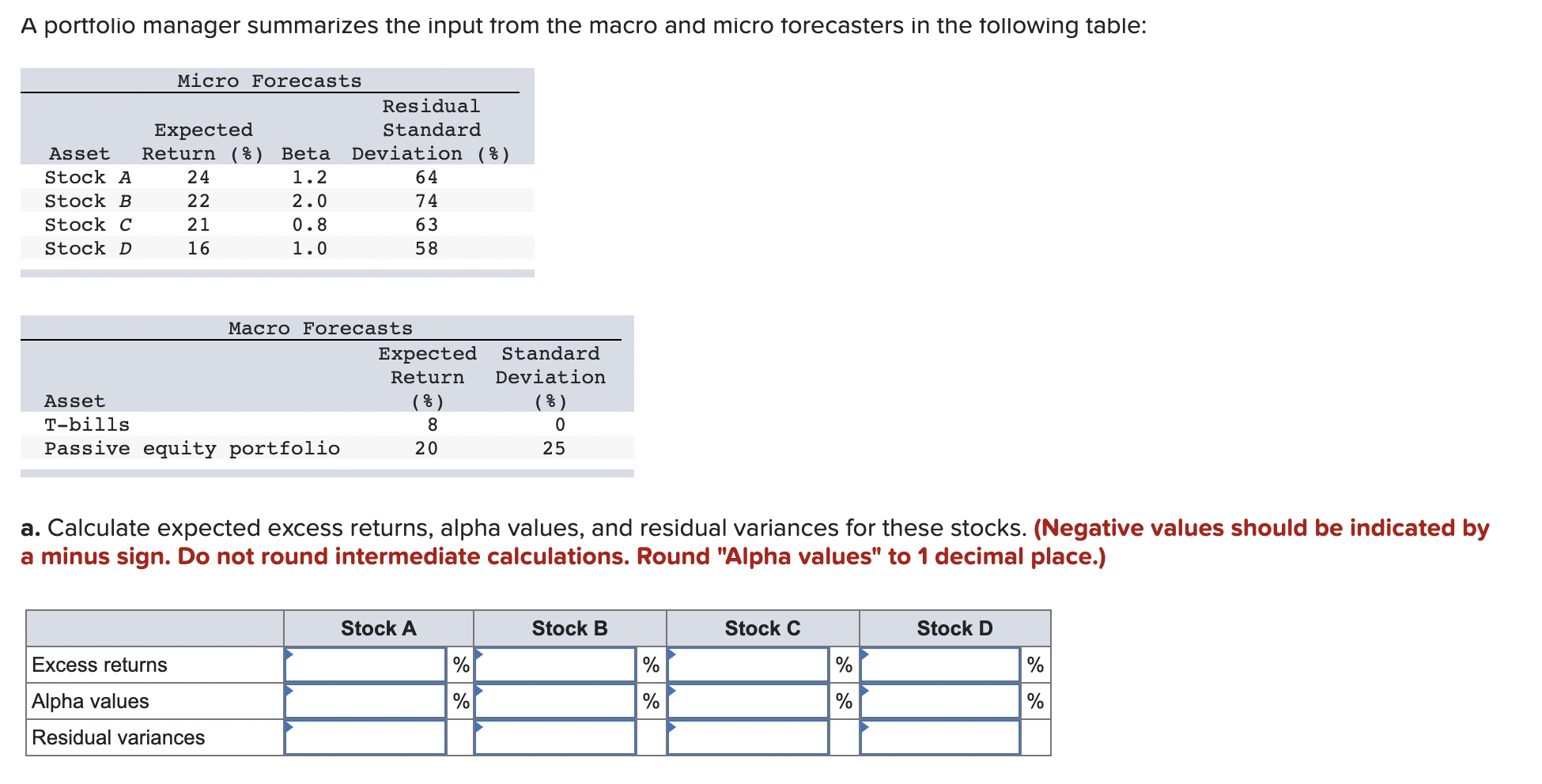
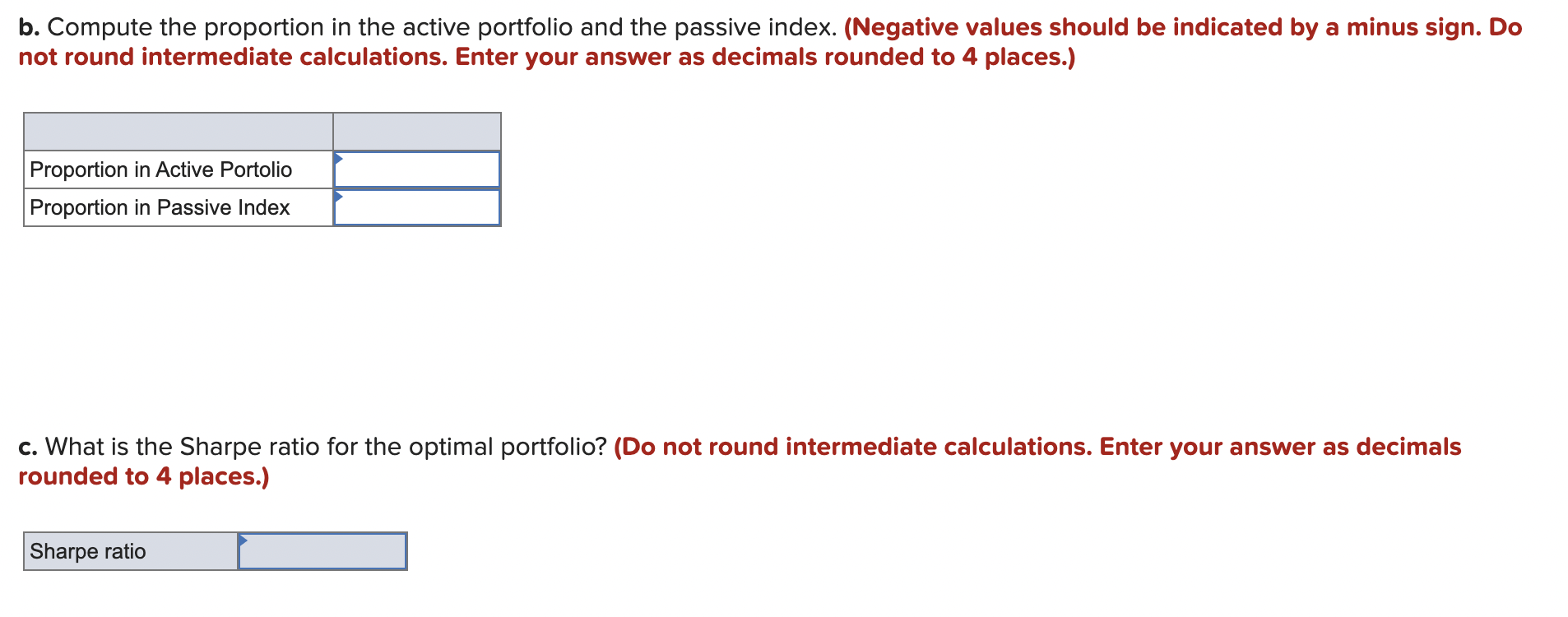
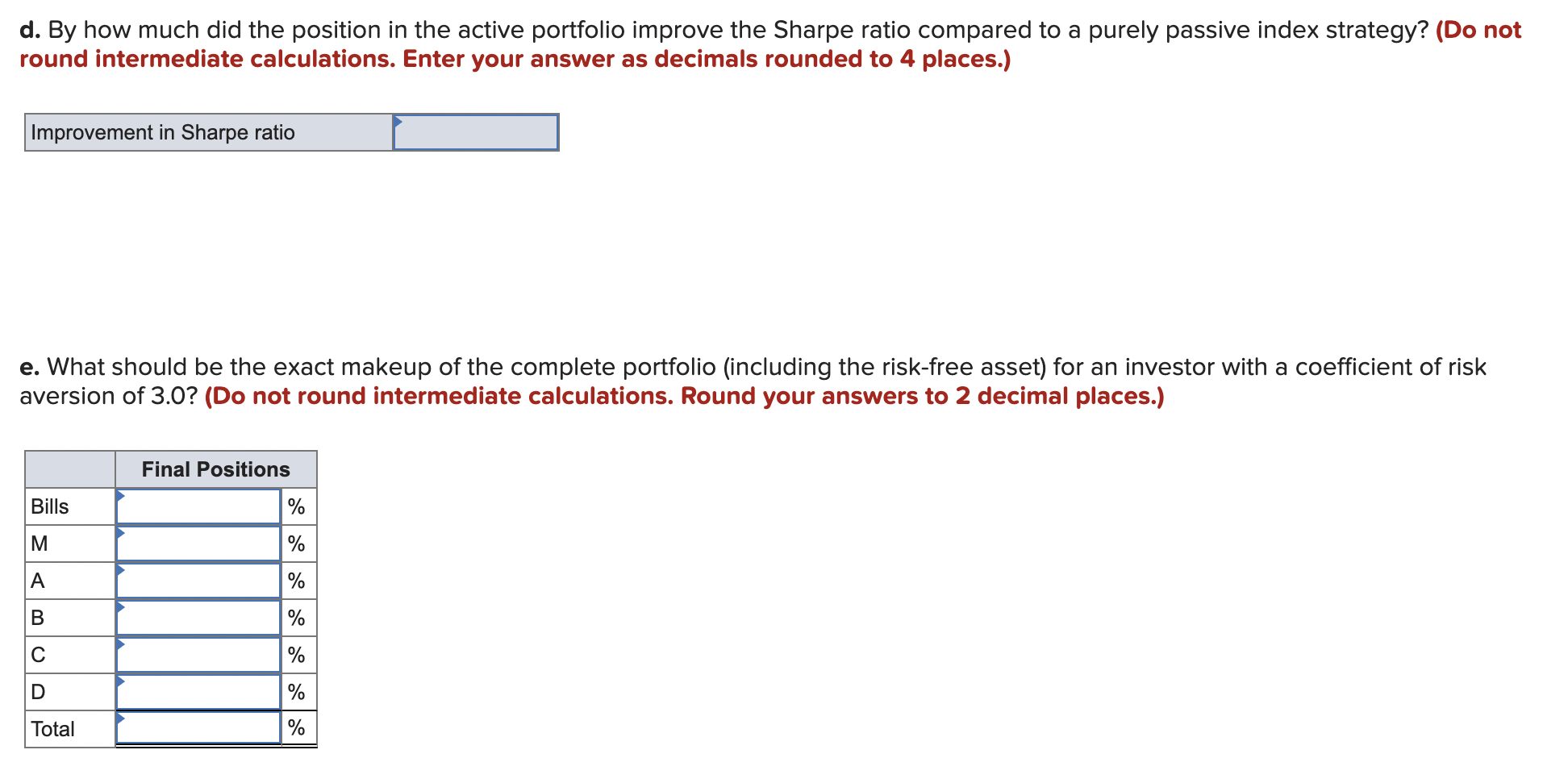
A portfolio manager summarizes the input from the macro and micro forecasters in the following table: Micro Forecasts Residual Expected Standard Asset Return (%) Beta Deviation (%) Stock A 24 1.2 64 Stock B 22 2.0 74 Stock C 21 0.8 63 Stock D 16 1.0 58 Macro Forecasts Expected Return Asset (%) T-bills 8 Passive equity portfolio 20 Standard Deviation (%) 0 25 a. Calculate expected excess returns, alpha values, and residual variances for these stocks. (Negative values should be indicated by a minus sign. Do not round intermediate calculations. Round "Alpha values" to 1 decimal place.) Stock A Stock B Stock C Stock D Excess returns % % % % Alpha values % % % % Residual variances b. Compute the proportion in the active portfolio and the passive index. (Negative values should be indicated by a minus sign. Do not round intermediate calculations. Enter your answer as decimals rounded to 4 places.) Proportion in Active Portolio Proportion in Passive Index c. What is the Sharpe ratio for the optimal portfolio? (Do not round intermediate calculations. Enter your answer as decimals rounded to 4 places.) Sharpe ratio d. By how much did the position in the active portfolio improve the Sharpe ratio compared to a purely passive index strategy? (Do not round intermediate calculations. Enter your answer as decimals rounded to 4 places.) Improvement in Sharpe ratio e. What should be the exact makeup of the complete portfolio (including the risk-free asset) for an investor with a coefficient of risk aversion of 3.0? (Do not round intermediate calculations. Round your answers to 2 decimal places.) Bills Final Positions % % % M A B % % D Total % A portfolio manager summarizes the input from the macro and micro forecasters in the following table: Micro Forecasts Residual Expected Standard Asset Return (%) Beta Deviation (%) Stock A 24 1.2 64 Stock B 22 2.0 74 Stock C 21 0.8 63 Stock D 16 1.0 58 Macro Forecasts Expected Return Asset (%) T-bills 8 Passive equity portfolio 20 Standard Deviation (%) 0 25 a. Calculate expected excess returns, alpha values, and residual variances for these stocks. (Negative values should be indicated by a minus sign. Do not round intermediate calculations. Round "Alpha values" to 1 decimal place.) Stock A Stock B Stock C Stock D Excess returns % % % % Alpha values % % % % Residual variances b. Compute the proportion in the active portfolio and the passive index. (Negative values should be indicated by a minus sign. Do not round intermediate calculations. Enter your answer as decimals rounded to 4 places.) Proportion in Active Portolio Proportion in Passive Index c. What is the Sharpe ratio for the optimal portfolio? (Do not round intermediate calculations. Enter your answer as decimals rounded to 4 places.) Sharpe ratio d. By how much did the position in the active portfolio improve the Sharpe ratio compared to a purely passive index strategy? (Do not round intermediate calculations. Enter your answer as decimals rounded to 4 places.) Improvement in Sharpe ratio e. What should be the exact makeup of the complete portfolio (including the risk-free asset) for an investor with a coefficient of risk aversion of 3.0? (Do not round intermediate calculations. Round your answers to 2 decimal places.) Bills Final Positions % % % M A B % % D Total %
Step by Step Solution
There are 3 Steps involved in it

Get step-by-step solutions from verified subject matter experts
 Study Help