







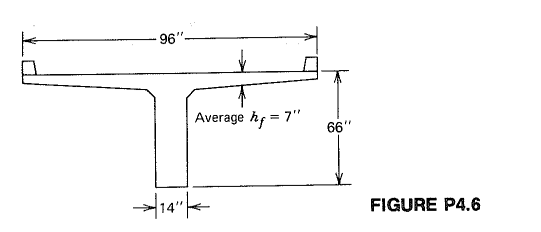
Question: A post - tensioned beam having the cross section shown in Fig. P 4 . 6 will be used as a single - lane access
A posttensioned beam having the cross section shown in Fig. P will be used as a singlelane access ramp of ft span. The flat, upper flange surface will serve as roadway and walk. The service live load providing the basis for design is psf assumed uniformly distributed over the full width of flange and full span of girder. The weight of curbs nonstructural and railings is plf of span. Required clearances and visual factors limit the total depth to in and a web width of in is selected anticipating the need for placement of stirrups for shear and torsion not a part of the present design problem as well as prestressed and nonprestressed flexural steel. The average depth of flange, governed by transverse bending and shear requirements, will be in Design the girder for flexure, using partial prestressing, and incorporating the design requirement for a balanced load state when full dead load acts. Nonprestressed reinforcing bars may be used if required to provide the needed strength. Stresses in the member in the initial stage and full service load stage should be checked, but need not meet the restrictions of the ACI Code. Check the width of cracks, if any, at full service load, using either of the methods of Section Concrete strengths are f psi and f psi. Standard Grade strands will be used for posttensioning eg Freyssinet system as shown in Appen dix B Grade rebars may be used also. Timedependent losses are estimated at percent of the initial prestress force.FIGURE P
Step by Step Solution
There are 3 Steps involved in it
1 Expert Approved Answer
Step: 1 Unlock

Question Has Been Solved by an Expert!
Get step-by-step solutions from verified subject matter experts
Step: 2 Unlock
Step: 3 Unlock
 Study Help