







Question: A power cycle operating at steady state is shown below. Net power output of the cycle is 2 9 , 8 3 0 k W
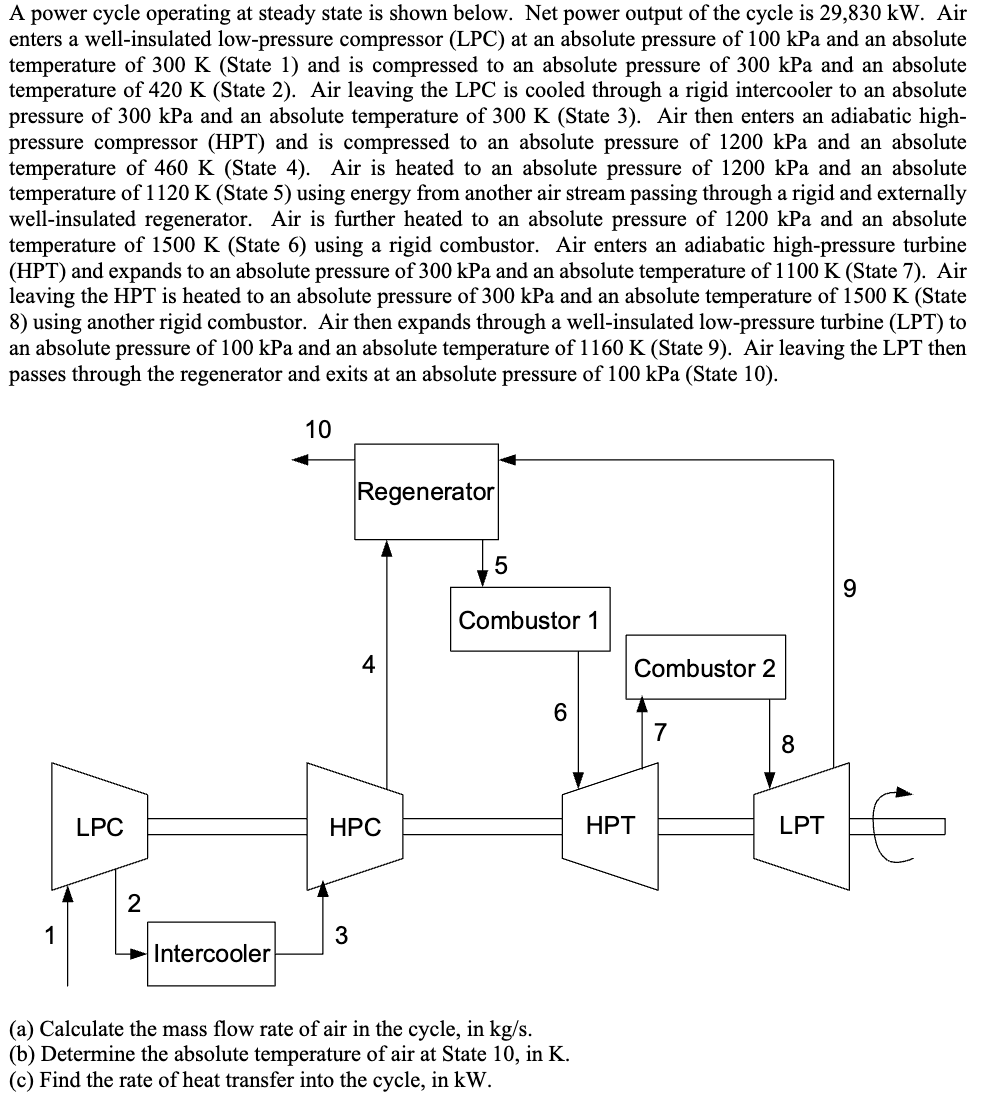
A power cycle operating at steady state is shown below. Net power output of the cycle is Air
enters a wellinsulated lowpressure compressor LPC at an absolute pressure of kPa and an absolute
temperature of K State and is compressed to an absolute pressure of kPa and an absolute
temperature of K State Air leaving the LPC is cooled through a rigid intercooler to an absolute
pressure of kPa and an absolute temperature of K State Air then enters an adiabatic high
pressure compressor HPT and is compressed to an absolute pressure of kPa and an absolute
temperature of K State Air is heated to an absolute pressure of kPa and an absolute
temperature of K State using energy from another air stream passing through a rigid and externally
wellinsulated regenerator. Air is further heated to an absolute pressure of kPa and an absolute
temperature of K State using a rigid combustor. Air enters an adiabatic highpressure turbine
HPT and expands to an absolute pressure of kPa and an absolute temperature of K State Air
leaving the HPT is heated to an absolute pressure of kPa and an absolute temperature of K State
using another rigid combustor. Air then expands through a wellinsulated lowpressure turbine LPT to
an absolute pressure of kPa and an absolute temperature of K State Air leaving the LPT then
passes through the regenerator and exits at an absolute pressure of kPa State
a Calculate the mass flow rate of air in the cycle, in
b Determine the absolute temperature of air at State in K
c Find the rate of heat transfer into the cycle, in kW
d Find the thermal efficiency of the power cycle, in
Step by Step Solution
There are 3 Steps involved in it
1 Expert Approved Answer
Step: 1 Unlock

Question Has Been Solved by an Expert!
Get step-by-step solutions from verified subject matter experts
Step: 2 Unlock
Step: 3 Unlock
 Study Help