







Question: A problem about Crypotography: Consider the following protocol for two parties Alice and Bob to flip a fair coin (more complicated versions of this might
A problem about Crypotography:
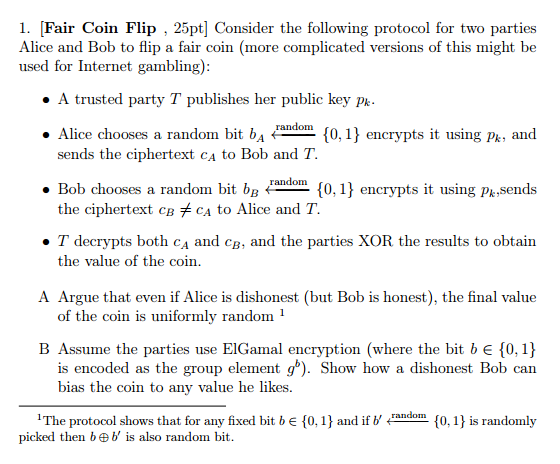
Consider the following protocol for two parties Alice and Bob to flip a fair coin (more complicated versions of this might be used for Internet gambling): A trusted party T publishes her public key p_k. Alice chooses a random bit b_A leftarrow^random {0, 1} encrypts it using p_k, and sends the cyphertext c_A to Bob and T. Bob chooses a random bit b_B leftarrow^random {0, 1} encrypts it using p_k, sends the cyphertext e_B notequalto c_A to Alice and T. T decrypts both c_A and c_B. and the parties XOR the results to obtain the value of the coin. A Argue that even if Alice is dishonest (but Bob is honest), the final value of the coin is uniformly random^1 Assume the parties use Megamall encryption (where the bit b Element {0, 1} is encoded as the group element g^b). Show how a dishonest Bob can bias the coin to any value he likes. the protocol shows that for any fixed bit b Element {0, 1} and if b' leftarrow^random {0, 1} is randomly picked then b b' is also random bit
Step by Step Solution
There are 3 Steps involved in it

Get step-by-step solutions from verified subject matter experts
 Study Help