



Question: (a) Problem X: Given a set S of n positive integers and another positive integer p, determine whether there exist two elements in S whose
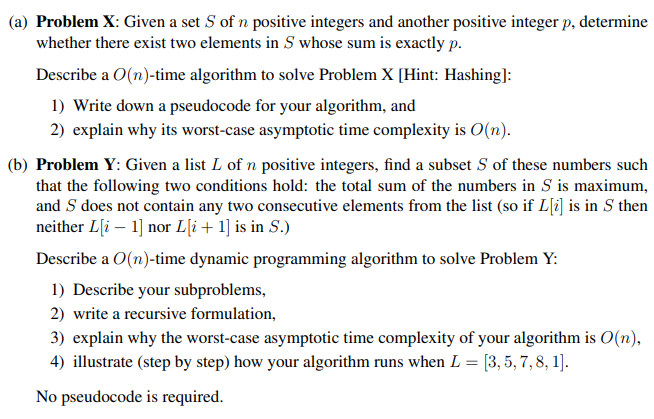
(a) Problem X: Given a set S of n positive integers and another positive integer p, determine whether there exist two elements in S whose sum is exactly p. Describe a O(n)-time algorithm to solve Problem X [Hint: Hashing]: 1) Write down a pseudocode for your algorithm, and 2) explain why its worst-case asymptotic time complexity is O(n). (b) Problem Y: Given a list L of n positive integers, find a subset S of these numbers such that the following two conditions hold: the total sum of the numbers in S is maximum, and S does not contain any two consecutive elements from the list (so if L[i] is in S then neither L[i1] nor L[i+1] is in S.) Describe a O(n)-time dynamic programming algorithm to solve Problem Y: 1) Describe your subproblems, 2) write a recursive formulation, 3) explain why the worst-case asymptotic time complexity of your algorithm is O(n), 4) illustrate (step by step) how your algorithm runs when L=[3,5,7,8,1]. No pseudocode is required
Step by Step Solution
There are 3 Steps involved in it

Get step-by-step solutions from verified subject matter experts