







Question: A professor using an open source introductory statistics book predicts that 10% of the students will purchase a hard copy of the book, 55% will
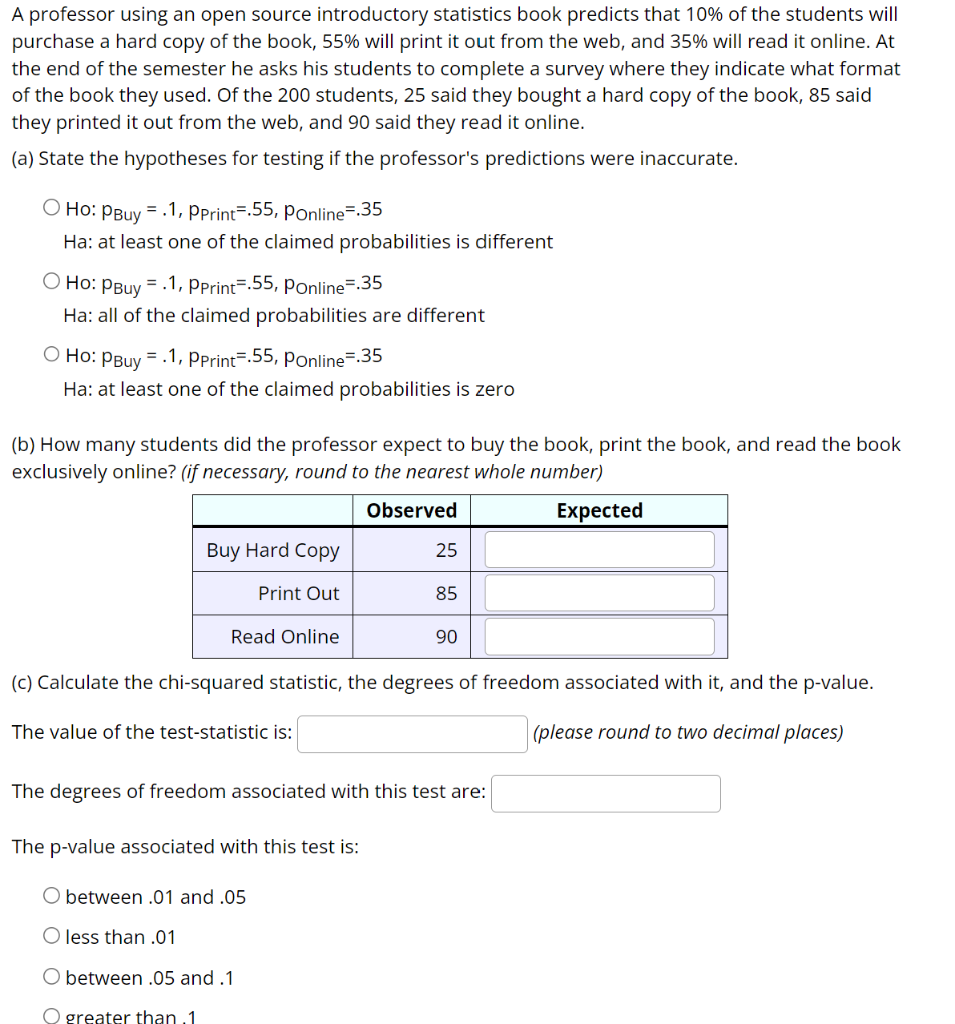
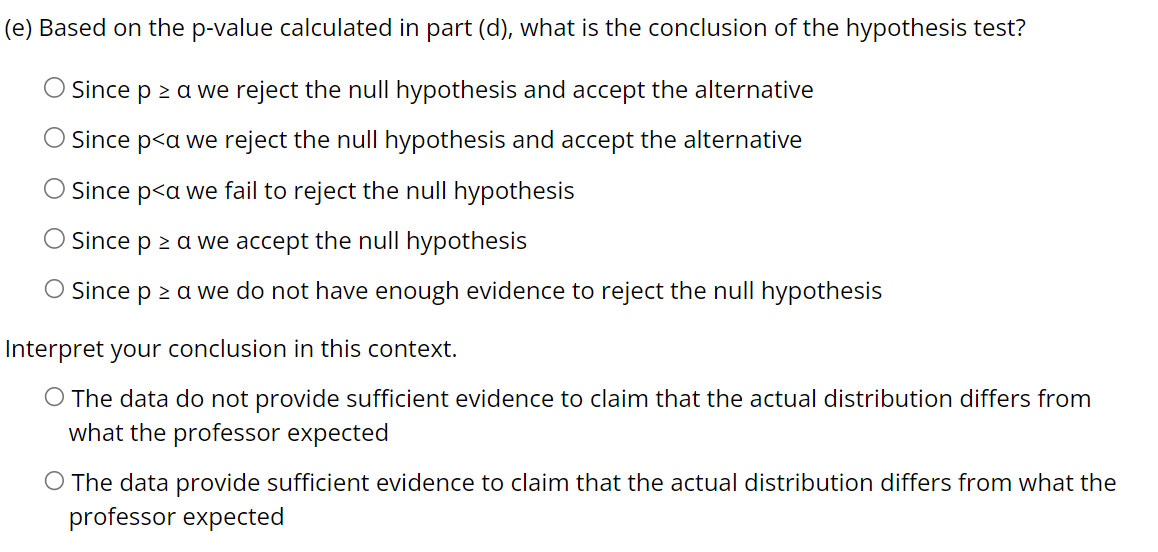
A professor using an open source introductory statistics book predicts that 10% of the students will purchase a hard copy of the book, 55\% will print it out from the web, and 35% will read it online. At the end of the semester he asks his students to complete a survey where they indicate what format of the book they used. Of the 200 students, 25 said they bought a hard copy of the book, 85 said they printed it out from the web, and 90 said they read it online. (a) State the hypotheses for testing if the professor's predictions were inaccurate. Ho: pBuy=.1,pPrint=.55,pOnline=.35 Ha: at least one of the claimed probabilities is different Ho: pBuy=.1,pPrint=.55,pOnline=.35 Ha: all of the claimed probabilities are different Ho: pBuy=.1,pPrint=.55,pOnline=.35 Ha: at least one of the claimed probabilities is zero (b) How many students did the professor expect to buy the book, print the book, and read the book exclusively online? (if necessary, round to the nearest whole number) (c) Calculate the chi-squared statistic, the degrees of freedom associated with it, and the p-value. The value of the test-statistic is: (please round to two decimal places) The degrees of freedom associated with this test are: The p-value associated with this test is: between .01 and .05 less than .01 between .05 and .1 (e) Based on the p-value calculated in part (d), what is the conclusion of the hypothesis test? Since pa we reject the null hypothesis and accept the alternative Since p
Step by Step Solution
There are 3 Steps involved in it

Get step-by-step solutions from verified subject matter experts
 Study Help