







Question: A program displays four rectangles colored orange, blue, black, and gray. The blue rectangle is the nearest to the camera at distance .3 , the
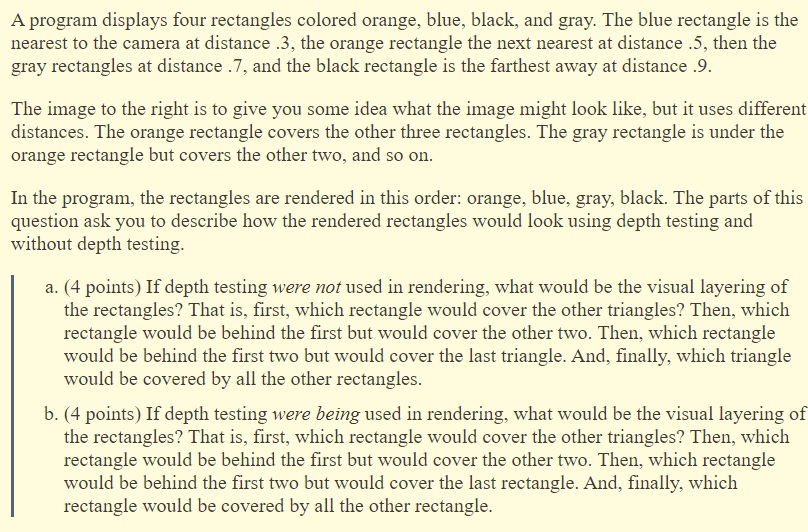
A program displays four rectangles colored orange, blue, black, and gray. The blue rectangle is the nearest to the camera at distance .3 , the orange rectangle the next nearest at distance .5 , then the gray rectangles at distance .7, and the black rectangle is the farthest away at distance .9 . The image to the right is to give you some idea what the image might look like, but it uses different distances. The orange rectangle covers the other three rectangles. The gray rectangle is under the orange rectangle but covers the other two, and so on. In the program, the rectangles are rendered in this order: orange, blue, gray, black. The parts of this question ask you to describe how the rendered rectangles would look using depth testing and without depth testing. a. (4 points) If depth testing were not used in rendering, what would be the visual layering of the rectangles? That is, first, which rectangle would cover the other triangles? Then, which rectangle would be behind the first but would cover the other two. Then, which rectangle would be behind the first two but would cover the last triangle. And, finally, which triangle would be covered by all the other rectangles. b. (4 points) If depth testing were being used in rendering, what would be the visual layering of the rectangles? That is, first, which rectangle would cover the other triangles? Then, which rectangle would be behind the first but would cover the other two. Then, which rectangle would be behind the first two but would cover the last rectangle. And, finally, which rectangle would be covered by all the other rectangle
Step by Step Solution
There are 3 Steps involved in it

Get step-by-step solutions from verified subject matter experts
 Study Help