



Question: A project team has been working on a proposal to develop a light rail transit system to replace a route bus service operating in part
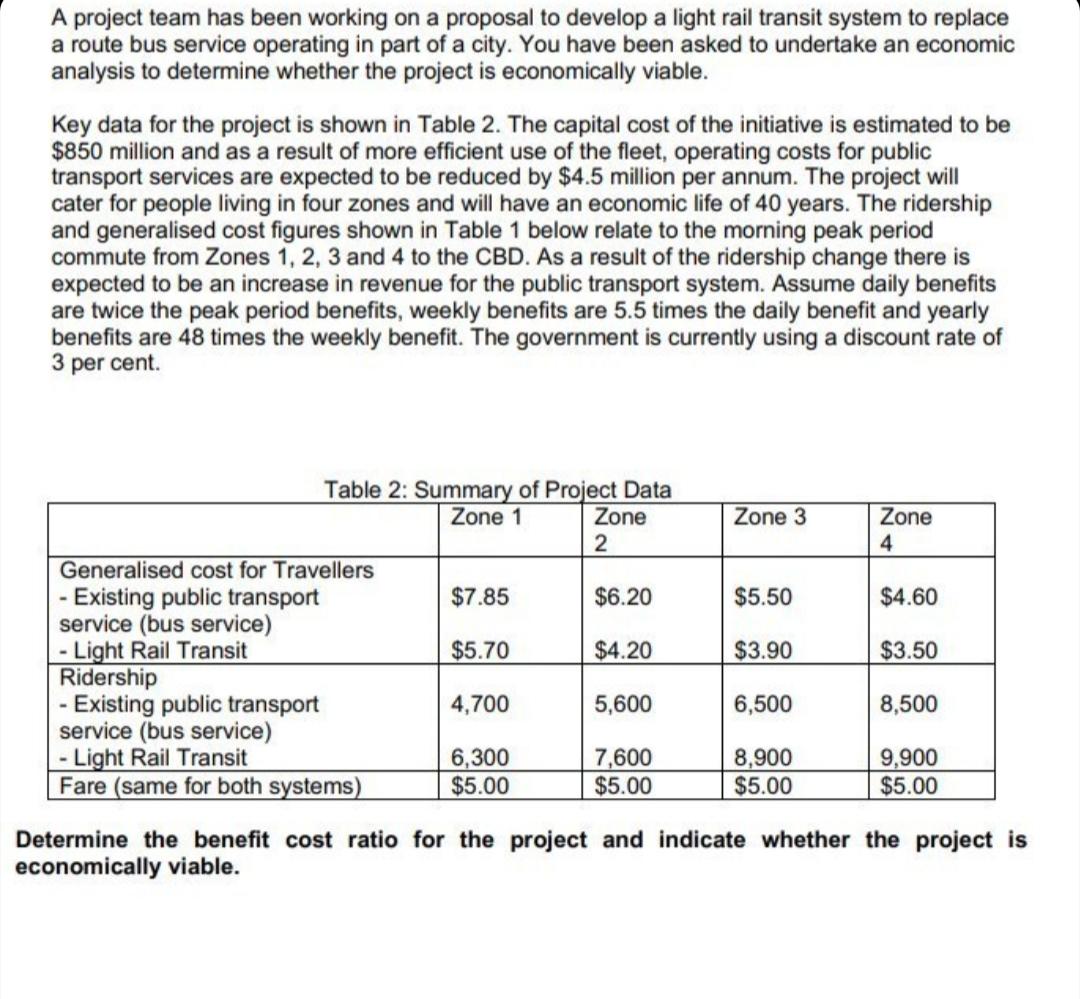 A project team has been working on a proposal to develop a light rail transit system to replace a route bus service operating in part of a city. You have been asked to undertake an economic analysis to determine whether the project is economically viable. Key data for the project is shown in Table 2. The capital cost of the initiative is estimated to be $850 million and as a result of more efficient use of the fleet, operating costs for public transport services are expected to be reduced by $4.5 million per annum. The project will cater for people living in four zones and will have an economic life of 40 years. The ridership and generalised cost figures shown in Table 1 below relate to the morning peak period commute from Zones 1, 2, 3 and 4 to the CBD. As a result of the ridership change there is expected to be an increase in revenue for the public transport system. Assume daily benefits are twice the peak period benefits, weekly benefits are 5.5 times the daily benefit and yearly benefits are 48 times the weekly benefit. The government is currently using a discount rate of 3 per cent Zone 3 Zone 4 $5.50 $4.60 Table 2: Summary of Project Data Zone 1 Zone 2 Generalised cost for Travellers - Existing public transport $7.85 $6.20 service (bus service) - Light Rail Transit $5.70 $4.20 Ridership - Existing public transport 4,700 5,600 service (bus service) - Light Rail Transit 6,300 7,600 Fare (same for both systems) $5.00 $5.00 $3.90 $3.50 6,500 8,500 8,900 $5.00 9,900 $5.00 Determine the benefit cost ratio for the project and indicate whether the project is economically viable.
A project team has been working on a proposal to develop a light rail transit system to replace a route bus service operating in part of a city. You have been asked to undertake an economic analysis to determine whether the project is economically viable. Key data for the project is shown in Table 2. The capital cost of the initiative is estimated to be $850 million and as a result of more efficient use of the fleet, operating costs for public transport services are expected to be reduced by $4.5 million per annum. The project will cater for people living in four zones and will have an economic life of 40 years. The ridership and generalised cost figures shown in Table 1 below relate to the morning peak period commute from Zones 1, 2, 3 and 4 to the CBD. As a result of the ridership change there is expected to be an increase in revenue for the public transport system. Assume daily benefits are twice the peak period benefits, weekly benefits are 5.5 times the daily benefit and yearly benefits are 48 times the weekly benefit. The government is currently using a discount rate of 3 per cent Zone 3 Zone 4 $5.50 $4.60 Table 2: Summary of Project Data Zone 1 Zone 2 Generalised cost for Travellers - Existing public transport $7.85 $6.20 service (bus service) - Light Rail Transit $5.70 $4.20 Ridership - Existing public transport 4,700 5,600 service (bus service) - Light Rail Transit 6,300 7,600 Fare (same for both systems) $5.00 $5.00 $3.90 $3.50 6,500 8,500 8,900 $5.00 9,900 $5.00 Determine the benefit cost ratio for the project and indicate whether the project is economically viable
Step by Step Solution
There are 3 Steps involved in it

Get step-by-step solutions from verified subject matter experts