







Question: A project's NPV prolile graph intersects the Y-axis at 0% cost of capital and intersects the X-axis at the project's IRR (where NPV = 0).
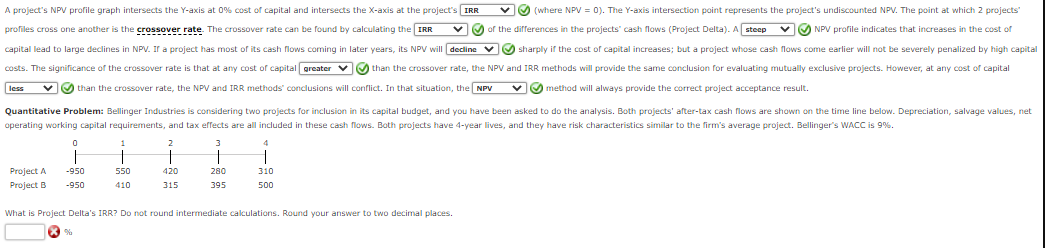
A project's NPV prolile graph intersects the Y-axis at 0% cost of capital and intersects the X-axis at the project's IRR (where NPV = 0). The Y-axis intersection point represents the project's undiscounted NPV. The point at which 2 projects profiles cross one another is the crossover rate. The crossover rate can be found by calculating the IRR of the differences in the projects' cash flows (Project Delta). A steep V NPV profile indicates that increases in the cost of capital lead to large declines in NPV. If a project has most of its cash flows coming in later years, its NPV will decline Sharply if the cost of capital increases; but a project whose cash flows come earlier will not be severely penalized by high capital costs. The significance of the crossover rate is that at any cost of capital greater than the crossover rate, the NPV and IRR methods will provide the same conclusion for evaluating mutually exclusive projects. However, at any cost of capital less V than the crossover rate, the NPV and IRR methods' conclusions will conflict. In that situation, the NPV V method will always provide the correct project acceptance result. Quantitative Problem: Bellinger Industries is considering two projects for inclusion in its capital budget, and you have been asked to do the analysis. Both projects' after-tax cash flows are shown on the time line below. Depreciation, salvage values, net operating working capital requirements, and tax effects are all included in these cash flows. Both projects have 4-year lives, and they have risk characteristics similar to the firm's average project. Bellinger's WACC is 9% 4 Project A Project B -950 -950 550 410 420 315 280 395 310 500 What is Project Delta's IRR? Do not round intermediate calculations. Round your answer to two decimal places
Step by Step Solution
There are 3 Steps involved in it

Get step-by-step solutions from verified subject matter experts
 Study Help